Robinson says confidence in Parades Commission remains low

 PA Media
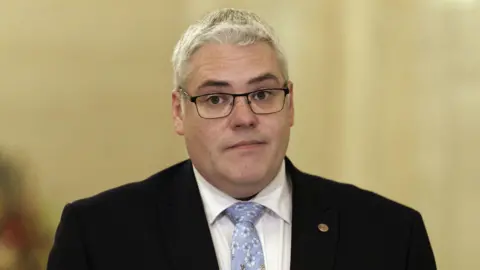
The Democratic Unionist Party (DUP) leader Gavin Robinson has said confidence in the Parades Commission remains low despite it submitting a plan aimed at restoring public confidence.
Northern Ireland Secretary Sir Chris Bryant said on Friday that he had received a letter from the commission outlining how it intends to restore confidence.
It follows a High Court decision to quash restrictions on this year's Orange Order parade along the Garvaghy Road in Portadown after the commission conceded a procedural error.
Speaking to BBC News NI on Saturday, Robinson said he wanted to hear from Sir Chris on plans to restore confidence in the Parades Commission.
'Urgent question'
The DUP leader said the party hoped to raise the issue at Westminster next week.
"My colleague Carla Lockhart (MP for Upper Bann) intends to table an urgent question, she wants to bring it on to the floor of Westminster itself, so there will be plenty of opportunity for political discussion and political consideration of the damage and difficulty that has been caused over the last week," he said.
 PA Media
Robinson said Sir Chris would have to consider the commission's response "properly" and "seriously".
However, the DUP leader added that the commission also needed to convince those involved in Orange Order parades.
"It's currently in a low place, it's in a bad place," he said.
"They may be able to convince Sir Chris Bryant and we need to see where that goes, but they also need to engage with and convince those who are most important in this process.
"That's the applicants, the parading organisations themselves."
'Issue of confidence'
One member of the commission, Billy Gamble, resigned on Thursday after facing criticism over private comments he is alleged to have made about the parade determination.
Robinson said the resignation had not resolved the concerns over confidence in the commission.
"It hasn't solved the issue of confidence," he said.
"I think there's still questions around the chair and there are questions for the secretary of the commission itself."
'Low confidence'
Robinson said Sir Chris "cannot assert confidence on behalf of my community".
He added that he expected there would be contact with unionist representatives as part of the process.
"There is low confidence at the moment within my community and those parading organisations who engage with the Parades Commission that needs to be restored," the DUP leader said.
"I'm not clear how it can be restored with the current crop of commissioners."
'Coherent plan'
The commission was asked to provide a credible plan to restore public confidence after a court case highlighted mistakes in its handling of the parade.
The Northern Ireland secretary confirmed on Friday that he had received its response and would consider it over the weekend.
Speaking to BBC News NI, the Northern Ireland secretary said confidence in the commission had "taken quite a knock this week", but that he was "not in the business of pulling the whole thing down".
Sir Chris said he wanted to be assured there was a "coherent plan" which had the confidence of all communities.
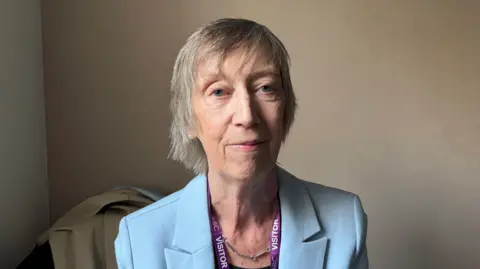
The commission's chair, Prof Evelyn Collins, said earlier this week that she would not resign and that the commission was committed to addressing the problems which have been identified.
She acknowledged that mistakes had been made and said the commission would work to regain the trust of all sections of the community.
Prof Collins described Gamble's private comments as "out of line", but said they had no bearing on the commission's decision-making process.
'No parade down Garvaghy Road'
The Orange Order has called for the chair and commissioners to resign, while Portadown District has said it is willing to engage in mediation.
However, Sinn Féin councillor Catherine Nelson dismissed the offer and said there would be "no parade down the Garvaghy Road".
The Craigavon representative said discussions were possible, but not about allowing a parade along the route, adding that residents were "very clear" on the issue.
What has led to this point?
On Tuesday, the High Court quashed the Parades Commission's decision to impose restrictions on this year's Drumcree parade.
The commission conceded a procedural error after not all six commissioners had signed off on the final determination.
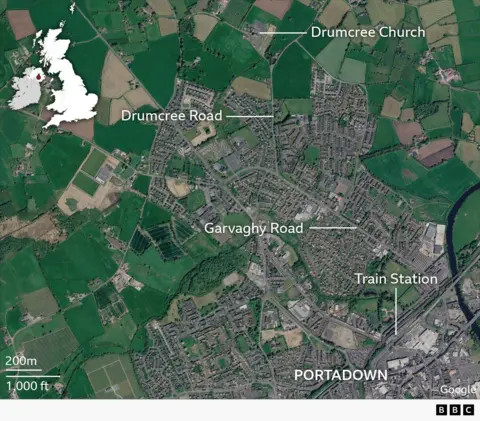
It had banned the parade from entering the mainly nationalist Garvaghy Road - reflecting every decision it has made since 1998.
 Pacemaker
Who are the Parades Commission?
The current commission was appointed in January 2024 for a three-year term and is chaired by Prof Evelyn Collins.
Gamble's resignation reduced the panel to five members, but it remains able to operate as three commissioners are required for a meeting.
When did the Drumcree dispute begin?
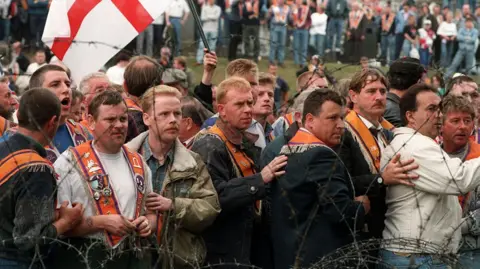
In 1998, the Parades Commission ruled that the Orange Order should not march down Portadown's Garvaghy Road on the return leg of its annual march from Drumcree Church.
The decision led to serious public disorder and a long-running parading dispute.
Stand-offs continued in subsequent years as members of the Order walked to police barricades in protest at the restrictions.
The High Court was told on Tuesday that the commission had conceded the latest case and requested that its determination be quashed.
The commission conceded a procedural error in how it dealt with the annual application for permission to walk along the Garvaghy Road.
Not all six members of the public authority had signed off on the final determination before it was issued last month.
Lawyers representing a local Orangeman argued the decision unlawfully breached his rights to freedom of belief, expression and peaceful assembly under the European Convention on Human Rights.