NI secretary to consider Parades Commission letter over Drumcree

 PA Media
Northern Ireland Secretary Sir Chris Bryant has said he will take time to consider a letter from the Parades Commission on how they plan to restore public confidence.
It comes after a commissioner resigned over the handling of its ruling on the Orange Order's Drumcree parade.
The commission was asked to write to Sir Chris by the end of the day to assure him that their decision making processes were fair after a court case highlighted mistakes over the ruling on the annual parade.
They were asked to come up with a credible plan to enhance public confidence across all communities.
Speaking to BBC News NI on Friday, Sir Chris said that confidence in the commission had "taken quite a knock this week" but he was "not in the business of pulling the whole thing down".
"If you look at what's happened over the last 28 years, I think most people just want peace and that's what was brought 28 years ago.
"It's much better to have a fully functioning Parades Commission that everybody has confidence in and that's what I'm in the business of trying to achieve."
 PA Media
One member of the commission, Billy Gamble, who had faced the most public criticism over private comments he is alleged to have made about the parade determination, resigned on Thursday.
Earlier on Friday, DUP leader Gavin Robinson said the matter was "far from resolved" and that Sir Chris had a responsibility to look at whether he has confidence in the parade commissioners.
He said one Parades Commission resignation "does not cut it".
But Sir Chris said: "Once you start losing more [commissioners], then the danger is you would end up not having a commission in place and I think that's a mistake."
He said he wanted to be "genuinely assured" that there was a "coherent plan" and that the commission had the confidence of "all the communities in Northern Ireland".
"If it doesn't cut the mustard I will say so, I just need a little bit of time to be able to look at that," Sir Chris said.
Restoring confidence
On Thursday the chair of the commission, Prof Evelyn Collins, said she would not resign but the commission would work hard to regain the trust of all sections of the community.
Robinson said he would "await with interest to see how it is these parade commissioners believe they are going to restore confidence".
"They have shattered it, they are the ones that have failed to abide by their statutory obligations," he told BBC Radio Ulster's Good Morning Ulster on Friday.
He said there needed to be a review of the legislation governing the Parades Commission.
The Orange Order has called for the resignation of the chair and commissioners.
"There is no confidence in anyone who has overseen this," the Portadown District said on Friday.
"Put simply it's one down, more to go," the statement said.
Portadown District also said it was "ready and willing to engage in mediation - either directly or through representatives we authorise - without any pre-conditions".

However Sinn Féin councillor Catherine Nelson dismissed the offer of mediation.
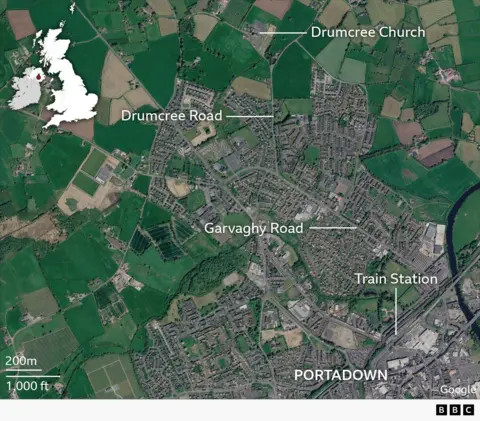
The Craigavon representative said talks about a parade down the Garvaghy Road were "off the table".
Nelson said discussions were possible but not about a parade.
"Let's put to bed any talk about mediation, talks, negotiation, whatever way others wish to frame it," she told BBC News NI.
"There will be no parade down the Garvaghy Road. Residents are very clear on that, very resolute on that."
Garvaghy Road resident: 'Sense of fear and tension'
Mary has lived on the Garvaghy Road since she was a child and told The Nolan Show that the recent days have "brought back up old memories" for her where a "sense of fear and tension and a definite air of unease" was being created.
Mary is not a member of the Garvaghy Road Residents Coalition and said she cannot speak for them.
She said the people in the Garvaghy Road area, whether they are Protestant or Catholic, are more interested in waiting list times and A&E times.
"They're more interested that their autistic child can't get an educational place to suit them within this area," she said.
"No one is interested in a march down the Garvaghy Road, on either side. People under 35 don't even remember marches coming down the Garvaghy Road, they can't relate to this at all," Mary added.
She said that "you can't mediate with someone who asks you to go into a meeting with preconditions".
A former RUC officer, who gave his name as Joe, described policing the standoff at Drumcree as "horrendous".
He told The Nolan Show that, as a part of a mobile support unit, there was "a lot of stress… very prolonged and would wear you down".
"It was difficult. There were occasions you were there for a week, maybe sleeping in the fields, and then maybe getting off to the base for a period of time then back on," he said.
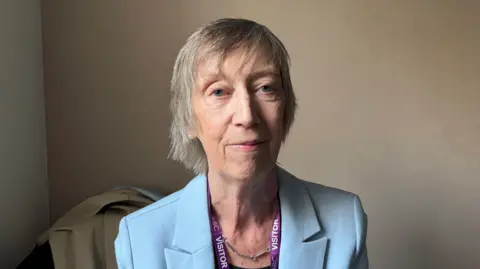
Speaking on Thursday before Gamble's resignation Prof Collins said the commission accepted the criticisms that had been made.
However, she said rather than resign they were "very committed to fulfilling our responsibilities under the legislation, to completing our terms of office and to addressing and fixing the problems that have been identified".
Collins had said Gamble's private comments were "out of line" but had no bearing on the decision-making process.
What has led to this point?
On Tuesday, the High Court quashed a decision to impose restrictions on the annual parade at Drumcree outside Portadown.
The Parades Commission had banned this year's parade from the Garvaghy Road - a move which reflected every decision it has made since 1998.
Breandan Mac Cionnaith of the Garvaghy Road Residents' Coalition has said the Orange Order parade "finished" in 1998 and it "will not be repeated".
 Pacemaker
Who are the Parades Commission?
The current commission was appointed from January 2024 on a three-year term.
Prof Collins is a former chair of the Equality Commission.
The others are Derek Wilson, a former banker, Billy Gamble, a former senior civil servant (who has since resigned), Nicola Rountree, a barrister, Rachel Quigley, a solicitor and Pauline Leeson, a social worker.
According to the last annual report, the chair is paid between £50,000 and £55,000 while the other commissioners earn between £20,000 and £25,000.
The chair is expected to devote one to two days per week to the work of the commission.
Commissioners are expected to devote approximately one day per week to commission business over the course of a year, with a proportionately greater commitment required April to August.
The commission only needs three members to make a decision.
Gamble's resignation reduced the panel to five but it is still able to function, and could technically continue to operate if there were two more resignations.
In accordance with the Public Processions (Northern Ireland) Act 1998, the quorum for a meeting of the commission is three.
When did the Drumcree dispute begin?
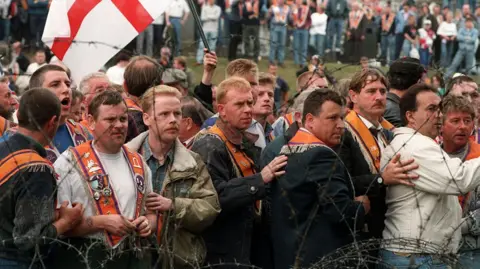
In 1998, the Parades Commission ruled that the Orange Order should not march down Portadown's Garvaghy Road on the end leg of its annual march from Drumcree Church.
It was a move that sparked some of the most serious public disorder in Northern Ireland's history and led to a decades-long parading dispute.
Stand-offs continued in subsequent years as members of the Order walked to police barricades in protest at the restrictions. Protests were also held by residents living along the Garvaghy Road.
The High Court was told on Tuesday that the commission conceded the case last week and requested the court quash its determination before a full hearing.
The commission conceded a procedural error in how it dealt with the annual application for permission to walk along the Garvaghy Road.
Not all six members of the public authority had signed off on the final determination before it was issued last month.
Lawyers representing a local Orangeman claimed the commission's latest decision unlawfully breached his rights to freedom of belief, expression and peaceful assembly under the European Convention on Human Rights.
Lawyers for the applicant also argued that Garvaghy Road residents had refused talks with the Orange Order and the commission breached legislation by making it "a pre-requisite to a parade".