Why do farmers want to build reservoirs and what's stopping them?

 BBC
In the face of climate change, farmers are calling for less red tape and more government funding to help them build reservoirs on their land.
They say storing more water on farmland could help reduce flooding in the winter, minimise the impact of drought in the summer and provide food security.
The reservoirs would hold winter rainwater to be used on their crops in summer.
Just 34 on-farm reservoirs have been built in England in the last five years.
The government is poised to launch a £15m scheme to go towards up to 100 farm reservoirs, but some farmers say that is a "drop in the ocean".
Which farmers need reservoirs?
Arable farmers with crops like potatoes, high-value salad, apples and pears are among those calling for solutions to their water shortages.
Philip Vaux's potatoes are destined to become posh crisps.
He farms at South Petherton in Somerset with his son and remembers the summer of 1976 but said this year has been "much drier - exceptionally dry".
"All crops have been affected, we're getting poor yields in the cereals and potatoes - for the livestock industry it's hard graft to find enough fodder for animals," he said.
 CLA
They rent 30 acres which has a borehole and has been able to be irrigated, but on the rest of their 300-acre farm, yields are down around two-thirds.
Vaux said they are seeing the effects of climate change, first-hand.
"We've had two dry summers now, this year and last year. The previous two summers were very wet. So we've gone from one extreme to another."
He has changed the type of potatoes they are planting to try and find drought-resistant varieties.

A few miles away in south Somerset, James Pullen said this year's harvest of potatoes and cider apples would have been a "total disaster" if it was not for his two on-farm reservoirs.
Holding five million gallons (22 million litres) between them, he said they are now "totally empty".
Even with the water, he said his potatoes were smaller this year.
"If we are going to have a continuation of these hot dry summers it's essential we have more water storage," Pullen said.
"Anyone who's seriously growing root crops would definitely need to be able to water them because they do need an excessive amount of water, but then it's not easy for some people because you do need a reasonable block of land."
How much can they cost to build?
As well as needing space to build a reservoir, and potentially a source of water like a stream to top-up the winter rainfall, the cost of building a reservoir can be prohibitive for farmers.
Philip Vaux said it can be "exceptionally expensive" with a reservoir "costing thousands and taking ten years to get your money back" in improved crop yields.
"It's no good just digging a hole and hoping the water is going to stay there," said Vaux.
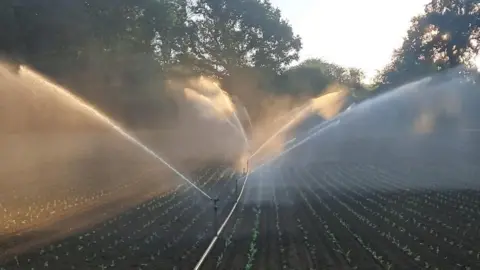
As a smaller-scale alternative he put in a second borehole last year at a cost of around £12,000 but they need to find another £8-10,000 to connect it to a pumping system to get the water out to the fields.
 Duncan Palmer
What other hurdles do farmers face?
The Country Land and Business Association (CLA) is a membership organisation for owners of land, property and businesses in rural England and Wales.
It said farm reservoirs are "a crucial solution" to help farmers adapt to climate change as they store water from wetter winters and sudden downpours for use in irrigation during dry spells.
Building a farm reservoir needs planning consent, an abstraction licence to take water from a watercourse as well as funding.
The CLA said "too often, farm reservoir projects face lengthy approval processes that add delay, cost, and uncertainty".
Liberal Democrat leader Ed Davey said farmers were being "blocked by outdated planning rules and a lack of proper support".
"We need a national call to store programme right now - identifying where that capacity exists, removing the barriers, and backing farmers who want to be part of the solution," he said.
"The demands of our changing climate will not wait for Whitehall to catch up."
What help is there to pay for them?
The government has promised a new round of funding for farm reservoirs will open in Autumn this year.
A Defra spokesperson said: "One of the Prime Minister's first visits was meeting farmers hit by brutal drought and dry weather, announcing a £65m package to help them through these challenging conditions, including £15m to support the development of on-farm reservoirs."
It said the £15m could support around 100 farms and if demand was greater, it would consider making more money available.
The government said it was also looking at changing planning rules and speeding up licensing for abstraction.
But Somerset farmer Philip Vaux said £15m was a "drop in the ocean".
CLA president Gavin Lane said the money was "a welcome and pragmatic move, but little more than a temporary fix".
"It will not change the reality that farming remains exceptionally difficult in this business environment, and in a country that does not have a plan for climate change adaption," he said.
Meanwhile, the National Farmers Union has called for the government to expand tax relief to include on-farm reservoirs in October's Budget.
Follow BBC Somerset on Facebook and X. Send your story ideas to us on email or via WhatsApp on 0800 313 4630.