Thousands of birds to be culled amid flu outbreak

 Reuters
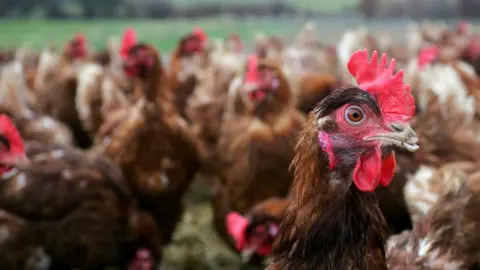
About 2,000 birds have died and thousands more are to be euthanised at a large poultry farm which has been impacted by bird flu.
The Department for Environment, Farming and Rural Affairs (Defra) confirmed the disease was found at a commercial facility near Belford, in north Northumberland.
It declared a 1.9 mile (3km) protection zone and 6.2 mile (10km) surveillance zone around the premises. The latter includes the Farne Islands, which are famous for their marine bird life.
Northumberland County Councillor Guy Renner-Thompson said 29,000 birds would have to be culled at the farm where the outbreak was identified.
"It's terribly sad for the family whose farm it is," he said.
He said "luckily" no other poultry farms were within the protection zone.
However, he said he remained concerned about the potential financial impact on other farms in the area, especially those with turkeys immediately before Christmas.
"If bird flu gets into those, that's ruined them for the year - because that's their main money-making part of the year."
While bird flu does not affect humans, the Conservative councillor warned people should be vigilant and neither touch, nor let their dogs touch, dead birds.
He said local people should alert Defra if they find a dead bird, and advised anyone who keeps chickens or birds to keep them indoors.
He said the last time there was a "bird flu lockdown" on the Farne Islands, there were "people with white coats shovelling dead birds off the island".
"We really don't want a repeat of that."

William Maughan, the National Farming Union's (NFU) Northern Chairman, said: "First of all, it's the human impact - it's awful for the people involved.
"But it also has a great impact on the stock, on the hens themselves.
"A lot of them die, and unfortunately the cull is part of the management strategy around that.
"Defra should be involved, very early on," he added.
"If you start to spot any issues, get in touch with a vet, then the ministry - the government vets get involved, they would come along and try to identify the disease.
"Once that is confirmed, there will be a cull on the site, and full disinfection of the site, to make sure the risk of passing it on elsewhere is minimised."
NFU's Northumberland Poultry Board chair, Will Raw, said the local case, which was the first one of the season in England, but it was a reminder that the disease "remains ever-present".
He urged poultry keepers to be vigilant and "maintain the highest standards of biosecurity".
"The NFU will continue to work closely with government and the wider supply chain to monitor the situation and support British poultry producers through the challenges posed by this disease.
"This involves both immediate support for those affected, as well as longer term strategic change, such as the government's vaccination policy."
Follow BBC North East on X, Facebook, Nextdoor and Instagram and listen to Radio Newcastle on BBC Sounds.