Double jeopardy killer cringes at past, panel told

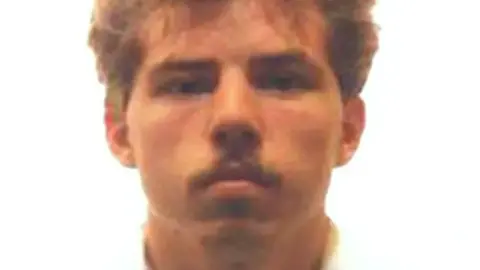 Cleveland Police
A murderer jailed after his victim's family got the double jeopardy law changed has told the Parole Board he is ready for prison release and "cringes" at the "selfish" violent man he was.
William Dunlop, now 63, strangled Julie Hogg, 22, before "sexually mutilating" her body and hiding her beneath her bath in Billingham, near Middlesbrough, in 1989.
Juries twice failed to find him guilty but after he made confessions to a prison guard, Julie Hogg's family campaigned for him to be prosecuted again, leading to him admitting murder and being jailed for life with a minimum term of 17 years in 2006.
At a new hearing, Dunlop's fourth attempt at parole, his victim's family said he should stay in jail.
Julie Hogg's body was found by her mother three months after Dunlop murdered her, the hearing at International Dispute and Resolution Centre (IDRC) in central London heard.
He was formally acquitted after a second jury failed to reach a verdict in 1991, but after he confessed to a prison guard in 1999 Julie Hogg's family successfully campaigned for the law to be changed so he could be prosecuted again.
 Family handout
Parole Board chief executive Cecilia French said the panel would consider 990 pages of information, including victim impact statements, to assess his "risk" to the public.
The panel of three, headed by retired judge Nicholas Coleman, was meeting in Dunlop's prison, which was not named for security reasons.
The hearing was streamed live to a room at the IDRC where Julie Hogg's family and journalists were gathered.
Only the back of Dunlop, who was wearing a light blue shirt and had short thick dark grey hair, was visible, with the board unable to "compel" him to show his face, French said.
Julie Hogg's son Kevin told the panel her family had the life sentence.
"Time isn't the great healer it's reputed to be," he said, adding he had "lost much" to Dunlop's "evil actions".
 Family handout
He said Dunlop could have admitted what he had done at the outset, but it was left to his grandmother to find her daughter's "sexually mutilated decomposing body".
Dunlop still posed a risk to the public, the hearing was told, and the family would feel "constantly on edge" if he were out of prison.
He said Dunlop was "hated" in the Teesside area and the killer's safety could be jeopardised were he to be released.
During just over two hours of testimony, Dunlop told the panel he had been a "violent horrible person" who thought only of himself and did "not care about who I hurt".
As a child he was taught to use violence to get respect, and attacked people who broke his unspoken rules, he said.
Dunlop said he saw Julie Hogg as an object and attacked her because he felt entitled to respect from her and he "never handled rejection very well".

He felt "euphoric" with "power" after killing her, but that faded after 30 seconds or so and his thoughts turned to trying to get away with what he had done, the panel heard.
Dunlop said he would probably have gone to on to injure or even kill other people, but being in jail had led to him being a "far happier person now than I was when I was a violent man".
He said he now got joy from helping people and being respected for his "work ethic" as a painter in prison.
"I'm just not interested in hurting anybody else now," he said.
Dunlop said since suffering the death of his son in the past year, he could "empathise" with Ms Hogg's family and the "hell" he put them through, adding: "I get it now."
Asked if he posed a risk to the public, Dunlop replied "no" and said "I'm more frightened of them than they should be of me".
He said the thought of the "selfish" man he was now made him "cringe" and he no longer recognised that person within himself.
Dunlop also said he was motivated by the song lyrics "I get knocked down, but I get up again", and would keep applying for parole.

His prison offender manager recommended he be released under strict conditions and housed at a supervised hostel.
She said he had "completed a significant amount of intensive treatment" and his risks could be managed.
The way he handled the loss of his son and a TV drama being released about his case showed he was able to "cope with very challenging events" without resorting to substance misuse, violence or sexual thoughts, she said.
Two psychologists, one from the prison and the other independent, both agreed he was ready for release, the panel heard.
Dunlop's community offender manager said he had no concerns about him and there was "not anything else he needs to do".
The panel heard Dunlop had "cultivated notoriety" in the late 1980s and left his victims fearful of reporting him, culminating in the following timeline:
- 16 November 1989 - Dunlop, aged 26, murders Julie Hogg at her home in Billingham
- 5 February 1990 - Ann Ming finds her daughter's body
- 1991 - Two juries fail to reach verdicts with Dunlop then formally acquitted
- 1998 - Dunlop is jailed for seven years for inflicting grievous bodily harm on a new partner
- 1999 - Dunlop admits to a prison officer that he killed Julie Hogg
- April 2000 - Dunlop is jailed for six years for lying under oath at his previous trials
- 6 October 2006 - Dunlop is jailed for life with a minimum term of 17 years for murdering Julie Hogg following Ann Ming's successful campaign to change the double jeopardy law
- 2019 - The Parole Board rejects an application to move him to an open prison
- September 2021 - Dunlop's minimum term expires
- 2022 - The Parole Board recommends a move to an open prison but it is blocked by the Justice Secretary
- December 2024 - The Parole Boards holds a hearing partially in public which culminates with another recommendation for a move to open conditions
- April 2025 - The Justice Secretary blocks the move
- 21 October 2026 - The Parole Board meets again to determine Dunlop's new application for release
The panel heard Dunlop had now spent 28 years in prison, including a lengthy spell in a secure mental unit where he was diagnosed with a severe personality disorder and psychopathic traits.
The hearing, which is the 10th by the Parole Board to be held in public, continues.
Follow BBC Tees on X, Facebook, Nextdoor and Instagram and listen to Radio Tees on BBC Sounds.