The challenge of selling a house with a dark past

 John Fairhall/BBC
At the heart of many grisly court cases lie the properties in which the crimes unfolded. Some are demolished, while others still cast a shadow over the communities in which they stand. So how do you go about selling a house where something terrible has happened – and who would buy it?
The addresses of some notorious properties seep into the public consciousness.
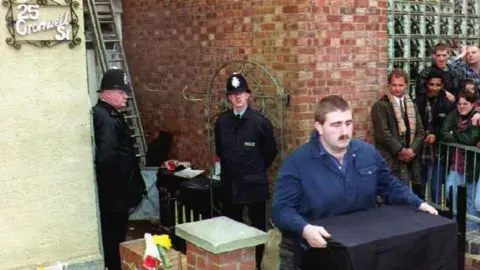
Twenty-five Cromwell Street in Gloucester – where the bodies of nine girls and young women, murdered by Fred and Rosemary West, were dug up – is one.
The house at 10 Rillington Place in Notting Hill, west London, where John Christie carried out his murders, and Ian Huntley's in Soham, Cambridgeshire, are others.
All three have since been demolished.
However, the house where Ipswich serial killer Steve Wright lived still stands, despite calls for it to be destroyed, as do the north London properties where Dennis Nilsen carried out his murders.
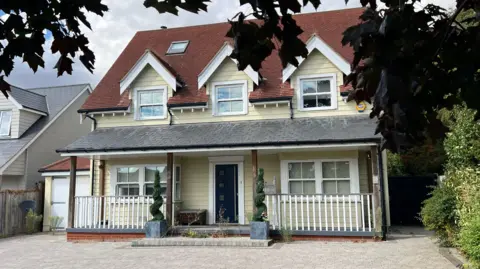
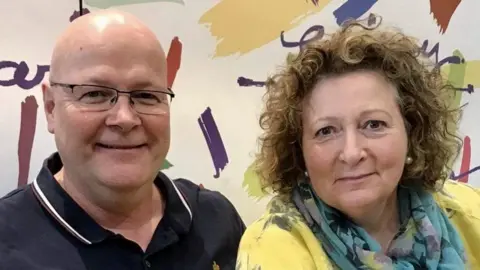
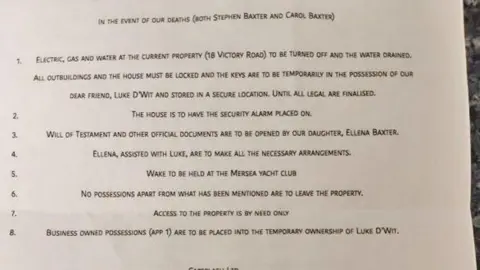
So, too, does the five-bedroom house on Mersea Island where Carol, 64, and Stephen Baxter, 61, were fatally poisoned with fentanyl by their friend Luke D'Wit in 2023.
The house, in Victory Road, is currently for sale.
 PA Media
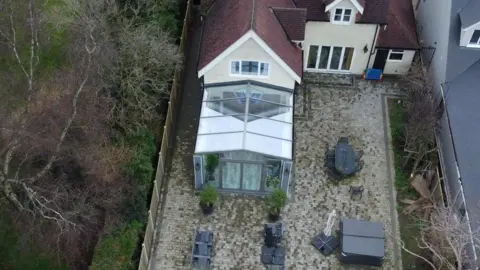
Standing in one of Essex's most coveted waterfront communities, and just a stone's throw from the island's yacht club, the three-storey property has hardly changed since the Baxters were found dead by their daughter Ellena in their armchairs.
A framed photograph of Carol and Ellena even features in the online property listing, giving potential buyers a clue about its past.
"They're going to know about the story," says Rachel Ollington, an Essex property consultant, of any potential buyers.
She believes 90% of viewings will be from people simply being "nosey".
When contacted for comment, Ellena Baxter said: "It was a well-loved family home."
D'Wit is serving life with a minimum term of 37 years for murdering the Baxters, but revelations at his trial left the community stunned and the shock is still raw for his fellow islanders.
The 37-year-old IT worker was known locally as a quiet "geek" who volunteered at a soup kitchen and helped organise the town carnival.
 Family handout
"I'll talk, but not about Luke D'Wit," says one islander when approached. "I don't want to be involved in that in any way at all.
"It's strained my relationship with friends."
Even trusted contacts on Mersea leave messages unanswered or do not want to revisit it. The murders were just too close to home.
In the absence of a smoking gun, some still refuse to accept D'Wit was the killer.
"There can be a feeling that the community share some sense of responsibility for it," says Dr Anne Eyre, director of the Centre for Collective Trauma.
"We can feel a sense of inappropriate guilt: 'Why didn't I see this?'. That's why sometimes people feel reluctant to talk about it.
"They may be feeling, 'I didn't see anything coming, I thought this person was trustworthy'."
- If you've been a victim of crime, details of help and support are available at BBC Action Line
Suspicion surrounding the deaths of the Baxters arose when post-mortem examinations found lethal doses of the powerful opioid painkiller fentanyl in their systems.
A clumsy false will naming "our dear friend, Luke D'Wit" as the director of the family's shower mat business led detectives to the killer.
"This kind of experience challenges our taken for granted assumptions about who we can trust and who we can't," Eyre notes.
 John Fairhall/BBC
Unlike Huntley or the Wests, D'Wit did not live at the house that he made notorious.
As a trusted friend of the Baxters, however, he was an almost ever-present guest.
In his own words, he was welcomed into their house like an "adopted son". For Ellena, he was the "nerdy weird" guest who never left.
He created a web of more than 20 false personas to manipulate the Baxters, before lacing their health smoothies with the drug to poison them on Good Friday.
But Ollington says there is no obligation for the estate agent to tell people viewing the house of its unsettling history. They must, however, disclose it if questioned.
The BBC has asked the agency if it is making people aware, but has not had a response.
"It does take a little while for the legacy to diminish... It's still going to have that murder house stigma," Ollington adds.
"But if you don't mind – and there are a lot of people out there that who are like, 'Meh, makes no difference to me' - then you can definitely pick up a bargain."
 Essex Police
The fentanyl used to murder the Baxters had been prescribed to D'Wit's late father and stashed "in abundance" after his death.
On Friday, the BBC revealed Essex Police had closed a review into whether D'Wit had used the drug to kill other people and remain undetected.
The legacy of what happened remains, not least in the form of the Baxters' home, which has an asking price of £800,000.
Its sale will divide some living on Mersea and Eyre says there will be "strong feelings" about its future.
"Although a house is only bricks and mortar, it is a symbolic place where something tragic has happened," she says.
It will raise questions, too, about how best to move on from its tragic past.
"But how do we do that while respecting and remembering what has happened there?"
Do you have a story suggestion for Essex? Contact us below.
Follow Essex news on BBC Sounds, Facebook, Instagram and X.