'Burnout, stress and anxiety' leading to industrial action for teachers

 BBC
BBCA west Belfast primary school teacher has described the "burnout, stress and anxiety" experienced by many in the workforce as they struggle to cope with increasing workloads.
It comes as Northern Ireland's five teaching unions voted for industrial action if their grievances concerning workload were not addressed.
Education Minister Paul Givan said he was "fully committed" to reducing teacher and headteacher workload and that he hoped further negotiations would help avert action.
John Kerr, head of key stage one at St Paul's Primary School, said between additional administration and pastoral care, he routinely worked over his contracted hours.
"It's one of the only professions that I can think of where essentially you're being told would you like to come in and work on Saturday for free, or during the evenings, or essentially doing overtime for free," he told BBC News NI.
The primary three and primary four teacher, who is now 15 years into his career, said the demands have increased year-on-year.
He said he recognised there may be little sympathy for teachers given the long holidays they have over summer, but that those breaks were necessary for recovery.
"When you get to the end of the year, the exhaustion and physical and mental health issues that a lot of teachers will experience, it takes until maybe July before you can feel like your normal self again and that's without exaggerating.
"The burnout and stress and anxiety that can come with the role is massive."
 PA Media
The education minister said he hopes further negotiations with unions will avoid strike action.
The unions said members were balloted following "sustained failure to deliver a credible implementation plan for the 27 recommendations of the Independent Review of Workload".
Givan said the ballot was "initiated before the negotiations had commenced".
"I believe that further progress is possible through continued engagement and I will continue to work with the NITC (Northern Ireland Teachers' Council) and employers to find a way forward," he said.
A potential strike date has not been set and the unions said industrial action could still be avoided if there are decisive moves to "ensure that workload is fully addressed".
In June, when plans to ballot on strike action were announced, Givan said he was "genuinely disappointed" by the decision.
Of the 54.89% of NASUWT members who voted, 92.04% voted in support of strike action and 98.63% voted in support of action short of strike.
In a statement, the minister said he recognised the pressures on the profession and he had personally requested the setting up of a panel to identify workload issues.
Speaking to BBC Radio Ulster's Good Morning Ulster programme, Maxine Murphy-Higgins from the NASUWT said the independent review on workload was "issued last November and we are still talking about the implementations of those recommendations, and I think therein lies the issue".
'Acknowledgement alone isn't enough'
 Getty Images
"Teachers need to see genuine workload reduction and not just promises."
Murphy-Higgins said the "concern is that, to date, there has been constructive ambiguity around workload changes and workload changes actually being delivered in schools".
She said the "ambiguity" and "difficulty" relates to the time teachers are given to complete certain activities such as parent-teacher meetings or marking controlled assessments.
"There has been some acknowledgement over the summer that workload has finally been acknowledged as a serious issue, the challenge is that acknowledgement alone isn't enough.
"The bigger issue here is that exhausted teachers can't continue carrying unsustainable workloads indefinitely."
Murphy-Higgins said teachers want a "profession where teachers can focus on the teaching, rather than excess of bureaucracy"
"Our members feel that they have been carrying an unsustainable workload in order to be able to deliver the education system that we do in Northern Ireland and that can't be allowed to continue."
'Realistic prospect of reaching agreement'
Givan said the panel's recommendations "have been taken forward and the employers along with my Department are committed to implementing them".
"Significant progress has been made through the Labour Relations Agency (LRA) conciliation process."
He said the department have "engaged in good faith, demonstrating a willingness to listen and respond and we will continue to do so".
"We will also need to consider how further engagement can be structured in a way that is meaningful and has a realistic prospect of reaching agreement.
"I believe that further progress is possible through continued engagement and I will continue to work with the NITC and employers to find a way forward."
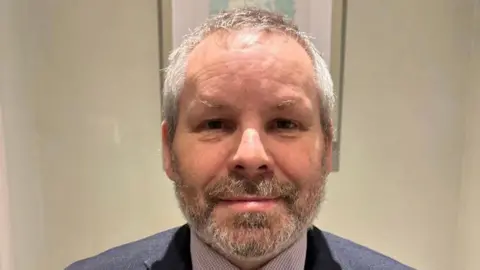 Sean McNamee
Sean McNamee is the principal of St Paul's Primary and Nursery School and said while there "seems to be some good ideas and suggestions" from the review, the "problem is around delivery and the time frames for delivery".
"We haven't got anything by way of indication as to when those might be delivered, so nothing is changing.
"Good will and good ideas are great, but unless they're delivered nothing changes and workload continues to mount."
McNamee said teachers and principals feel they "have to do more in the hours that are provided" to them, which is not "sustainable" or "achievable".
"We're in a situation now where workload is increasing over time, our contracted hours aren't increasing but we're trying to get more done.
"It's come to the point where, if something doesn't give, then principals' and teachers' health is going to suffer," he said.