The Glasgow weavers helping the fight to defend Ukraine

 BBC
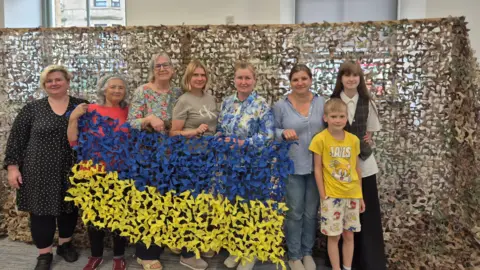
BBCA quiet old school building in the east end of Glasgow may seem a world away from the war-torn streets of Ukraine's cities.
But in a converted classroom, a group of refugees are putting their hearts into helping their homeland – by weaving camouflage nets for the war effort.
Everyone in the Weegie Weavers team has family in Ukraine, including some serving in the military. Their own lives remain "on pause" as the conflict continues.
For four years now many of the group have met, talked, shared laughter, and expressed their worries to each other.
They have also created more than 300 nets to send to Ukraine.
Nataliia Matsenko previously worked in a laboratory developing dry mixes for construction work.
Her life has completely changed since the war started. In September 2022 she moved to Scotland.
"I could not stay in Ukraine but I wanted to still help," she says, speaking with a translator.
"I saw a message in a Ukrainian group just after moving here that asked if anyone made nets here in Glasgow and I replied to that. It was from a woman called Ludmilla and the weavers came from that.
"Some people just come along for interacting, others find it clears the mind. We will share our own problems and different people have different experiences, and we can share information."
Neither the weaving nor the war are showing signs of stopping. Russia currently controls about a fifth of Ukrainian territory and both countries continually exchange strikes.
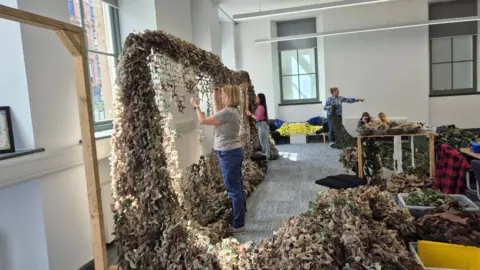
Two nets were just being finished when BBC Scotland News visited the group's current base in Parkhead.
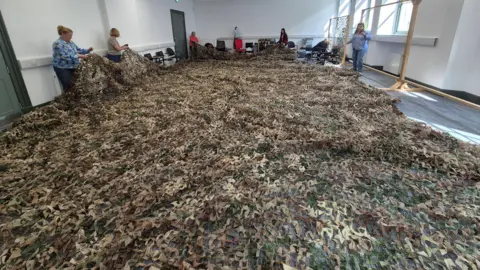
They are different sizes and colours, fitting the requirements being requested back in the women's homeland. One of them covers the entire floor.
"The nets are made to go into particular environments, and therefore they change with the seasons," says Lindsay Campbell, a member of the group who is not Ukrainian herself but has a son-in-law who is.
"You can't use a snowy net in the middle of summer and there is no point hiding under a green net during the winter either.
"We respond to what we are asked for. I have no idea where they actually go once they are sent off, we just get told what sort of environment they are going to."
Lindsay took in a refugee who arrived in Scotland in 2022, part of the group that arrived and initially stayed on a cruise ship on the River Clyde.
When the woman staying with Lindsay decided to pop along to the Weegie Weavers, Lindsay went along too, and has been a member since then.
"It has been a good thing for them, because it's very difficult, they've left everything they know behind," she says.
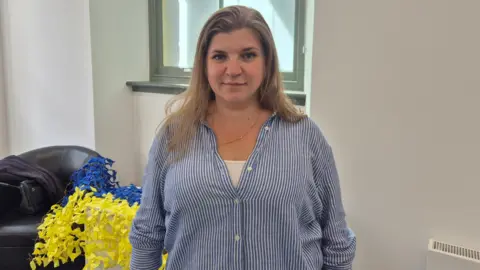
Oksana Khvostenko has also uprooted her life. She moved to Scotland with her two children shortly after the war broke out, but her husband remained behind to fight.
"It was easier for my son, he was just five when we came here. He had missed part of nursery due to Covid and it was easier for him to adapt into Scotland. He has made friends and started school here.
"It has been much more difficult for my daughter. She is 14 now and already had friends, and was going to school."
Those in the group - like many other refugees forced to flee in 2022 - have an uncertain future ahead of them, no matter their circumstances.
"Nobody knows if we will have a chance to stay here," says Oksana.
"Every story is different. Some people came from occupied territories, or have had their houses destroyed, so they just don't have any place to return to.
"In my case, our house is untouched right now, but the situation can change literally every second. Most Ukrainian lives are put on pause. We are waiting in safety while others decide our future."
Oksana says opinions are mixed on what should happen next. Some would like to stay in Scotland as their children are growing up here, but others are keen to return home when it is safe.
Earlier this year, Oksana and her children were able to travel back to Ukraine for the first time in four years, making a brief stop to visit relatives.
"It was great to see my family. I hadn't seen them in years. But it was difficult to see the damage, to see the places you used to know that just do not exist anymore.
"The next day, after we went on to Poland, there was a huge attack on Kyiv."
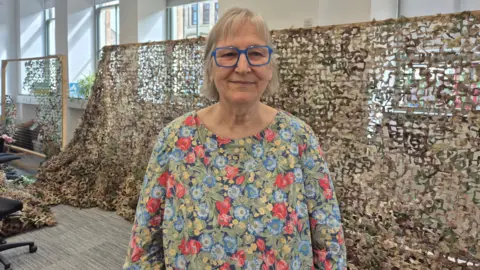
There is uncertainty over the Weavers too. In the past few years the group has been based in different locations. As a non-profit group, Lindsay says it can be easy for venues they meet in to no longer have space available.
She is currently trying to secure a more permanent base where the Weavers could meet at evenings or weekends. But she feels there is increasing apathy to the war itself.
"These things vanish from people's minds very quickly and a sort of war fatigue makes it harder to actually find a space," she says.
"It used to be a massive shock to hear Kyiv was being bombed and now it's taken as just something that happens."
The Weavers women are unlikely to ever feel that way. They will carry on meeting, and weaving, for as long as they can.
"People here are connected by the same ideas", says Oksana.
"We still remember the war is not over and people are surviving every day. We just want to help.
"If even one of these nets saves a life in Ukraine then it will be worth it."