Germany's far-right AfD hails big victory in east, but falls short of majority

 Reuters
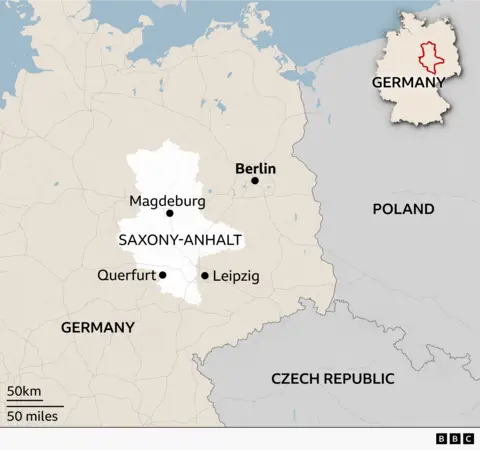
The far-right Alternative for Germany (AfD) has won a decisive victory in Germany's eastern state of Saxony-Anhalt, far ahead of mainstream rivals.
But preliminary results show it has gained 43.8% of the vote to the conservative CDU's 17.2%, falling short of an outright majority needed to govern alone. Tricky negotiations on who will run the state lie ahead.
AfD's charismatic leader in the state, Ulrich Siegmund, said it was "sensational" and added that the party had won a mandate to govern.
No far-right party has controlled a German state since World War Two, and governing at state level would mean powers over policing, local education and culture.
Saxony-Anhalt has a small population of 2.1 million and the AfD in the state is assessed by domestic intelligence as "right-wing extremist", a classification rejected by Siegmund, 35.
He along with joint national leaders Alice Weidel and Tino Chrupalla were overjoyed as exit polls revealed they were on track to score more than double the party's 2021 result.
The AfD is currently heading for 39 seats in the 83-seat state parliament - three short of an outright majority.
Siegmund has said he does not intend to lead a minority government, even though the party's national leaders see it as a possibility.
"If necessary there'll just be new elections, then we'd just get 50 or 55%," he said, while adding he was prepared to work with individual MPs or a party.
One idea being floated is whether there could be informal deal whereby a small party - the BSW - could give their tacit support to allow the AfD to form a minority government.
The left-wing populist BSW, which is set to win five seats, is also tough on migration and backs importing Russian gas.
The AfD has signalled an openness to talk with other parties but all - apart from the BSW - refuse to co-operate with the far-right.
Beatrix von Storch, deputy parliamentary leader of the AfD, told the BBC on Monday her party intended to hold talks to secure the support of members of parliament from other parties.
This included individuals within the CDU group in the state parliament "because they're very, very unhappy with their own party".
She added that parties which continued to refuse to work with the AfD and did "not accept the vote of the people" risked "severe chaos and a new election".
Another possibility - at least in theory - is a messy, minority coalition government led by the CDU. But that appears very unlikely.
Commentators and political opponents called AfD's victory a watershed and break with the past. Main TV channel Das Erste cancelled its legendary crime drama Tatort to focus on what the result meant.
"This isn't just about Saxony-Anhalt," Siegmund told supporters. "It's a signal for the whole of Germany - a self-confident signal."
US President Donald Trump posted a screenshot of the German TV projection on his Truth Social platform, and then Russian presidential envoy Kirill Dmitriev took a screengrab of Trump's post and praised a "historic win for the pragmatic AfD".
Dmitriev had earlier praised the Russia-friendly AfD as "the party of hope and reason, co-operation truth and hope for Germany". Ahead of Germany's federal election last year, US Vice-President JD Vance endorsed the party, in a move criticised in Germany as political interference.
Polish centre-right Prime Minister Donald Tusk saw the result very differently, saying "in Poland only idiots and traitors can rejoice at the triumph of the AfD".
 Reuters
A crowd of supporters at the AfD election night party HQ erupted in cheers as the projections came up on the screen.
A short while later, people burst into singing Germany's national anthem.
"We have made history in this state," Siegmund said. His opposite number in the CDU, Sven Schulze, conceded victory as he watched the conservative vote slump by more than half on the previous election.
"This was an extremely tough and intensive election campaign," said Schulze, adding that his party would have to deal with the result.
Germany's centre-left SPD described the outcome as "truly dramatic" and national leader Lars Klingbeil, whose party is in government nationally with the CDU, described the outcome as a "signal to Berlin" and he was adamant that they would hear it.
Turnout in Saxony-Anhalt was particularly high at 77.8%, and AfD supporters in Magdeburg praised Siegmund's success in winning over voters.
One man called Ollie said: "This man gives us what no-one else can give."
"No matter what government, they all just promise things to get better. This is a party for the working people. It is the alternative for Germany," he told the BBC.
Another AfD voter called Bert said people in the east could sense things were not going well: "Things need to improve for us, for my family - I have three children. I'm in fear, I'm really in fear that safety erodes more and more."
The AfD leads the opinion polls nationally, ahead of the ruling conservatives of Chancellor Friedrich Merz and the Social Democrats, but their heartland lies in the eastern states.
They also won the 2024 state election in neighbouring Thuringia, but failed to secure enough seats to win power.
Among the AfD's policies is a highly controversial plan for "remigration", which is widely understood to mean mass deportations of migrants, although the party says it refers to deporting criminals and those in the country illegally. It would not be able to achieve either if it ran the government of one of 16 states.
But it would have significant local powers. The party has been particularly critical of the Bauhaus school of design which the Nazis shut down in the city of Dessau in Saxony-Anhalt after they came to power in 1933. The AfD has called it "the dead-end of modernism", prompting some to accuse the party of using similar language to the Nazis.
Nikita, a demonstrator at an anti-AfD "Democracy Festival" in Magdeburg on the eve of the vote said Germans had to "learn from our history and not go back. We don't want the dark times any more".
Responding to the news from Saxony-Anhalt, the veteran head of the Jewish community in Munich and Bavaria, Charlotte Knobloch, said it frightened her. "On days like this I find it hard to recognise my homeland any more," the 93-year-old Holocaust survivor said, appealing for mainstream parties not to stand by and allow "this decline".
One of the AfD's top figures in Saxony-Anhalt, Hans-Thomas Tillschneider, has also been criticised for his approach to Russia. When asked why he had a Russian army mug in his office, he said it was just a souvenir, and "it's not our war".