'Technology has given me my husband back'

 Jamie Niblock/BBC
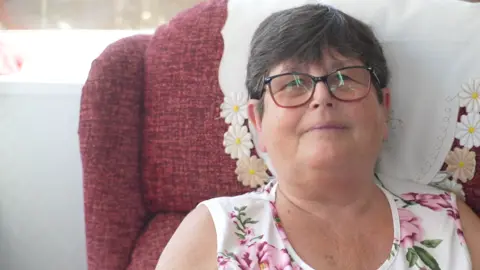
Heather Monk says her marriage has been transformed after it was severely tested by her husband John's health needs.
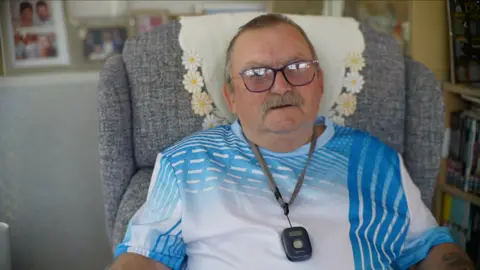
John, 71, has Parkinson's and a medical condition that affects his memory, making it difficult for him to use a regular phone.
This left Heather, 63, feeling unable to leave the house without him, and John feeling "tied to her apron strings".
But the couple, from Lowestoft, say assistive technology developed by Suffolk County Council and its partners has made a huge difference to their lives.
The system, called Cassius, uses sensors, electronic tablets, pressure mats and other technology to help people to live independently and safely in their own homes.
About 6,900 people across Suffolk are using the technology, and more than 14,000 have been referred for it.
So far, £12.4m has been invested in the scheme and it has resulted in savings of £20m, with another £4m expected this year.
 Jamie Niblock/BBC
"Before I had the technology, I didn't go anywhere without the wife, really," says John.
"I was hanging on to her apron strings, just in case something happened."
Heather says: "It was hard. Half of me said, 'I've got to do it, because he's my husband and I look after him,' but there were days when I would think, 'Oh, for goodness sake, can I just pop out? Please let me just pop out.'"
The couple, who have been married for 42 years, had a video care phone and a smart speaker installed.
The care phone is next to John, and his tablet has pictures of Heather and their two sons on it.
If he needs to contact them, he can just tap their picture, and a call is made to them via an app so they appear on screen.
He also wears a fall pendant that activates if he falls over, or that he can press if he needs help.
More from Suffolk:
The technology means John can live more independently.
"I am more myself now," he says.
Heather agrees. "I see the difference in John. He's got more confidence.
"And, for me, I can pop to the corner shop quite happily without worrying too much."
The smart speaker has also meant they can share music they love together.
"He puts that on in the morning, and it's like having John back because he sings along, and that's lovely," says Heather.
"We're more of a couple now."
 Jamie Niblock/BBC
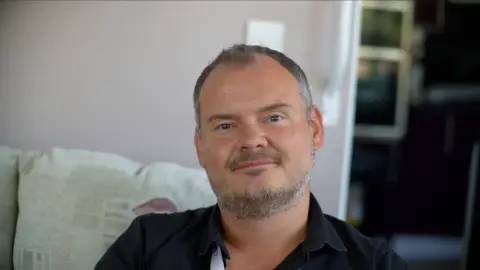
Ben Hurren is an independence and wellbeing practitioner for Suffolk County Council who specialises in digital technology and dementia care.
He worked with the Monks to install their technology, which he says saves money as it keeps people in their own homes and living independently.
It also provides a "safety net" so that carers can go about their own lives.
"I think the sooner and the earlier we can get it in, the more we enable independence," says Hurren.
"And it's making a huge difference, particularly to family members. It just gives them peace of mind."
 Vikki Irwin/BBC
The Cassius project was set up in 2021 by the council's Conservative administration.
It was developed with Essex-based firm Alcove's technology and social care consultancy Rethink Partners.
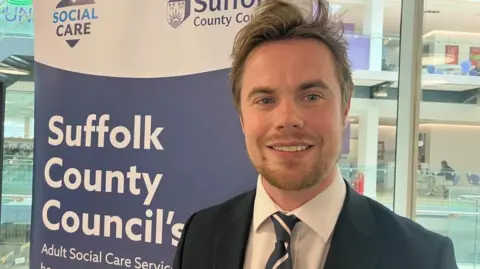
Philip Faircloth-Mutton, who is responsible for adult social care at the authority, now led by Reform UK, says: "We were the first in the UK to devise this system for a rural county.
"The demand for adult social care meant we needed to come up with new ways of being able to manage that demand, keep people in their homes for longer, where they are better served and get better outcomes."
The council's budget for adult social care this year is £382m and £17.8m in savings are needed.
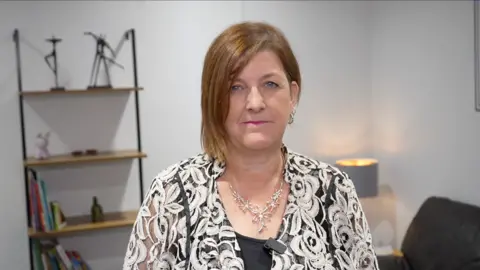
Faircloth-Mutton says while not everyone would want to use the technology, and that it will not replace carers, it should be seen as a complementary service that "preserves dignity" and "can deliver proper value for money for Suffolk's residents".
 Jamie Niblock/BBC
Jo Finch, professor of social work at the University of Suffolk, says she understands the benefits of the technology – particularly in keeping people safe, living independently and preventing them from being in hospital.
But she says there is no long-term research into how it affects people.
"So if they don't wish to use this technology, if they struggle to use it, if they feel it's imposing or getting in the way of human interaction, we really need to hear those voices as well," she says.
"So it needs to be more than saving money, [though] it is a good thing and much needed."
Councils in England and Northern Ireland have a statutory duty to pay for care for people with savings of less than £23,250.
The cost of this takes around half of councils' entire budgets.
Andy Burnham, the new prime minister, has said "the NHS will collapse" if social care is not reformed and that he would not want to leave office without implementing "substantial change".
An independent review by Baroness Casey has been considering possible solutions. It was expected to be completed by 2028, but the PM has asked her to bring it forward to 2027.
Do you have a story suggestion for Suffolk? Contact us below.
Follow Suffolk news on BBC Sounds, Facebook, Instagram and X.