Farmers call for food rules update after heatwaves

 BBC
BBCFarmers have said they have had to throw away their produce because this summer's extreme heat has caused fruit and veg to grow in unusual shapes or colours - meaning retailers will not buy it.
They said they were calling for the government to update the current appearance standards to help the country avoid "a future food security crisis".
James Pullen, a potato grower in Tintinhull near Yeovil, said he was facing £200,000 losses due to his produce appearing bruised or not growing at all. He said retailers would not purchase such produce.
Sarah Dyke, MP for Somerton and Glastonbury, said she was calling for retailers to relax "rigid appearance standards" which she described as "absurd".
However, Andrew Opie, director of food and sustainability at the British Retail Consortium, said: "Retailers face the dilemma of supporting British farmers but also making sure that... customers have what they expect to buy.
"Extreme weather, including drought, can affect crop yields and place upward pressure on prices.
"Retailers are experienced in managing supply disruptions and will take all necessary steps to minimise any impact on customers, including sourcing from alternative suppliers and expanding ranges of odd-sized produce."
Pullen described this year's crop and the losses that would be incurred as "devastating".
"I expect we'll be £200,000 down on potato sales," he said.
"In a good year, potato crops will average around 25 tonnes to the acre [but] I'm sure this year it will average around 20.
"We've had two dry years back to back on previous occasions but next year will be critical.
"In my lifetime I can't remember three dry summers back to back," he said.

He said usable potatoes would be sent for processing while green or damaged ones would be used as animal feed.
Pullen said the weather had left many of the potatoes too small.
He mostly grows Electra potatoes, which have to be 45mm in diameter to sell to retailers.
"This year, about 20% of the crop is around 40mm in diameter," he said.
And it's not just potato farmers who are struggling.
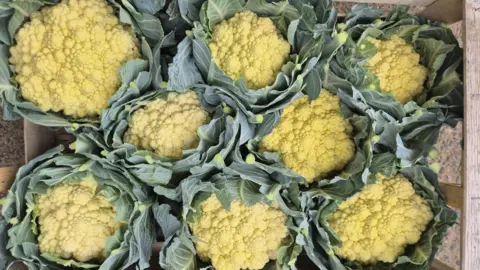
Cauliflowers require a lot of water to grow into the white shade shoppers are used to seeing but this year more light is reaching them and turning them yellow.

Dyke said she was calling for retailers to relax rigid appearance standards.
She also said she wanted "stronger protections for farmers against unfair trading practices, investment in agricultural water infrastructure and legislation through a Good Food Bill to strengthen the UK's food security".
She said: "It is absurd that perfectly good British-grown food could be left to rot simply because a cauliflower is a little yellow or a cucumber isn't quite the right shape."
A Defra spokesperson said that the UK's food system was already "resilient and secure".
The spokesperson said: "We do not expect recent dry weather to impact national food security.
"Through stronger food supply chains, a new Farming Roadmap and continued work with the National Drought Group, we are ensuring Britain is better protected against future shocks and disruptions."
 Oddbox
Paul Keene, from the Primrose Vale Farm Shop in Gloucestershire, said his crops were also affected.
He said he was leaving anything he was unable to sell in the fields to be used as compost.
Kate Benson, from Wivey Kitchen which provides community meals from surplus food in Wiveliscombe, said it made her "depressed to see supermarkets reject food from farmers".
She said: "Our charity does take surplus food and we cook it into food that we deliver to people who need it.
"A yellow cauliflower or knobbly cucumber is still perfectly edible.
"We need to educate the consumer."
Follow BBC Somerset on Facebook and X. Send your story ideas to us on email or via WhatsApp on 0800 313 4630.