Campaigners call on PM to scrap floating bus stops

 BBC
BBCDisability campaigners and organisations have called on the prime minister to ban and remove England's floating bus stops due to concerns the infrastructure poses a major safety hazard for blind, deaf and disabled commuters.
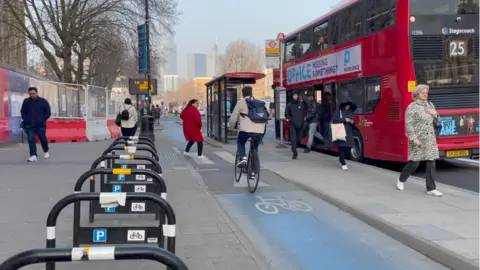
Floating bus stops - also known as bus stop bypasses - feature a dedicated cycle lane routed between the main pavement and the passenger waiting island.
While designed to protect cyclists from main-road traffic, critics argue that the layout creates a daily hazard for vulnerable pedestrians attempting to board or leave buses.
The government said it was listening carefully to concerns raised by disability groups and local organisations.
 NFB
NFBSarah Gayton, who helped coordinate the letter and Monday's protest, said people with visual or hearing impairments cannot see or hear approaching cyclists.
"Some have been injured, while others feel it has taken away their sense of independence," Gayton told BBC Radio London.
She said over 290 organisations representing blind, deaf, disabled, partially sighted, and elderly people had written to the prime minister demanding a reversal of government proposals on floating bus stops and their removal from road infrastructure.
"People are going out less, they're not using the buses so it is having a real, serious, life-changing consequences for people, because the bus is the big connector in London.
"Not everywhere has got a Tube, and blind people can't cycle, they can't obviously drive, so the bus is that lifeline, and that lifeline is being robbed from them."
Campaigners argue that despite government guidance published in January, progress has been inadequate and existing stops continue to present a daily danger.
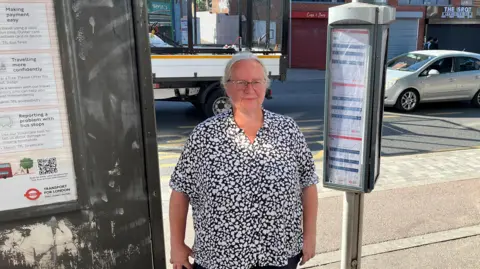
Gary Wiggins, a visually impaired trustee for the Waltham Forest Blind Association, said he got hit by a cyclist when stepping off a bus on to what he thought was a pavement but turned out to be a cycle lane.
"My rollator went one way and I went another. I got shouted at - a mouthful of abuse. I couldn't recognise the cyclist. I do not want that experience again," he said.
Adam Gabsi said he understands the need to improve safety for cyclists and promote active travel but this "shouldn't come at the cost of people being scared to even make their journey".
"This is an injustice that should be stopped," he added.

Christina Calderato, director of transport strategy and policy at Transport for London (TfL), defended the network's safety record while acknowledging the concerns raised by disability groups.
"Our absolute priority is that everybody should be able to travel around London safely and competently," Calderato said.
She highlighted ongoing efforts to improve infrastructure and customer information such as audio announcements on buses.
TfL previously said there were five pedestrian casualties involving cyclists and one with an e-scooter in a three-year period at floating bus stops compared with 11,400 pedestrians injured by motor vehicles.
There were 164 floating bus stops in the capital in 2024, London Assembly figures show.
Asked about cyclists not adhering to the rules, Calderato said: "There are zebra crossings between the footway and the bus stop. And all road users must stop at those zebra crossings."
A Department for Transport spokesperson said: "We are listening carefully to the concerns raised about floating bus stops from a wide range of organisations, including disability groups.
"That is why we asked councils to pause work on the most problematic type of floating bus stops in November 2025, and we are making funding available to make existing infrastructure more accessible."
A spokesperson for London Mayor Lord Khan said floating bus stops "provide a safer route for everyone" but that TfL would continue to engage with Londoners to ensure it was accessible to all commuters.
Listen to the best of BBC Radio London on Sounds and follow BBC London on Facebook, X and Instagram. Send your story ideas to hello.bbclondon@bbc.co.uk