Exploring the mystery of the 'Bomber Oak' tree

 Woodland Trust/PA Media
"I regard it as a living tribute to all those who served."
Even at first hearing, the story of the Bomber Oak is laden with tragedy, pathos and echoes of a different age.
According to farmer Andrew Brown's family tradition, the proud oak tree still bears the scars of when it was struck by a desperately crippled aircraft during World War Two.
This cherished part of Fairchilds Lodge Farm in Rutland was recently shortlisted by the Woodland Trust for its Tree of the Year award.
 Woodland Trust/James Reader
Previous winners include Glasgow's Argyle Street Ash and the Sycamore Gap tree before it was illegally felled.
But which aircraft actually hit the Bomber Oak and what happened to its crew?
Brown, whose family have worked the land near the town of Uppingham for generations, said: "I remember my grandfather telling me about the bomber and the oak tree.
"For years after we would find little bits of Perspex in the ground, probably from the front of the bomber.
"Even now you can see that some of the branches are a slightly different shape, which after 80 years shows how hard it must have hit.
"I regard it as a living tribute to all those who served and especially those men in the aircraft."
But what is the truth behind the story?
 International Bomber Command Centre
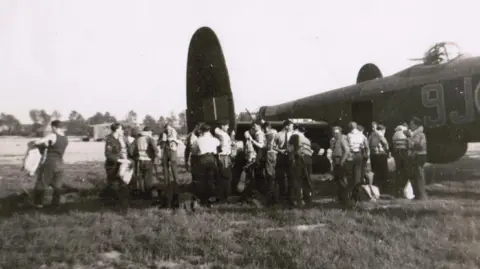
Initial family research suggested a possible candidate was Lancaster PD339, which crashed on 26 April 1945.
Further investigation found the fate of this aircraft had been studied by Roger Kirkham and Bill Lockerbie, two volunteers at Delapre Abbey stately home in Northamptonshire.
It had crashed while taking part in an airlift of allied prisoners of war back to England in April 1945, and after flying too low, lost control and came down near the house's lake.
Five of the crew, four New Zealanders and one from Nottingham, became part of the 55,573 Bomber Command aircrew killed during wartime.
Lockerbie says: "When you get down to five people, all of a sudden it becomes personal.
"It becomes about the individual young men.
"The pilot was the oldest, he was 22, the youngest was 19, it really does tug at the heart strings."
But was it the bomber which had hit the Brown family's oak?
 Delapre Abbey
Lockerbie says: "They have dropped off the former prisoners at an RAF base near Aylesbury and start off north to their base in Lincolnshire.
"But they crash at Delapre, which is south of the tree in Uppingham.
"They never got as far as Uppingham, it doesn't make geographic sense.
"On top of that, the detailed report into the crash makes no mention of an earlier tree strike.
"There is no evidence to suggest PD339 and the oak are connected."
So is this a dead end?
Surely tracking down another candidate for a Lancaster flying at low level over this farmland more than 80 years ago would be like looking for a needle in a haystack?
 Jim Wright
"I honestly thought the Lancaster was going to take the church spire off," says Jim Wright. "He was as low as that.
"Of course, we didn't know what it was about, these Lancasters were just buzzing about for what seemed like weeks, but nobody knew what was happening."
Wright, 98, who has lived in the Uppingham area all his life, clearly remembers when, for a few weeks the skies became a hive of unusual activity.
"It was quite frightening at first," he says. "But then we got used to it and took it for granted.
"There were American bomber airfields around, so we were used to seeing those but the Lancasters were less common and these were flying so low."
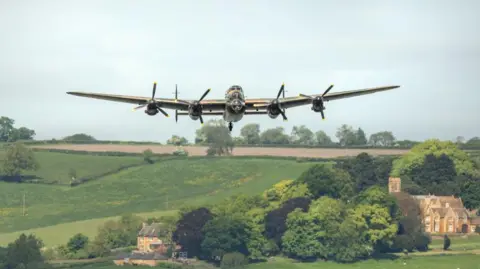
In early 1943 Eyebrook Reservoir - then known as the Uppingham Lake - had been one of a number chosen for practice by a newly formed squadron.
It had been assembled for a specific mission - to carry out attacks on German dams, which required flying at an exact speed, on an exact course and at very, very low level.
 Gerry Gutteridge
So was the Bomber Oak struck by a Dambuster? Was it even likely?
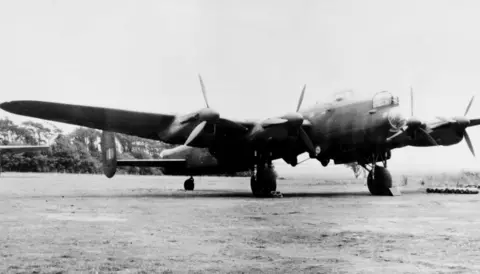
Robert Owen, 617 Squadron's official historian, says: "There are certainly a few instances in the official record which indicate that aircraft did hit trees and came back with branches in the tail wheel or engine radiators.
"But if there was Perspex found at the scene, that would indicate the bomb aimer's blister was badly damaged.
"And there is an accident damage report for a Lancaster damaging this blister while possibly flying near Uppingham.
"Unfortunately it doesn't say which aircraft, it only gives a rough location and it doesn't detail the damage, but it was enough to ground the aircraft and require a replacement."
But probably the biggest issue with linking the Bomber Oak with 617 squadron is the date - April 1943, instead of April 1945.
 PA Media
With a Dambuster aircraft only being a remote possibility, it would need another piece of evidence to move the search on.
"I had the bright idea of looking at my grandfather's diary," says Brown. "I had gone through the war years and had almost given up, then I turned a page over and there it was.
"The entry for 30 April 1945 says 'found plane had crashed through top of oak tree in Big Meadow'.
"He had been ill for two days so it must have happened while he was inside.
"I remembered then that my grandfather used to say a plane had gone over to the village of Gretton and crashed there.
"And there was one that fitted the bill, PB983. Two of the people on it, who were from the Royal Australian Air Force, were killed.
"The diary notes there was snow on the ground and the records show this plane crashed because two of the engines stopped after they iced up."
 Google
Lancaster PB983 was on a training flight from RAF Little Stoughton in Cambridgeshire on 28 April but suffered icing after flying through a snowstorm.
It is listed as crashing near RAF Deenethorpe, near Corby, killing pilot Robert Patrick Terpening and gunner John Grylls Watson.
So is the mystery solved?
The date is potentially right - but the crash site has been identified by local researchers as a field behind the church of St Nicholas in the village of Bulwick, Northamptonshire.
Bulwick is more than five miles (8.5 km) from the Brown's farm, which is a long way for a crippled Lancaster flying at - literally - tree top height.
Perhaps the answer lies in the crash investigation of PB983, or the flight records of some as yet unidentified aircraft.
Whatever the true answer, an incontestable fact is the Bomber Oak stands as the Brown family's living memorial to the crews who flew and fought, and the many who never made it home.
Listen to BBC Radio Leicester on Sounds and follow BBC Leicester on Facebook, on X, or on Instagram. Send your story ideas to eastmidsnews@bbc.co.uk or via WhatsApp on 0808 100 2210.