How did some houses survive the Stourbridge fire while neighbours lost everything?

 EPA/Shutterstock
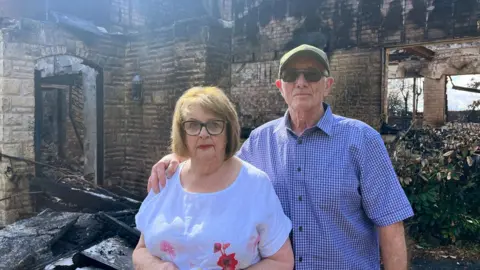
Many who have seen the damage caused by the devastating fire in Stourbridge have shared similar thoughts to Pritpal Boyal, whose relatives' house burnt down - why did some homes survive unscathed while others were gutted?
"I was just amazed at how my father-in-law's house was still standing," he said, mystified. "It was like a lottery of whether your house was going to survive or not."
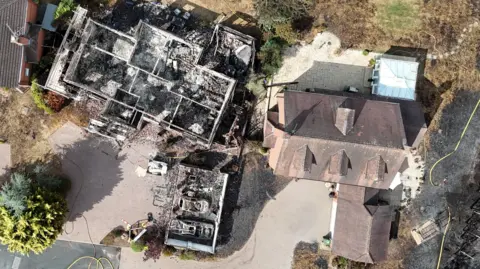
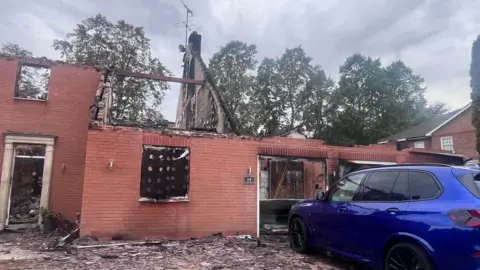
Nineteen homes across five streets in the town were completely destroyed by the fire last week, with eight households left able to view the shells of their former homes.
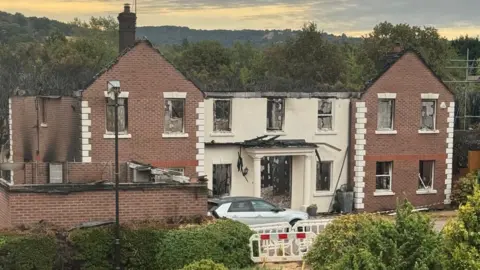
Aerial images of the aftermath showed some houses looking like they escaped the flames while those not far away from them burnt to the ground.
"It was just a scary sight. I really feel for the people that have lost their homes," Boyal said.
Dozens of people were evacuated as the fire raged but, of the 96 houses that were evacuated, 85 families were able to return, Dudley Council said.
Thirteen households whose homes were damaged by the fire were also able to go back to them.
David Price is one of those whose home escaped the flames in Stourbridge and he is still trying to understand why it was spared.
"When you see the devastation it's literally skipped [our house]," he said. "There's still hanging baskets here. I can't work it out."
The wind appeared to have steered the flames clear of his house, he said, while "the other ones over the road just went up".
"I'm devastated for them, I think it's awful," he added. "It isn't something you can just put right, is it?"
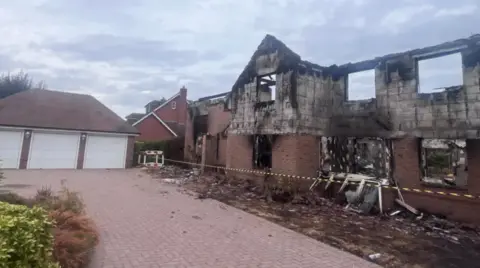
Why did one house burn, but not its neighbour?
The stark difference between neighbouring properties can make the destruction difficult to comprehend for many people.
But for fire safety expert Dr Tony Fogarty, there are many reasons why one home can be engulfed in flames while another is barely touched.
Wind, intense heat and burning embers can all affect how a fire moves, meaning two neighbouring houses can experience very different conditions.
One of the biggest factors is what lies between a fire and a building, Fogarty explained.
"You might have one property which may have fences, shed, decking, loads of dried vegetation," he told BBC Radio WM's Trish Adudu.
"The house next door may have patios and may not have any sheds next to the building, and then essentially that forms a firebreak and can initially stop that fire in its tracks as it moves up the garden."
This could explain why the damage can appear so uneven, even between neighbouring properties, Fogarty said.
It can be tempting for many to imagine a wildfire as an unstoppable wall of flames, creeping steadily across an area - but Fogarty, from Redditch, Worcestershire, said fires did not behave like this.
"When fire is burning, it doesn't move like a solid wall," he said. "Think a bit more like being a powerful hose in the wind. Some areas get force and others don't."
The wind could change the direction and speed of a fire, he added, while burning embers could be carried ahead of the main flames and set fire to new areas.
That meant a house did not necessarily have to be directly in the path of the fire to be at risk.
Another important factor was what was called radiant heat, he said.
The intense heat from a fire could damage or set fire to things even when its flames had not physically reached a building.
"It's not only the flames that cause fire itself on to the properties, you've [also] got what we call radiant heat," he said.
"The flames do not actually have to touch the property itself... the heat that it creates will actually automatically engulf anything that's in its path."
This was one reason why a home could suffer severe damage, Fogarty said, even when the flames did not appear to have directly touched it.
How did dry conditions have an effect?
The risk becomes greater when vegetation and other materials are exceptionally dry, according to Fogarty.
"Everything is tinder dry and when you've got a wind behind that, and we've got a source of ignition, it will spread beyond what people could even recognise," he said.
In those circumstances, Fogarty said, relatively small sources of ignition could become much more dangerous, as a fire found dry vegetation and other combustible material.
Wind could then carry flames and embers beyond the immediate area of the original fire, he explained.
The result could be a highly unpredictable pattern of destruction: One property could be gutted while another, just metres away, survived.
What could stop a fire?
There was no single reason that guaranteed a home would survive a fire, particularly when conditions were extreme.
But reducing combustible materials close to buildings - like wood in the form of sheds, decking, even unused timber - could remove some of the fuel a fire needed to spread, Fogarty said.
Patios and areas without vegetation could create breaks between a fire and a home, while, on the other hand, sheds, decking, fences and dry plants could provide extra fuel to the fire.
Ultimately the behaviour of a fire depended on a combination of factors, including wind, heat, embers, available fuel and the layout of individual homes, he added.
That was why, after a major fire, the pattern of destruction could look so starkly uneven - as in Stourbridge.
Follow BBC Birmingham on BBC Sounds, Facebook, X and Instagram.