Rail guard who won 'whites only' job gets plaque

 Getty Images
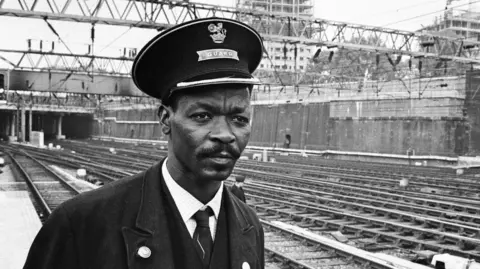
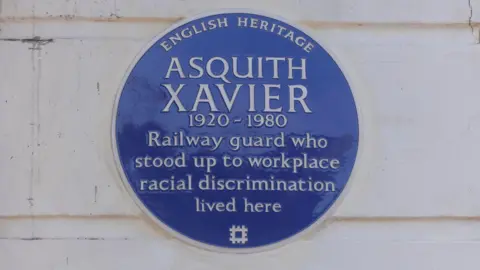
A blue plaque has been installed at the former west London home of Asquith Xavier, a West Indian railway worker who became a leading figure in the fight for racial equality in Great Britain.
Xavier became the first black guard at Euston Station in 1966 after successfully challenging an unofficial policy banning "non-white" people from higher paid jobs at some railway stations.
Despite being an experienced guard, bosses at Euston initially refused him a job due to his race.
English Heritage, which runs a London-wide blue plaque scheme, said it hoped the plaque in Notting Hill would help ensure Xavier's "remarkable contribution" to the equal rights movement was remembered.
Xavier's daughter Maria Xavier and granddaughter Camealia Xavier-Chihota officially unveiled the plaque in a ceremony at the house Xavier lived in during the campaign at 149 Ledbury Road on Friday.
 English Heritage
What did Asquith Xavier do?
Born on the island of Dominica in 1920, Xavier travelled to London in the late 1950s as part of the Windrush generation.
He started working for British Railways at Marylebone Station the next day and quickly progressed from porter and carriage cleaner to train guard.
In 1966, his application to transfer to Euston Station was rejected.
It was later explained to Xavier in a letter that managers at Euston would not allow the transfer of "coloured staff".
Rather than accept the decision, Xavier challenged it, with support from his trade union.
His case became a national story and his campaign exposed the existence of a "colour bar" operating on London's railways.
During the summer of 1966, he was interviewed by newspapers outside the house on Ledbury Road.
Here, he told reporters he was not seeking publicity but simply wanted the opportunity to progress his career and support his family.
On 15 July 1966, British Rail announced that the "colour bar" at Euston and St Pancras would end and Xavier was given the position he had applied for.
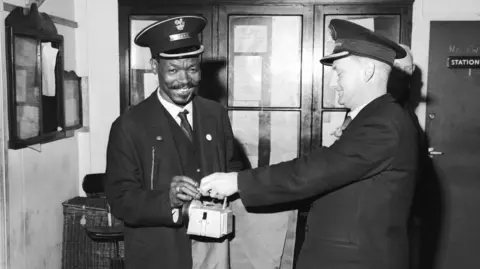
A month later, he became the first black railway guard to work out of Euston Station.
His story has since been commemorated at Euston and Chatham stations, and a train has been named in his honour.
 Getty Images
Howard Spencer, senior historian at English Heritage, said: "Asquith Xavier's story is a powerful reminder that ordinary people can have an extraordinary impact.
"He was not seeking to become a campaigner or public figure.
"His fight began with a simple desire for a fair opportunity to support his family, but it became a landmark moment in Britain's struggle against workplace discrimination."
Correction note: This article had previously incorrectly stated Xavier's birthplace as the Dominican Republic. It has now been amended to the island of Dominica.
Listen to the best of BBC Radio London on Sounds and follow BBC London on Facebook, X and Instagram. Send your story ideas to hello.bbclondon@bbc.co.uk