Date set for archaeology on 'Merlin's mound'

 Marlborough College/Pete Davies Photography
Work that includes archaeological investigations on a more than 4,000-year-old monument will begin in the summer of 2027, it has been confirmed.
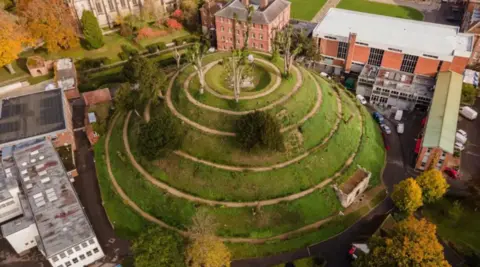
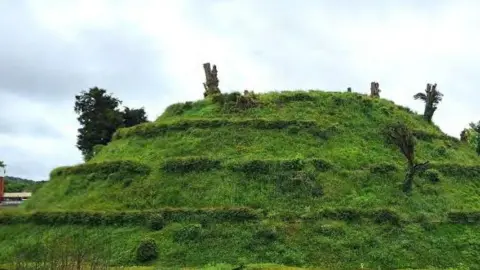
The 60ft (19m) Marlborough Mound, known in local legends in Wiltshire as being the burial place of the wizard Merlin, is in the grounds of Marlborough College.
The college has said it wants to remove some 20th Century structures built into the site, adding: "The demolition work and then the archaeology is planned to happen at the start of the school summer holidays 2027."
The project was previously delayed, but the college confirmed it was going ahead after suggestions on social media that it had been cancelled.
"The expectation is that any findings can be published in September,"a spokesperson added.
The mysterious mound dates from about 2,400 BC, making it comparable with monuments such as nearby Silbury Hill and West Kennett Longbarrow. It is also very close to Avebury.
It lies at the heart of one of Marlborough's most enduring legends.
The Merlin story is reflected in the town motto: "Where now lie the bones of the wise Merlin."
David Chandler, from the Marlborough History Society, explained: "It's on the borough coat of arms, the town coat of arms, the flag flies from the town hall on occasions."
He said many places across the West lay claim to connections with Merlin, and added he was pleased archaeologists will be investigating the mound.
 Marlborough College/Marlborough Mound Trust
Previous work suggested there was a relatively low chance of major remains surviving beneath the modern buildings.
However, archaeologists believe there is good potential to uncover evidence of medieval and post-medieval waterways.
The mount was once thought to be simply the remains of a later Norman castle.
Chandler said the keep of the 11th Century castle was put on top of the mound, but the mound itself is "definitely established" to be much older.
It later became part of the grounds of a Tudor mansion and then an aristocratic pleasure garden, complete with a spiral path and shell grotto.
Permission for the work was granted by Wiltshire Council in November 2025.
Rather than simply knocking down the buildings, they are due to be carefully dismantled with an archaeologist present, allowing experts to investigate the exposed section of the mound.
Additional reporting by Sophie Parker
Follow BBC Wiltshire on Facebook, X and Instagram. Send your story ideas to us on email or via WhatsApp on 0800 313 4630.