Farmers hope jabs can save herd from Bluetongue risk

 BBC
BBCThe owners of a dairy farm in Derbyshire have opted to vaccinate their herd against bluetongue virus, saying losing calves would be "heartbreaking".
While the disease is rarely fatal for cattle, it can cause cows to miscarry and reduce milk yields. Cases of the disease are on the rise in the UK, particularly in the South West of England.
Jessica White, who manages a 500-strong herd of dairy cows in Shottle, near Belper, said she and her husband Paul had opted to vaccinate their herd as an outbreak would be "unthinkable".
But vets have warned that supplies of the jab remain low and that some farmers may have to wait before their animals can be vaccinated.
Bluetongue disease is a virus spread by infected midges. The Department for Environment, Food & Rural Affairs said it expected any midges, which had been "newly infected" in the last few months, to "have the potential to have completed their extrinsic incubation period and become infectious".

Looking out over the 120 heifers in one of her fields, White, 26, rattles off facts about each cow. She knows how many times they have calved, their temperaments and how they might react if we move closer.
Her breeding cows are split into two "blocks". One block will calve in the spring, the other in the autumn.
"It means we have a lot of cows calving at one time. One of the main symptoms of bluetongue are miscarriages," she said.
"So if our cows were to experience that on a large scale, we could potentially lose a large proportion of our calves as well as a reduced milk yield."
The disease can also have a distressing effect on affected animals, such as discharge from the eyes and nose as well as swelling of the face and eyes.
 PA Media
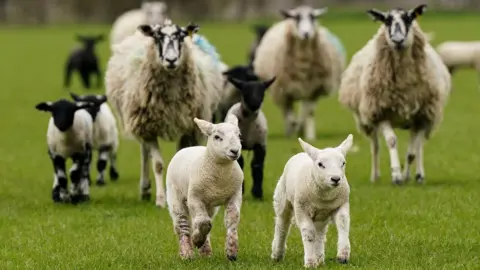
Vet David Anderson, from Derbyshire Farm Vets in Kirk Langley, said the effect on sheep could be much worse.
"Mortality rates can be horrendous, typically anywhere from 5% to 30% and up to 70% in some flocks," he said.
"The Netherlands had a major outbreak in 2024 and they lost 10% of their national sheep flock, which is an awful lot of animals."
He added that while farmers in the UK had started to vaccinate their animals (something he recommends), the demand for vaccines had outstripped supply and some vets have waiting lists for when supplies arrive.
Listen to BBC Radio Derby on Sounds and follow BBC Derby on Facebook, on X, or on Instagram. Send your story ideas to eastmidsnews@bbc.co.uk or via WhatsApp on 0808 100 2210.