Charity says action needed to help 'starving' sheep on remote islands

 Getty Images
A Scottish animal welfare charity says "meaningful action" is needed to protect a rare breed of sheep in the Outer Hebrides from starvation.
Soay and Boreray roam wild on St Kilda and are descended from animals first brought to the remote archipelago thousands of years ago.
There have been calls for their numbers to be controlled due to a lack of available grazing in winter.
Animal Concern, which is holding a public event in Glasgow next month to raise awareness of the sheep, said intervention was needed due to "recurring welfare concerns".
National Trust for Scotland (NTS), which owns St Kilda, said it was finalising its plans for the sheep following a management review.
Sophie Gaft, campaigns and outreach lead at Animal Concern, said much of the suffering experienced by the animals took place out of public view.
"We believe that this has contributed to the issue remaining largely outside the public consciousness, despite the serious and recurring welfare concerns raised by veterinary professionals," she said.
Speakers at the Glasgow event will include vets David Buckland and Graham Charlesworth.
They argue that the sheep are not native to St Kilda and have undergone thousands of years of domestication, so should be treated the same as sheep on farms.
They said their analysis of the St Kilda Soay Sheep Project's figures suggested more than 1,000 sheep, which included lambs, had died in some years.
They claimed yearly mortality rates on average were seldom lower than 400.
Gaft said: "Humans placed the sheep on these islands, and this raises the question of what responsibilities we have towards animals whose lives and circumstances are the result of human intervention."
NTS manages St Kilda as a Unesco World Heritage site.
A spokesperson for the charity said: "We are analysing and evaluating the recommendations from the Scottish Animal Welfare Commission to integrate them into our management review of the Soay and Boreray sheep on St Kilda.
"We intend to finalise our plans and make them public this year."
 Getty Images
Sheep were first brought to St Kilda in prehistoric times, and the rare breed is named after the archipelago's small, uninhabited island of Soay.
The animals are small and their fleeces have a wide range of colours and shades, including dark brown.
Sheep taken from Soay were raised as livestock on Hirta, the largest island, until the last inhabitants abandoned St Kilda in 1930, taking their animals with them.
In the years that followed, about 100 sheep were moved from Soay to Hirta.
Today there are more than 1,800 sheep on Hirta, according to the latest figures of the University of Edinburgh's St Kilda Soay Sheep Project.
The project has been gathering data since 1985.
St Kilda's flock was protected by the Wild Mammals (Protection) Act 1996, the same protection given to Scotland's wild deer population.
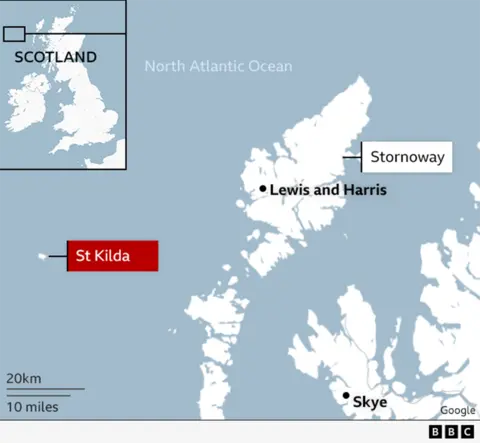
St Kilda is more than 40 miles (64km) west of the Western Isles.
Hirta is inhabited but only on a temporary basis by visiting NTS workers, scientists and also contractors who work at small Ministry of Defence site.