Snake undergoes 'world-first' human cancer therapy

 Chester Zoo
A snake named after the Hollywood star Jodie Foster has made a full recovery after receiving cancer treatment normally used in humans.
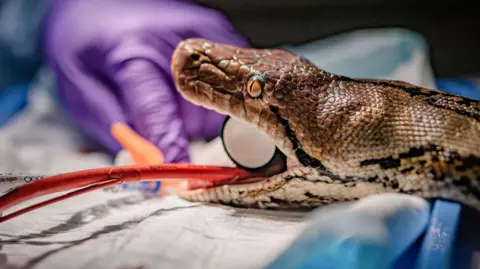
The 4m (15ft) reticulated python, who lives at Chester Zoo, was given electrochemotherapy after a cancerous tumour was discovered in its jawbone.
The reptile is believed to be the first snake in the world to receive this kind of treatment, according to the veterinary team at Chester Zoo.
Working alongside specialists at the University of Liverpool, the team adapted the treatment for the snake.
Zoo keepers first became concerned when the snake began eating less and spending more time inactive.
Tests confirmed the reptile had a fibrosarcoma - a malignant tumour - in the jaw.
Although vets initially removed the tumour, it later returned.
Ian Ashpole, veterinary officer at Chester Zoo, said: "When the tumour came back and started destroying part of her jawbone, we knew more surgery on its own probably wasn't going to be enough.
"We were facing the possibility of losing her as the tumour made it more and more difficult for her to eat, so we worked with cancer specialists to see whether we could adapt electrochemotherapy for a snake.
"As far as we're aware, this is the first time it's ever been used in one."
 Chester Zoo
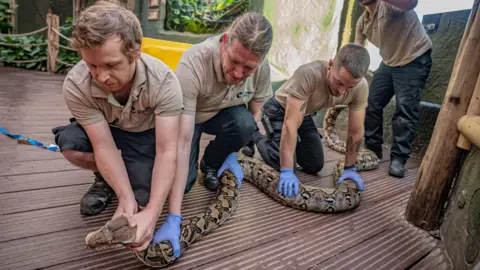
With no operating table built for the python's size, keepers and vets said they had to improvise by connecting two operating tables together.
"We used heated blankets and warmed air to keep her body temperature stable throughout the operation, and after 90 minutes of surgery, she recovered remarkably quickly," said Ashpole.
He removed the tumour and part of the diseased jawbone, but the electrochemotherapy was administered to target any remaining cancerous cells.
 Chester Zoo
Jose Alvarez Picornell, from the University of Liverpool, said the success of the treatment was "a testament to the power of collaboration".
"We will be formally publishing details of the procedure so that veterinary colleagues around the world can learn from and build upon our approach," he said.
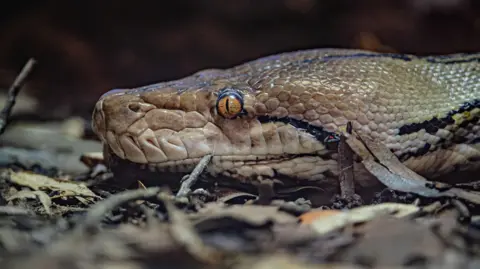
Staff at Chester Zoo said seeing the snake "back to her normal bright and feisty self has been incredibly rewarding".
"A few months ago, we genuinely didn't know whether she'd survive," said Ashpole.
"Now she's eating normally, exploring her habitat and behaving exactly as we'd hope."
Read more stories from Cheshire on the BBC, watch BBC North West Tonight on BBC iPlayer and follow BBC North West on X. You can also send story ideas via Whatsapp to 0808 100 2230.