Activists' bank attack 'not terrorism-linked' - judge

 BBC
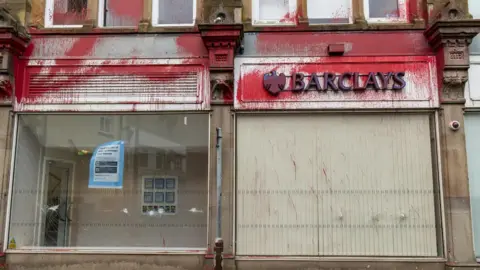
BBCAn attack on a Barclays Bank by five people from the Palestine Action group will not be treated as terrorism when they are sentenced, a judge has ruled.
The five smiled with relief and were hugged and cheered by supporters as the ruling was given at Preston Crown Court earlier.
It means all five will still be sentenced next month for criminal damage in the attack on the bank in Burnley, costing £200,000.
But Judge Robert Altham, the Recorder of Preston, ruled section 69 of the Sentencing Act, establishing a terror link to the criminal damage offence, did not apply – so the defendants will face lesser sentences when they are dealt with.
At the time of the offences Palestine Action had not yet been proscribed as a terrorist organisation and it was not illegal to be a member of or support the pressure group.
The group claimed it had targeted Barclays over the bank's links to a company called Elbit, which it said had sold military components to Israel which were used in the conflict in Gaza.
Brendon O'Hagan, 28, Amanda Kelly, 31, Hmeera Atiqnisar, 31, Mohammed Malik, 28, and Alma Yaniv, 70, said they had no idea their case could be treated as terrorism until after they were found guilty in June.
They are due to be sentenced on 4 September at Preston Crown Court.
 Handout
Judge Altham said while the damage was substantial, it was not of the size of other attacks or on a sensitive property, such as an arms firm, as has happened during previous Palestine Action action.
He said: "For section 69 to apply the damage must amount to serious damage.
"The threshold is a high one, the quality of the act must also be considered.
"I agree the monetary value is not the only factor.
"The nature and sensitivity of the property damaged is also relevant.
"Whilst the damage is undoubtedly significant, I'm not satisfied it amounts to serious damage for the purposes of the Terrorism Act.
"Section 69 does not apply in this case."
About 100 supporters, many waving the red, white, black and green flag of Palestine, cheered and banged drums on the steps outside as the defendants left court.
'Draconian sentences'
The group targeted the Barclays branch on St James's Street in Burnley on 5 August 2024.
They claimed the 02:00 BST attack was designed to pressure Barclays into withdrawing financial support for weapons manufacturer Elbit Systems.
Palestine Action was proscribed as a terrorist organisation in July 2025 and has been behind a string of direct action protests targeting Elbit.
In May this year, a judge at Woolwich Crown Court ruled Palestine Action activists who caused £1.2m of damage in a raid on Elbit's factory near Bristol should be sentenced as terrorists.
All the defendants in the Barclays trial, apart from Yaniv, were either closely linked to Palestine Action or full members, they had attended a training session on direct action and the attack on the bank was part of a wider campaign by the group to exert pressure over its financial ties to Elbit.
They were masked and armed with hammers, filming their actions to be distributed publicly and caused damage valued at £212,805.14.
If sentenced as terrorists, the five would have faced longer jail terms, lost the right to automatic early release and spent an extended period on licence and subject to police monitoring.
Earlier, Pete Weatherby KC, representing O'Hagan, said if the defendants were to be sentenced as terrorists, it would "lead to draconian sentences with dire consequences".
Weatherby said what they had done: breaking windows "in the dead of night" with a hammer, daubing slogans with paint, dropping leaflets about Palestine at the scene, was "very far from terrorism", adding: "Ordinary criminal law is sufficient to cover such convictions."
He added: "The political motivation was to do with what the defendants consider, and many agree with them, the genocide in Gaza."
Listen to the best of BBC Radio Lancashire on Sounds and follow BBC Lancashire on Facebook, X and Instagram. You can also send story ideas via Whatsapp to 0808 100 2230.