Walking in the footsteps of the Vikings

 BBC
BBCA legend surrounding Byard's Leap claims it takes its name from a horse that leapt 60ft during a fight between a knight and a witch.
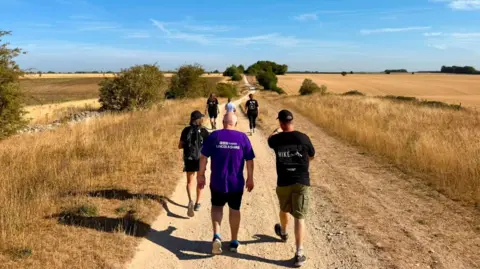
But today there are only a couple of hares scampering across a field under a beautiful, big blue sky.
It is the starting point for a trek between "the leap and the steep" - Byard's Leap, near Cranwell, and Steep Hill in Lincoln, which is about 15 miles (24km) away.
We're following the Viking Way, a 149-mile path from Rutland to the Humber Estuary which is celebrating its 50th birthday this year.
To mark the anniversary, BBC Radio Lincolnshire is celebrating the people and places we find along the route.
We're met here by members of Lincoln Hike Club, a group founded to bring the community together with a walk and a chat.
Incredibly, the members say their hikes have attracted 1,700 people over the past five months.
"It's just a great community," says Ishka Beard. "I think the thing about Lincoln Hike Club is there is something for everybody.
"Whether it's a three-mile walk around the park, whether it's a 10-mile walk... we've got the Peak District walks, 20 miles, things like that.
"And tonight we're launching abroad as well. So from next year, there's going to be the chance to do Kilimanjaro, the Sahara Desert, loads of exciting adventures.
"I think there is honestly something for everyone, whether you just want a short walk or an absolutely life-changing experience."
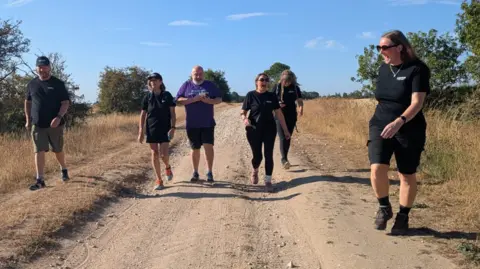
The members are kitted out in stylish T-shirts and caps, which are given out to people who do their regular "big hikes".
It creates a vibe not dissimilar to that of a motorcycle club.
"Basically, you pay to go on the big hike," says fellow member Eliza. "And then you get a T-shirt which shows you've done the walk. It's got the details of it, how far it is... people are collecting them.
"And it's great because you'll feel like you're part of something and you've got a bit of a memento."
About halfway up today's route, near Wellingore, is an old concrete structure with tiny little windows.
Norman Gosbee, a countryside access volunteer, points out another.
"They're from the war and they used to have people in there with machine guns," he says.
It is not only World War Two pillboxes that can be found here: the route follows Ermine Street, the old Roman road that ran from London through Lincoln up to York.
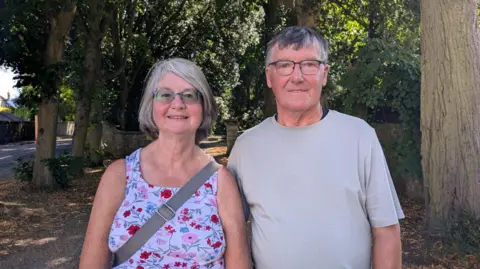
Paths such as the Viking Way do not maintain themselves. Instead, it is the likes of Norman and his wife Karen who do so.
The "patch" of footpaths they look after is actually closer to Sleaford, but they have met us here to explain the work of the volunteers.
Norman says: "If there's any growth we remove it, any signs of damage we report it, any bridges unsafe we report [them, as well as] signs and all sorts of things like that."
Karen adds: "We do it because it gets us out [and] keeps us fit and healthy out in the sunshine – well, in all weathers, really.
"It is very rewarding because you get to know your local area more, or even a little bit further afield, and meet other people as well."

On the outskirts of Lincoln is a spot known as the city's "secret orchard".
It is just off the Viking Way, at Cross O'Cliff, and is open to the public all year round.
"It's quite peaceful here as we're surrounded by old fruit trees and the buzz of pollinators," says Hattie Winspear, who works in woodland creation at Lincolnshire County Council.
"The orchard itself has been here for around 150 years. It was abandoned for almost 50 years and then rescued in 1995, and that included careful pruning of old trees and planting of new fruit trees, mostly led by volunteers."
Today, the orchard is an ideal spot for people to come and relax for a few hours.
"They can bring a picnic, and then in the autumn they can come and pick fruit," says Hattie.
"Through the winter, they can come and get involved with the volunteers who do the pruning of the trees."
Families are not the only regularly spotted visitors.
"There's lots of wildlife here that's supported by the orchard, including birds like great spotted woodpeckers [and] sparrowhawks, and then butterflies, like orange tip and small tortoise shell," she says.
"It's just a really peaceful place to come to and escape the stress of day-to-day life."
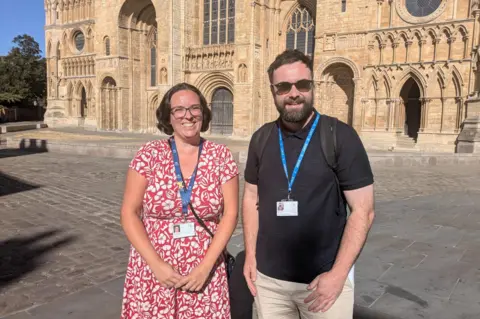
Today's route ends at Lincoln Cathedral. As ever, it is an awe-inspiring sight.
"The second you walk through the door, you feel uplifted. You get to see such a beautiful building," says Fern Dawson, the cathedral's curator.
Appropriately for a point on the Viking Way, the cathedral has many associations with Nordic nations.
"The patron saint of Iceland actually came here to the cathedral in 1153. He came because we were quite a centre of learning," says Fern.
Another connection comes in the "wave" shape of the Trondheim Piers – medieval, gothic pillars that match those found in Nidaros Cathedral in Trondheim, Norway.
"We still welcome the choir each year from Trondheim," Fern says.
"And then we're right near key and significant Viking spaces," she adds, pointing to roads such as Bailgate.
"We're surrounded by Viking history."
Listen to highlights from Lincolnshire on BBC Sounds, and watch the latest episode of Look North.
Download the BBC News app from the App Store for iPhone and iPad or Google Play for Android devices