'Don't ask me to print your ChatGPT birthday card': Hitting back at AI 'slop'

 Getty Images
When they first started appearing, it was hard to tell where they were coming from, these posters, flyers and food menus that all looked like they had rolled off the same industrial printing press.
Belfast was awash with them during Fleadh Cheoil na hÉireann this month, but by that time most people had them sussed out.
"More AI," they sighed, glancing at a caricatured guitarist on a gig poster or an abnormally glistening burger on a menu.
There were even several images of Ed Sheeran appearing to be making his way around the city.
Artificial Intelligence (AI) has become part of our everyday lives, and has proven useful for businesses who want to produce promotional material quickly and at little-to-no cost.
But there is a growing backlash from creatives and venue owners, who say 'AI slop' is artistically empty and putting real artists' jobs at risk.
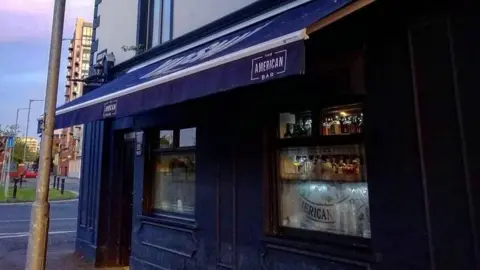
The American Bar in Belfast became one of the first businesses in Northern Ireland to declare itself an AI-free zone, and other bars and restaurants have since ridden in behind.
And the backlash is happening in other places too.
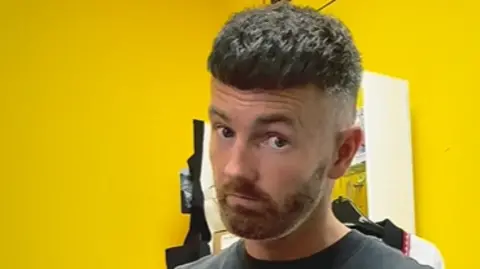
Chris Ferry, who makes greeting cards that specialise in the famous Londonderry sense of humour, doesn't think there is much to joke about when it comes to AI.
In a recent video that attracted thousands of engagements online, he warned customers not to "be coming to me asking me to print a birthday card you've made on ChatGPT ever again".
"It's an insult to me, it's an insult to everybody in the creative industry, and it's an insult to the hard work I've put in here," he said.
'People don't seem to get it'
 Social media
Artists of all kinds have reported feeling threatened and cheated by AI.
But Ferry thinks the public don't appreciate that AI-generated imagery risks making graphic designers redundant "the same way AI music disadvantages musicians".
"It's exactly the same but people don't seem to get it," he said.
Recently people have visited his shop and asked him to print designs they created using AI, which he said demonstrates a dissonance around how AI is impacting graphic designers like him.
"I'm very proud and passionate about what I do. I'm a designer, not a print shop, so you come in with a scenario and I'll turn it into a design, and that's why our business works, because we're very different."
Ferry said these instances "really annoyed" him but that he didn't blame the customers.
"It's everywhere, it's convenient, and people just aren't thinking of the repercussions for people like me, so I don't hold it against them.
"The customers who brought in the AI stuff offered to pay but I declined and explained why. It's the principle."
He is "worried about the potential long-term consequences" AI might have on business but he said hopes "the very specific nature of the Derry sense of humour" and "the fact people want stuff made by real people" will future-proof Ferry Clever.
'It's regurgitative and soulless'
 Inbetween Days Photography
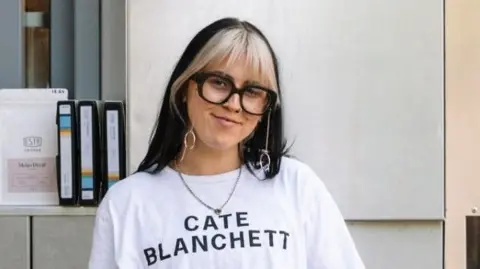
Frances Smyth is a freelance graphic designer who said AI is weighing heavy on her mind too.
When she graduated in 2021 "AI wasn't very present" in her degree.
Now a part-time lecturer at Ulster University and somebody whose job has been affected by the pivot to AI within the creative industry, Smyth said she contemplates the rapidly growing technology a lot.
"Students aren't necessarily encouraged to use it but everybody who is creative has to think about it, because it's so prominent in our industries now."
Many creative agencies, she said, are haemorrhaging clients, as businesses turn to AI to reduce marketing costs.
"As soon as savings is mentioned now, one of the first things businesses think is, 'Could we can use ChatGPT to do that?'
"Often the answer is, 'Yeah, sure'. But the problem is that ChatGPT doesn't do as good a job as an actual artist would. It can't replicate like that authentic artistic expression."
She said AI can be "used for a quick turnaround" but is "regurgitative and soulless".
"Even bad art is better than AI slop. I'd much rather see like a gig poster or a menu done on a post-it note than I would to see it put into ChatGPT.
"Like, I honestly would. It has so much more integrity."
'Death to the technocracy'
 Social media
Some venues have recently taken "a principled stance" against the use of AI on their premises, including Mandela Hall, located inside Queen's University Student's Union.
This month, the American Bar in Belfast said it "made the decision to boycott the use of AI" in the pub and on social media.
This included all AI-made artistic material, from music to gig posters.
They said "it constitutes a very real threat to the livelihood of artists" and that the "detriment that AI use has on the environment is well documented".
Speaking to BBC NI, co-owner Tomas Gorman said he believed AI is "a deeply damaging technology, particularly for our local artists and those working in the creative industries".
Co-owner Peter McCloskey added: that "even a shoddily made poster cobbled together by the most inexperienced and computer shy of designers holds within it infinitely more creative value and interesting perspective" than AI.
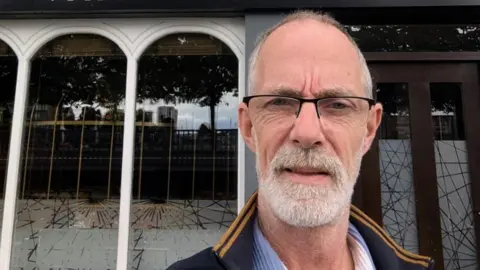
Like many businesses during the Fleadh, Mal Houston from Three Rivers Restaurant used AI posters to highlight entertainment offerings and food deals.
Then somebody put a sticker on a few of his flyers, reading: "Say no to AI."
"I don't know who had time to do that during the fleadh, but it did make me think."
Houston recently announced that his restaurant and nightclub would no longer be using AI-generated art, "even if it does save a few shillings".
"Hospitality is going through a tough time at the minute, so AI can be convenient and cheap if you need a flyer or menu made up.
"But the other side of that is that it is putting graphic designers out of jobs.
"And just like the hospitality industry is struggling because of challenges we're facing, they're struggling because of AI.
"And that's not fair. These are creative people who've paid to develop their talents at university and because of AI the work just isn't there."
So, while AI remains in its ascendancy and continues to proliferate, a small local - and global - backlash has begun.
And Frances Smyth believes the fight against it is there to be won or lost by each individual.
"People have a sense that the march of AI is inexorable, like we need to embrace it and like it's going to happen anyway.
"But it's not inevitable. Like just I've disabled as much as possible on all my devices and I'm saying no.
"You can do that - say no. We don't need that slop in our lives."