New aerial shots show size of devastating wildfire

 National Trust/John Miller
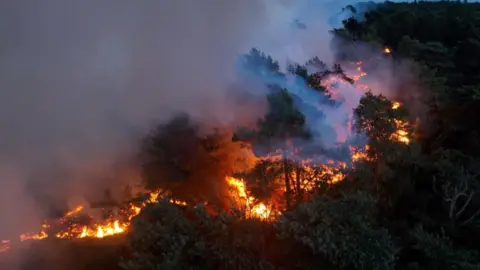
New aerial images have been released which show the devastating impact of a wildfire.
It is three months since a blaze ravaged Dunwich Heath in Suffolk, which the National Trust has warned faces "a long recovery".
More than 104 hectares (257 acres) of heathland were destroyed, and recent monitoring has shown "significant impacts" on the health of the soil.
"The destruction has been so complete that [although] we will see some early regrowth, a full recovery is likely to take decades," said the trust's Russell Clement.
He added: "This is the beginning of a very long journey, but after three challenging months, we are looking to the future with hope."
 Ryan Lovejoy
Clement, the charity's general manager for Suffolk and Essex Coast, thanked the public after thousands of people donated to an emergency fundraiser.
More than £500,000 is being used to fund two years of repair and recovery work at the heath, which is not expected to fully reopen for "many months".
Since August, teams have been monitoring cliff stability and burn severity, and testing soil, water, and ash.
Some areas of soil lost 82% of their organic matter, making it harder to store water and more vulnerable to drought, the trust said.
Clement added: "The intensity of the blaze was absolutely astounding".
"It's not only things above the ground that have burned: tree roots have burned down to a metre below ground level.
"What that means is the entire seed bank and topsoil has been sterilised and lost," he said.
 National Trust/Bluesky UAV Specialists
Experts have also inspected "badly burned" trees which were left standing.
The trust's coast and countryside manager, Matt Wilson, said: "We don't yet know the full impact on the trees."
"Some were felled while the fire was burning, to help with access, but many of those still standing will have been weakened and may not survive the winter storms.
"We need to make sure the site is safe for visitors," he added.
The charity, which owns and manages Dunwich Heath, said it hoped to "retain as many trees as possible" but "any found to be a risk will need to be removed".
As well as the trees, unstable terrain, high ground temperatures and dust pollution are also concerns.
"Even for us that know the site really well - it's really difficult to navigate.
"Most of those visual markers, and the places that people think they know, do not look the same currently," said Wilson.
 National Trust/Bluesky UAV Specialists
Clement said they were seeing "really positive signs for wildlife".
"One thing we can be grateful for is we didn't find a lot of animal remains, so we know that most of the fauna will have escaped the blaze."
Large parts of RSPB Minsmere were also damaged during the wildfire. How it started is still not known.
Wilson added: "The biggest worry for me is the loss of vegetation and that organic layer on the soil.
"There is nothing here for the wildlife that would normally call it home to return to."
He said they were "seeing some signs of recovery", but it was on a "very, very small scale".
 Alex Dunlop/BBC
For Wilson and his colleagues, the sense of loss is immense.
"Growing up, I came here as a child. My children came here on family holidays.
"It's always been part and parcel of my life, even before working for the National Trust.
"My heart drops every time I drive in through the entrance," he said.
Clement agrees.
"It was a horrific, emotional experience for everyone involved. I have some volunteers and staff who've worked literally 20 to 30 years in this landscape."
Now they are focusing all their efforts on slowly restoring that landscape.
"There are things we can do, and nature often has the solution.
"It's making it wetter where we can, improving the mosaic, looking at the diversity of the species," he said.
"We will make the landscape more resilient and better able to adapt to the new climate that it's finding itself in," he added.
Do you have a story suggestion for Suffolk? Contact us below.
Follow Suffolk news on BBC Sounds, Facebook, Instagram and X.