X-ray verifies taxidermy as extinct Tasmanian Tiger

 Supplied
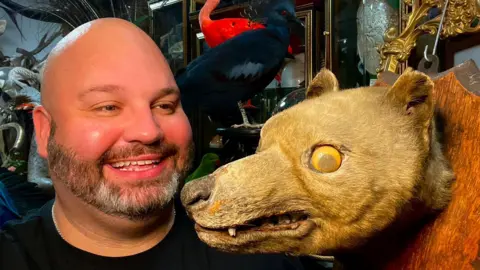
A mounted head of an animal that was bought at auction has been officially verified as an extinct Tasmanian Tiger specimen.
James Cranfield, a natural history collector from Leigh-on-Sea, Essex, spent £62,600 buying the taxidermy earlier this month from Auctioneum, in Bristol.
On Sunday, the 38-year-old heard from the International Thylacine Specimen Database that X-ray images had verified it was the head of a rare thylacine, a creature sometimes referred to as a Tasmanian Tiger.
"To be vindicated in everything that I said is amazing and also surreal. It's like a dream. It's like a movie. You couldn't write this," he said.
"It is continually overwhelming. I'm in disbelief in this surreal moment in my life," he added.
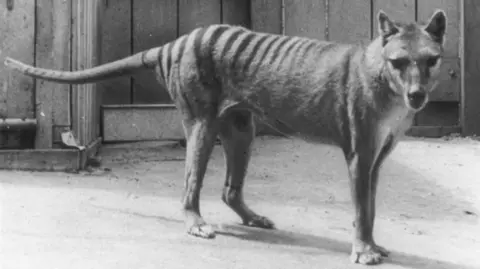
The thylacine was a carnivorous marsupial with dog-like traits that was native to New Guinea, Australia and Tasmania.
Most died out about 2,000 years ago but a population continued on Tasmania into the 20th Century before hunting, disease and habitat destruction drove it to extinction.
 Getty Images
Cranfield said he had been bidding against someone else who also believed the lot was more than an antique fox head, which was how the auctioneer labelled the item when it went up for sale for £50.
He said: "The only reason they stopped [bidding] is because they had a 0.01% niggling doubt that it wasn't.
"I turned to them in the car park after the auction and I said, 'Well, it's a good thing I'm 100%'. I've been 100% the moment I laid eyes on it in person."
Yet despite being "certain" he was right, news coverage did make him worry he had got it wrong.
"I would never be able to face the public again," he said, "my reputation would have been down the drain."
Cranfield said he hopes to get help extracting DNA to learn more about the species.
Remarkable find
The item will be loaned to museums and kept in the public eye, and eventually displayed at Cranfield's Curiosity Cabinet in Southend-on-Sea, Essex, Cranfield said.
The International Thylacine Specimen Database holds a catalogue of all known specimens.
Project director Dr Stephen Sleightholme said confirming the species via radiographic examination was "relatively straightforward".
He said: "Although it is unfortunate that the specimen is entirely lacking in provenance, it is nevertheless a remarkable find... being only the second known example of a mounted head."
He commended Cranfield for "recognising its significance and bringing it to attention".
Do you have a story suggestion for Essex? Contact us below.
Follow Essex news on BBC Sounds, Facebook, Instagram and X.