How the police track down missing people

 BBC
BBCTens of thousands of people go missing across the UK every year, with Thames Valley Police alone dealing with about 16,000 cases.
The force receives approximately 10,000 missing person reports and a further 6,000 missing-related incidents that do not meet the threshold for a full investigation.
On any given day, between 10 and 30 people are listed as missing across the force area. The reasons can be varied but, in each case recorded, an investigation will be launched to help find that person and ensure their safety.
The BBC has been speaking with the force's Missing Investigation Support Team (MIST) about the work that goes into tracking these people across Berkshire, Buckinghamshire and Oxfordshire.
Why do people go missing?
 Getty Images
A number of those who go missing each year are identified by Thames Valley Police (TVP) as "repeat missing people".
"It probably falls slightly more heavily towards children," says MIST acting supervisor Sam Childerley: "Especially children in care who go missing from placements.
"But we do have vulnerable adults who are repeat missing too, especially those with dementia and similar vulnerabilities."
He says while every case is different, there is typically an underlying theme of mental health or vulnerability.
"People may go missing because they're overwhelmed, unable to cope, wanting to escape stress, trauma, abuse, pressure, anxiety… a whole host of reasons," he says.
The force draws a distinction between those pushed away from home and those pulled away.
"A good example is the exploitation of children," says Childerley. "There's a pull factor... the exploiter is pulling them out, making them feel appreciated.
"Whereas you might have another missing person with domestic abuse in the household, which is pushing them out, meaning they don't want to be there. Identifying that early is key."
A criminal element is relatively rare, he says.
When a missing person is found, the team speaks with them to help identify what happened and make sure they get the right support. That can mean a referral to social care or mental health services.
Behind the scenes
 Getty Images
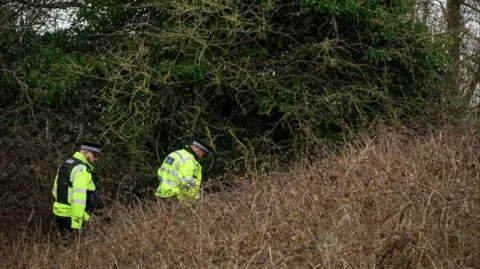
When a missing person is reported, the case is initially handled by the local police response team.
They do the work on the ground, conducting house-to-house inquiries and speaking directly with relatives.
As soon as it is recorded, the case is flagged to MIST, a team of police staff who work alongside officers on the ground.
There are, according to Childerley, more than 100 different types of inquiry the team are able to conduct.
"We do hospital checks, ambulance checks. We get information from GPs, adult social care, whoever it may be. For international cases, we liaise with Interpol, who go and complete inquiries for us."
The team also has full access to police systems and can access information like places people frequent and known associates.
Social media also plays a role, says Childerley, adding: "The technology missing people use is ever-changing, so we have to be adaptable."
But public appeals remain one of the most effective tools available, he says, particularly for more vulnerable missing people.
"If you've got that 80-year-old with dementia that's left the care placement, the likelihood is they've probably been seen by a member of the public."
The 'golden hour'
 Sam Childerley
Teams searching for missing people use a principle known as the "golden hour" - the initial minutes and hours after someone's disappearance.
"If you know that person's pattern, say they always go to a particular shop, that's where fast-time inquiries immediately after they're reported can make the difference," says the supervisor.
"If that window is missed, the person may already have moved on."
Anyone can report someone missing, it does not have to be a relative, and there is no minimum time a person must be missing before police will act.
"That idea from American films, that you have to wait 24 hours before police can search, that can actually be really dangerous," he says.
While most people are found within a day or two, a small number remain missing for years, with some remaining on the team's board for several decades - staying open until a location of some form is identified.
Childerley says these long-term cases are permanently taken on by his team once local officers have exhausted their inquiries.
The team then builds a relationship with the family. That could be a monthly phone call or a no-contact agreement unless there is news.
The weight of not knowing
 Getty Images
Childerley recalls a case involving a young man who had stopped contacting his family while travelling.
Weeks went by with no word and his family grew increasingly concerned.
Eventually, the team made contact and confirmed he was safe.
"He said, 'look, I'm just living my life'," says Childerley. "It was not the same as bringing him home but it was enough.
"I can't even begin to explain the levels of appreciation that they had. It consumes their world... and, for them, having that bit of information, to know that someone's OK, you can just feel the weight coming off their shoulders."
The hardest cases are often the ones stuck in limbo, he says.
"If someone passes away, you'll see grief for them but, when they're missing, you have that void and that unknown."
It also has a lingering effect on those working the cases.
"I try my best to detach from work... go to the gym, go on a walk, do something as a complete cut-off," says Childerley.
"I think if you didn't, it would just completely consume you and you'd burn out."
One of the biggest misconceptions is that a large number of missing persons cases remain unsolved, says Childerley.
He says that is partially linked to high-profile cases that dominate public attention but the "majority" do get resolved".
Another false belief is the idea that a single investigator carries out a missing person investigation alone.
"It's a hugely joined-up effort, not just from policing but from partnership agencies too," says Childerley.
"It's not just down to one detective, like a lot of these TV programmes go off and show."