Andrew Scott feels the Pressure as 'unsung hero' in WW2 thriller

 Alex Bailey/Focus Features/StudioCanal
Andrew Scott says he loved the challenge of his latest acting role in the film Pressure, as the meteorologist key to the success of World War Two's D-Day - the largest seaborne invasion in history.
“Group Captain James Stagg may not have been the most charming person, but I think he had a huge amount of humility in the face of nature. And that's one of the themes I think of the film," Scott tells the BBC.
"He appeared to me to be an extraordinarily interesting cinematic character, as well as an unsung hero from history."
Stagg played a crucial advisory role when US General Dwight D Eisenhower invaded Normandy, laying the foundations for the Allied victory in World War Two.
"It was a wonderful part to play," he says, while painting a mixed picture of Stagg, calling him "very chilly", while also "forthright, direct, obsessed with weather - and not afraid to speak truth to power".
 Met Office National Meteorological Library & Archive
Stagg isn't a traditional war hero, something Scott clearly relished sinking his acting teeth into.
"I really enjoyed the way that Stagg was not interested in ingratiating himself with anybody," he told BBC Culture correspondent David Sillito, calling him "a real fish out of water in this situation".
The actor's other starring roles couldn't be more different, including romantic fantasy film All of Us Strangers, for which he was nominated for a Golden Globe, plus his memorable "hot priest" in TV's Fleabag and the menacing Jim Moriarty in Sherlock, for which he won a Bafta. His award-winning stage roles include Vanya and Present Laughter.
In Pressure, Stagg is thrown into a high-stakes furnace of egos. He has to work with a team of meteorologists who robustly and publicly disagree with each other.
Stagg "wasn't a particularly garrulous character" Scott says, which is partly why he was perhaps an unlikely hero.
"So many of the heroes in our own lives don't have that big swashbuckling moment," he says.
"And you know, a hero comes in all different shapes and sizes.
"I tried not to be afraid of the fact that perhaps, at the beginning, the audience might be like, 'Who is this guy?' And hopefully by the end we understand his motivations and his inner workings."
 Alex Bailey/StudioCanal SAS
The actor is speaking to the BBC on board HMS Belfast, which led the opening bombardment for the D-Day landings, when tens of thousands of troops from the UK, the US, Canada and France attacked German forces on the coast of northern France on 6 June 1944.
"The stakes were so enormously high... they were all locked down, and they couldn't leave the place. Stagg's wife was very heavily pregnant at the time, so it was a very, very difficult time for him," Scott explains.
"It's completely unimaginable, the pressure that they would have been under, not just Stagg, but everybody in the building."
This of course explains the name of the film, which is based on the successful 2014 stage play by actor and writer David Haig.
 Getty Images
The film also charts how Eisenhower had the good sense to pay heed to the experts around him.
Scott says although the film is about many things, it's chiefly about "the humility of leadership, and about the difference between power and expertise".
"Real experts have the humility to go, 'I don't know about that, but I am in a position of power, so I'm going to delegate this, and I'm gonna listen to what this person has to say'," he says.
The film's co-writer and director, Anthony Maras, employed his own weather experts for the film, including Martin Young, a former deputy chief of the UK's Met [Meteorology] Office, who'd spent 40 years studying the weather and more than 10 as its chief forecaster.
Young's long career also meant he had first-hand knowledge of processes, data and equipment Stagg would have used.
 Getty Images
The film is nearly all set in the planning rooms for D-Day, and you see all of them working around the clock, while living on top of each other.
"There's a huge amount of wit in the film that I really enjoyed," Scott says, while adding: "I love films that are about work.
"These relationships are no less significant because they're work relationships, they're collegiate.
"And at the end of these extraordinary three days they shake hands with each other - he's not a hugger, that probably wasn't part of the culture then.
"But they nevertheless went through something absolutely enormous together, and they had enormous feelings towards each other - whether that was rage, admiration, intimidation or connection."
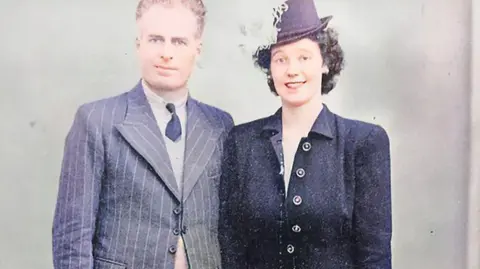 Sweeney family
Scott also managed to use some previous experience of working on a film about D-Day to help with his performance.
"I've been very lucky. As a young actor, I was in the opening sequence of Saving Private Ryan [Steven Spielberg's Oscar-winning film which depicts the horror, fear and brutality facing troops landing at Normandy].
"I was there for that as a 19-year-old on the beach. So, of course, I have no sense of what the horrorism would have been like as a reality, but I certainly had an idea of how it would have looked visually because he stretched the camera for as long as the eye could see."
 Getty Images
Scott is delighted that Pressure pays tribute not only to Stagg, but also references another unsung hero, Maureen Sweeney, who lived in Ireland and was the first to confirm any break in the weather, from her lighthouse in County Mayo.
"It's another story in itself actually," Scott adds.
"A big part of my family are from around those parts. So that was wonderful," the Irish actor adds.
Scott ends by saying why he was so drawn to the film, and Stagg in particular.
"I think there's something just very moving about a singular passion someone might get.
"Their imagination might get captured by the weather as a young man, and if you apply yourself to something and you become excellent at something, it serves a place in the world and serves a place in humanity.
"He quietly went back to his life and it's wonderful that we can pay tribute to him in this way all these years later. He's a movie hero."
Pressure is in UK and Irish cinemas from 9 September.
You can watch Andrew Scott talking about his role to BBC News here on YouTube.