'Light at the end of the tunnel' or 'halfway there' - NI businesses on new Brexit deal

 BBC
Businesses in Northern Ireland have broadly welcomed a new UK-EU trade deal that aims to make it easier to bring in goods from Great Britain.
The agreement, reached in Brussels on Friday, will remove routine checks and health certificates for most food and plants moving across the Irish Sea.
Retailers and wholesalers said the changes could cut costs, speed up deliveries and make it easier to source products from suppliers in Great Britain.
Retail NI, which represents independent retailers and wholesalers, said the deal could cut paperwork, costs and delays for businesses bringing in goods from Great Britain.
Its chief executive Glyn Roberts described the agreement as a "welcome light at the end of the tunnel" for retailers who had faced "significant challenges" sourcing and receiving products from GB suppliers.
 PA Media
Northern Ireland Chamber of Commerce chief executive Suzanne Wylie said fewer checks and certificates "should mean lower costs and less paperwork" for businesses.
She said the changes could also benefit consumers, as delays and costs in supply chains could affect what was available on shelves and how much it cost.
Wylie welcomed progress on linking UK and EU emissions trading schemes and commitments on steel trade, but said businesses needed to see how the new arrangements would work in practice.
'Tentatively happy'

Andrew Lynas, a director of Lynas Foodservice, told BBC News NI he was "tentatively happy" with the agreement and said it could speed up deliveries and make it easier to buy from suppliers in Great Britain again.
But he said the deal would only address some of the problems facing businesses that operate on both sides of the Irish border.
He also raised concerns about how long it would take to come into force.
"I would say it's gone halfway to what we would love to happen," he said.
Lynas said the red and green lane system and the requirement to pay duty upfront on many goods remained concerns. He added that businesses which had changed how they sourced products would need time to rebuild relationships with suppliers.
"We have rerouted a lot of our goods, so we have to re-engage with our GB suppliers and see can we do business again," he said.
'Major step forward'
Federation of Small Businesses (FSB) national chair Tina McKenzie called the agreement a "major step forward" and urged the government to bring forward the legislation needed to put it into practice.
The FSB said 63% of small firms trading with the EU had faced significant barriers.
Of those moving goods across the border, 64% had struggled with customs paperwork and one in five had faced problems with physical inspections.
McKenzie said delays could hold up entire shipments or leave businesses with stock they could no longer sell. She called for clear guidance before the new rules take effect.
"The test now is whether these agreements deliver real changes for small firms, not more paperwork."
What has been the political reaction to the deal?
 Reuters
Northern Ireland Secretary Sir Chris Bryant said the changes for food products would be "completely transformational".
Speaking during a visit to a florist on Belfast's Ormeau Road, he said the deal would make it easier to bring in flowers and plants and allow people to order seeds from Great Britain by post.
"Up until now, it's been almost impossible to get seeds sent from GB to Northern Ireland. That will be possible now," he said.
Bryant added that cutting paperwork should help ease pressure on prices.
Stormont's agriculture minister, Andrew Muir, said: "Whilst this will not fix everything, it's a massive step in the right direction."
The Alliance Party MLA added: "There will be huge benefits for all of us in Northern Ireland from reduced trade barriers and less checks on goods moving between GB to Northern Ireland.
"This will mean lower administrative hurdles and costs for businesses and government, as well as making it easier for retails to put produce on our shelves."
Economy Minister and Sinn Féin MLA, Caoimhe Archibald, told BBC Radio Ulster's Good Morning Ulster the agreement was "moving in the right direction".
She welcomed the prospect of fewer barriers for businesses and said the need to remove them showed what an "unmitigated disaster" Brexit had been.
 PA Media
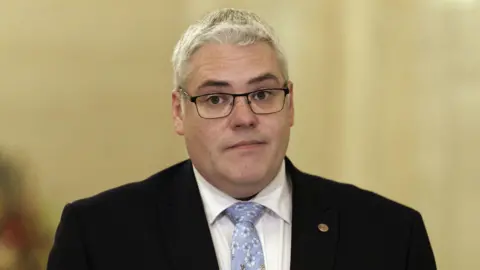
DUP leader Gavin Robinson said "reducing barriers is not the same as removing them" and called for the inspection facilities at Larne, Belfast and Warrenpoint to be dismantled.
Ulster Unionist MLA Steve Aiken welcomed the outcome of the summit but said it remained to be seen whether the changes would help dismantle the Irish Sea border or strengthen trade within the UK.
Traditional Unionist Voice (TUV) leader Jim Allister criticised the agreement, saying the UK would have to follow EU food rules while customs declarations and some tariffs would still apply to goods moving from Great Britain to Northern Ireland.
"If food checks are being removed, then when will the border posts - built for that purpose - be removed? That's the test," he said.
Taoiseach (Irish PM) Micheál Martin called the summit a "significant step forward" in UK-EU relations, while Irish Trade Minister Helen McEntee said the agreement reflected the particular circumstances of Northern Ireland.
Ireland's European Affairs Minister Thomas Byrne welcomed the agreement that was also reached on a youth experience scheme, saying it would give young people more opportunities to work, study and travel.