Warning UK could go backwards on landfill green energy

 BBC
On top of a landfill, a worker drills a hole in a pipe, and out rushes an invisible but very audible gas under extremely high pressure. It's like a fire extinguisher going off.
It is methane (mostly) and it is a legacy problem in our landfills, but also a source of green energy, one that the government might see slip through its fingers.
"Landfill sites such as this date back to an era where we just simply buried all of our waste in the ground rather than recycling it," Trevor Hutchings, chief executive of the Renewable Energy Trade Association, said.
"And of course that's created an environmental legacy because as that waste breaks down it gives us methane emissions, which are really quite potent when it comes to climate change - 80 times more potent than just carbon emissions."
Methane is made from hydrogen and carbon. About 60% of it is generated by human activity such as agriculture, the production of fossil fuels and decomposing landfill waste.
As you might have guessed from Hutchings' interest, you don't have to just let that methane escape into the atmosphere.
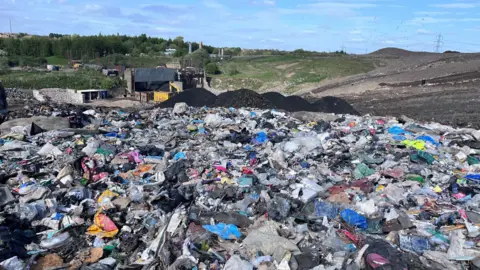
The pipe can be hooked into a system that takes the methane, scrubs it and then uses it in generators to make green energy.
At a stroke you remove a potent greenhouse gas and you turn it into something useful.
This is technology found at more than 20 landfill sites across the Midlands, including at Sandy Lane in Worcestershire, Highfields South Landfill Gas in Staffordshire and Himley Power in Dudley, in the West Midlands.
However, although you can sell this energy, the whole endeavour still needs subsidy to be financially viable and existing support is coming to an end.
Despite positive noises, new Prime Minister Andy Burnham and minister for energy Michael Shanks have yet to formally announce what new scheme will replace it, and industry voices say they are running out of time.
Unless a decision is taken soon, some Midlands sites could go out of business.
Green Alliance, an independent think tank focusing on environmental policy, said the UK had "a success story to tell" on cutting methane from landfills, but that it risked "going backwards" at a time the world should be accelerating "action on methane emissions".

David Rice, managing director of Envirogas, gave me a tour of his set-up on a landfill site outside Rugby in Warwickshire.
"Current support ends on 27 March and it's unlikely that we're going to have a new support mechanism in place for 12 to maybe 18 months," he said.
"The impact of that gap in support will mean that around a quarter of these sites will have to close, because they become uneconomic without the support."
If the government decides not to support these schemes at all, then it is thought almost all sites, about 90%, will close.
But does that matter?
This is a very useful source of green energy and it is consistent at a level the grid can rely on.
The site near Rugby provides power for 10,000 homes, but if methane was not being hoovered out of the landfill for power what would happen?
"It would be very smelly and then as that gas was produced it would drift down wind into the local towns and cities," said Paul Cleary, operations manager for Envirogas.

If companies like his cannot carry on, then it will be up to local authorities and the Environment Agency to deal with the methane.
But it isn't just the smell and the impact on the climate.
"If you don't have power generation you have to flare it... rather than running it through a generator... it would be burned up a very large stack," he added.
And those flares would operate 24/7 all year round.
In a statement, a government spokesperson said: "We are committed to reducing methane emissions and continue to explore potential future support for landfill gas generators.
"It is important that proposals undergo proper consideration including on value for money."
The industry remains worried. Despite a new plan being ready to go, continued delays could jeopardise a source of green energy and longer term risk damage to both local communities and to the planet.
Follow BBC Coventry & Warwickshire on BBC Sounds, Facebook, X and Instagram.