Survivor, 102, recalls tragedy that killed 464 men

 BBC
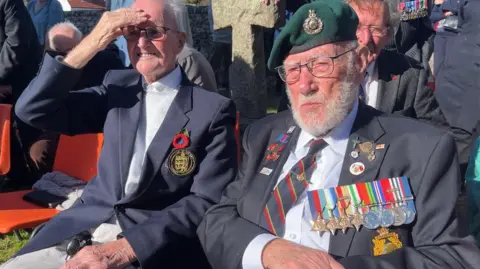
A 102-year-old survivor of the sinking of a ship in World War Two has described spending more than four hours in oil-covered water as he waited to be rescued.
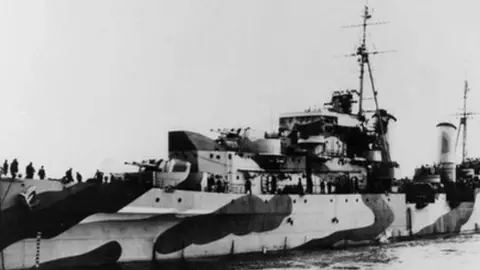
Royal Navy cruiser HMS Charybdis was torpedoed off Guernsey by German E-boats on 23 October 1943.
John Eskdale, from Lydney in Gloucestershire, was 19 and serving as a Royal Marine when the ship sank, with 464 members of the crew losing their lives and 107 being rescued.
Eskdale's story has now been preserved in a documentary made with the help of his nine-year-old great-granddaughter, Olive, helping pass his memories to a new generation.
 Ministry of Defence
Speaking ahead of Remembrance Sunday, Eskdale recalled the moment the attack began.
"They had spotted us first and fired two torpedoes at that particular time which were followed by another 18. The second hit finished us completely."
Eskdale said communications were lost and the vessel developed a heavy list before sinking.
"I was on the after turret so I did nothing but just swim off," he said. "She went down stern first."
He recalled hundreds of men entering the sea as the area became covered in diesel oil.
"You got something like 300 men in the water trying to get into two carley floats, which was havoc," he said.
Eskdale said he entered the water at about 01:55 and was not rescued until 06:30.
"We waved and we shouted," he said as a ship approached survivors.
"Only for the ship to turn around and go away again."
The vessel later returned and rescued those still alive, he explained.
 Family picture
In another recent interview, Eskdale became emotional as he reflected on the disaster, saying: "We were four-and-a-half hours in the water. Terrible. It will live with me for the rest of my life."
The sinking remains closely linked to Guernsey, where 21 bodies washed ashore and were buried with full military honours. A memorial service has been held annually at Le Foulon Cemetery since 1947.
Olive, who interviewed Eskdale for the documentary, called Keep Smiling, said: "I am the oldest out of all his great grandchildren, so I wanted to make a film so that all the younger ones can learn about them."
She said it was important that people watched the documentary because "it keeps the memories alive".
Eskdale said involving Olive had given him "an insight of how other people, other children are thinking about it".
Follow BBC Guernsey on X and Facebook and Instagram. Send your story ideas to channel.islands@bbc.co.uk.