Wildfires left fire service close to 'major incident'

 Leicestershire Fire and Rescue Service
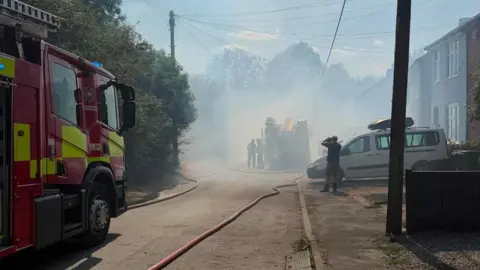
Leicestershire Fire and Rescue Service was close to declaring a major incident following a series of wildfires, its chief fire officer has said.
Callum Faint said crews had been "consistently stretched" over the last two and half months as heatwaves and drought conditions put fire services across the country under unprecedented pressure.
Four firefighters suffered heat-related injuries as the service responded to three separate wildfires in Leicestershire on 13 August.
Faint said: "I can confidently say in my 31 years of service this has been the busiest summer for Leicestershire Fire and Rescue Service."
"Normally, we could rely on potentially calling on some of our neighbours to reinforce us, but actually everyone was dealing with wildfires in the same way," he added.
"We've been consistently stretched over probably two, two and a half months now.
"Crews have responded absolutely phenomenally. Our control room staff are absolutely the bee's knees in the way they have dealt with it, but we really have been stretched.
"Last Thursday, we were probably one or two incidents away from declaring a major incident ourselves."
Eight crews were called to the largest of the three wildfires last Thursday - off Battram Road near Ibstock - with about 10 hectares (24.7 acres) of land affected.
Crews also attended blazes near Ratby, off Burroughs Road, and off the A14 near Swinford.
 Leicestershire Fire and Rescue Service
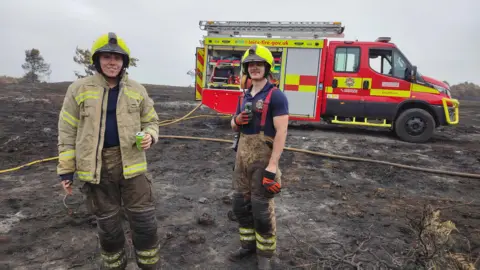
Faint said the nature of wildfires meant crews were spending extended periods of time at the scene.
"When crews were on duty they were expecting to be deployed for the entire day," he said.
"You don't go there just for 30 minutes or an hour to extinguish it and come away.
"Because of the way wildfires are, they become very deep seated, and you have to dig a lot of ground out, you have to chop a lot of wood away.
"So, you are actually there for six, seven, eight hours, and that just means fire engines are committed at incidents for an awful lot longer.
"Certainly, last week we had every one of our operational resources committed at incidents at various points in the day."
Faint added that the service had been "evolving" over recent years in response to climate change.
He said this included bringing in more 4X4 and off-road vehicles.
A spokesperson for the service said two Variable Response Vehicles made it easier for crews to access rural land compared to standard, heavier fire appliances.
Faint said: "We are moving towards a much more, almost kind of Mediterranean model, where wildfires will almost be business as usual over the summers.
"We really need to look at the protective equipment firefighters wear. We do need some specialist fire kit just to make sure crews are able to respond to those types of incidents."
Faint urged the public to "enjoy the weather but please do it sensibly".
He added: "Don't have bonfires, don't have outdoor barbecues, please don't use fireworks. Help us to help you, prevent the incidents from happening."
Listen to BBC Radio Leicester on Sounds and follow BBC Leicester on Facebook, on X, or on Instagram. Send your story ideas to eastmidsnews@bbc.co.uk or via WhatsApp on 0808 100 2210.