Trump signs order to rename Lake Ontario as Lake America
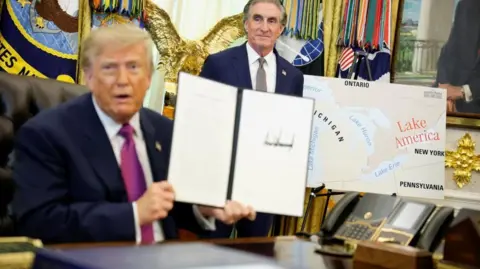
US President Donald Trump has signed an executive order seeking to change the name of Lake Ontario to Lake America.
The move comes after trade talks between the US and Canada collapsed last week, and the US imposed new 50% tariffs on $20bn (C$28bn) worth of Canadian goods. Canada will implement "dollar for dollar" counter-tariffs next month.
Trump said the renaming of the lake, which straddles both countries, was effective immediately. He has broad discretion over how the US recognises landmarks but other countries do not have to follow.
Canadian Prime Minister Mark Carney said in response that "things must be called by their name, and this lake is called Lake Ontario - today and forever".
The executive order gives the US Department of the Interior 30 days to update the name change with the Geographic Names Information Service - the official repository of domestic geographic names in the US.
Carney noted that the name Lake Ontario could be traced back more than 400 years, adding that it preceded the formation of the Canadian Confederation and the US Declaration of Independence.
"We know that the United States is changing," he said. "Their trade relations, their foreign policy, their national monuments, their hydronyms.
"Canadian women and men also know that things must be called by their name, and this lake is called Lake Ontario - today and forever."
There is no universally recognised international body setting the names of international waters.
When Trump took to the White House in 2025, he signed a similar order that changed the Gulf of Mexico to the Gulf of America. Mexico has rejected the name change, arguing a single country cannot rename a shared body of international water.
It also led to a legal dispute between Mexico and tech giant Google, which renamed the gulf in its maps application.
In that case, Google Maps users in the US see "Gulf of America", while those in Mexico see the "Gulf of Mexico". Those in other countries see the "Gulf of Mexico (Gulf of America)".
The White House at the time also blocked Associated Press reporters from presidential events over the news agency's refusal to adopt the name "Gulf of America" in its coverage. The AP sued the Trump administration in response, and that legal battle is ongoing.
Canadian officials dismissed Trump's move to rename the lake.
Ontario Premier Doug Ford wrote: "It's Lake Ontario to Canadians and the rest of the world. Now and forever." Other premiers and ministers made similar statements.
The names of three of the Great Lakes - Ontario, Michigan and Erie - originate from indigenous words. Lake Superior was named after an anglicised French word. Lake Huron derives from a French word. Lake Ontario, the smallest of the Great Lakes, borders both the Canadian province and the US state of New York.


There was a mixed reaction from US politicians.
Trump's Secretary of the Interior Doug Burgum applauded the move, writing: "We're on it, Mr. President!"
"The places and waters that border our nation and support our economy should reflect the greatness of the United States," he said, adding that the US Geological Survey "maps our country for the world to see, and we are PROUD to implement your Executive Order to rename LAKE AMERICA".
But Democratic lawmaker Debbie Dingell of Michigan, the US state that borders four of the five Great Lakes, said that she would introduce a bill in Congress to nullify the name change, calling Trump's order "idiotic".
She wrote: "The Great Lakes are a shared treasure that generations of Americans and Canadians have worked together to protect".
Democratic New York Governor Kathy Hochul said her state, the sole US state bordering Lake Ontario, would not be calling it Lake America.
 Reuters
As he signed the order on Thursday in the Oval Office, Trump said it was not a direct message to Canada, but that America's northern neighbour "has been ripping us off for a long time on trade".
US-Canada relations have fallen to a new low, with insults thrown back and forth over the past week.
But there was a hint on Thursday that there was room for a return to the negotiating table.
Canadian US trade minister, Dominic LeBlanc, said the US had withdrawn some of its demands around labelling requirements in French, one of the sticking points. The US has maintained it never made demands about language.
Both sides have accused the other of demanding last-minute changes that caused the breakdown in trade negotiations.
Correction 2 September: We have amended this report after we mistakenly said that the name Lake Huron originated from an indigenous word. The report now says that "Huron" is French in origin.

Follow the twists and turns of Trump's second term with North America correspondent Anthony Zurcher's weekly US Politics Unspun newsletter. Readers in the UK can sign up here. Those outside the UK can sign up here.