'Pottery liberates me from MND symptoms'

 BBC
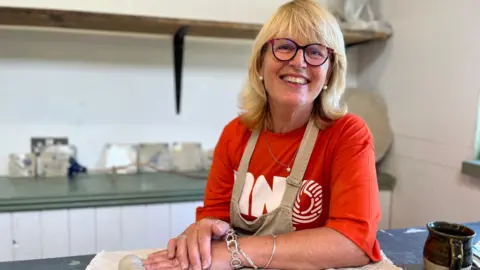
BBCA woman who has taken up pottery finds the craft "liberating" since developing a rare form of motor neurone disease (MND).
Linda Mace, from Winterslow, in Wiltshire, was diagnosed in 2023 with Primary Lateral Sclerosis (PLS) - a slower progressing form of MND that affects mobility.
She took up pottery two years ago when one of her sons bought her sessions at a studio. Since then, the charity MND Association, has supported her hobby through its wellbeing fund.
Mace said because MND damages upper motor neurons which carry messages from the brain and spinal cord to the body, doing a slow activities like pottery has helped her manage her movements and it gives her "purpose on that day".
MND causes muscle weakness, external that gradually worsens over time. It kills almost 2,200 people in the UK each year.
Mace said: "I'm okay when I'm walking slowly but if I try to move fast, then it will make me trip because all the bits of the body are not working.
"So pottery is a process; it's very slow. It gives me routine and it has given me a purpose on that day. I'm in an environment with a piece of cloth and a piece of clay. I'm safe.
"I've got myself. I can't fall over because I've got a bench and it's just relaxing, so handling clay is very liberating."
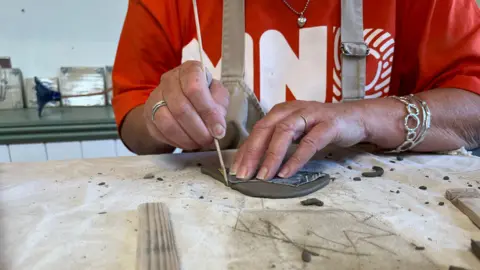
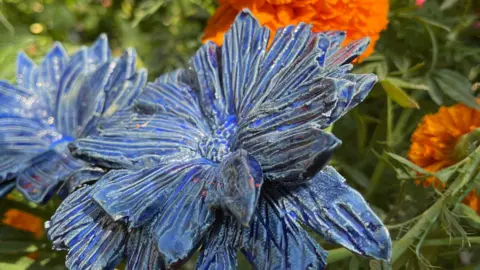
Mace has learned to create several things, including mugs, flowers and clay chickens.
She said it is supportive and helping her "to be realigned for three hours."
Sarah Brain is the owner of Stonehenge Pottery, where Mace is part of a group learning the craft.
Brain said Mace's participation has seen other members educate themselves about MND.
The group has also developed a symptoms information card with the MND Association, for people with the condition to carry.
It reads: "My condition can cause sudden or intense crying or laughing. This may not match how I feel, but usually stops by itself. Thank you for being patient."
Brain added: "I do spend a lot of time with people on the pottery wheel saying 'you need to do less moves and decide what each move is going to do before you start it'.
"She (Mace) has to think about each move she makes, whether it's putting on glasses, putting earrings in, or making a cup of tea."
Mace's friend of more than 30 years, Elaine Gwyther, said she thinks pottery has helped Linda immensely.
"She's gone out of her comfort zone. I think it's changed her enormously," she added.
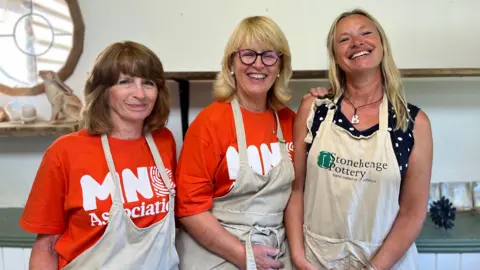
Gwyther said she first realised something was wrong when Mace fell a few times during a charity walk.
It took a while for Mace to receive the MND diagnosis and she said she picked up a court to learn more.
Her friends and the pottery group have also raised money for the MND Association, including creating 100 clay flowers, which helped towards raising £5,000 for the group.
Follow BBC Wiltshire on Facebook, X and Instagram. Send your story ideas to us on email or via WhatsApp on 0800 313 4630.