Could rebel knight Roger Casement be exhumed for a second time?

 Press Association
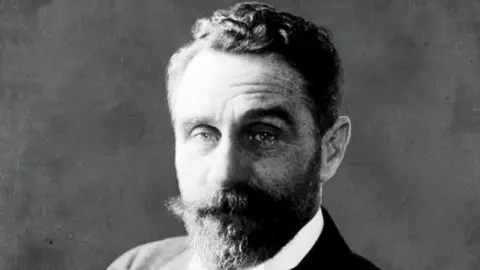
An application has been lodged to have the remains of a knight of the realm turned Easter Rising conspirator, Sir Roger Casement, moved to Northern Ireland.
If successful, it would be the second time Casement will have been exhumed and reburied.
Casement was originally interred in the grounds of Pentonville Prison in London, where he was hanged in 1916 after being discovered returning to Ireland aboard a U-boat following a trip to Germany to secure arms for Irish nationalists.
In 1965, his remains were exhumed and brought to Glasnevin Cemetery, Dublin.
But a commemoration society in his name, who have lodged the application, has said it wants to "fulfil his wish" of being buried in County Antrim.
The Roger Casement Commemoration and Re-interment Association has applied for an exhumation licence from Dublin City Council and Glasnevin Cemetery.
Specifically, they want to transfer Casement's remains from the Irish capital to Murlough Bay in County Antrim - where, they said, a man called Patrick McCarry has agreed to allow the reburial on his ground.
In a letter on 25 July 1916, just more than a week before his death, Casement wrote: "Don't let my body lie here - get me back to the green hill at Murlough, by the McGarry's house, looking down on the Moyle, that's where I'd like to be now, and there's where I'd like to lie."
 PA
In a statement, the association said its plans have the support of Casement's family - namely James Casement from Arizona in the United States.
On Thursday night, the association and McCarry gathered at the Casement Social Club in Belfast alongside their legal team, Phoenix Law solicitors, and O'Neill's Funeral Directors.
Association chairperson Alan Daly said: "After many months of preparation, we have formally applied for the exhumation of Roger Casement to bring him home."
He said "Casement always wanted to return home" and that it was "historic to be co-signing this application with Roger's direct and surviving relative, James Casement".
The association has claimed that "exhumations are regularly granted across the island of Ireland".
However, obtaining an exhumation licence in Northern Ireland or the Republic of Ireland (ROI) involves a highly regulated process, primarily due to the strict legal, ethical, and public health safeguards surrounding human remains.
When it was suggested Casement's bones should be repatriated to Northern Ireland from Pentonville in 1965, Prime Minister Harold Wilson's government forbade it, insisting it would stir up political tensions.
It is unclear how Casement's complex legacy will influence this most recent attempt to bring him to County Antrim.
Who was Roger Casement?
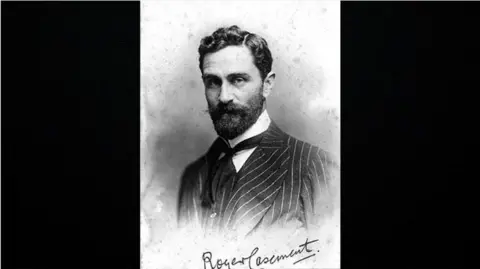
Those unfamiliar with the life and times of Roger Casement might still recognise his name from the sports stadium at the heart of one of Northern Ireland's most enduring modern political rows - Casement Park.
But while it is not unusual for a GAA stadium to be called after a perceived Irish republican martyr, it is much less common for a pitch to be named after a British knight.
And before being stripped of his knighthood at the end of his life, Casement had been both.
In 1911, Casement was knighted by King George V for his humanitarian work - which took him from central Africa to some of the poorest parts of South America.
But on his travels Casement - who considered himself a Protestant most his life - eventually became disillusioned with colonialism, retired from diplomacy and dedicated himself to the Irish nationalist cause by joining the Irish Volunteer Force.
Smuggling, rebellion and execution
With World War Two raging, Casement became attracted by the potential of an Irish-German alliance as a way of securing full Irish independence.
As the secret military council of the Irish Republican Brotherhood (IRB) planned the Easter Rising, Casement agreed to travel to Germany, where he would attempt to raise a brigade by recruiting Irish soldiers who had fought for Britain and been captured by Germany.
But his plan failed.
Soon after arriving on the continent, it became clear than the German promises of soldiers and 200,000 rifles were not going to be fulfilled.
Returning on a German U-boat to County Kerry in April 1916, Casement was intercepted and arrested by British authorities.
As Pádraig Pearse read the proclamation on the steps of the Dublin's General Post Office, Casement was locked in the Tower of London awaiting trial for treason.
On 29 June 1916 Casement was found guilty of high treason and sentenced to death.
A campaign for a reprieve was supported by leading political and literary figures, including W B Yeats and George Bernard Shaw, but ultimately failed.
Casement was executed on 3 August 1916.
Part of what hampered his chances of a reprieve were extracts from his diaries which were widely circulated, publicly outing him as a homosexual.