Lucy's Law: A real bite on NI's illegal puppy trade or a toothless attack?

 Getty
GettyLegislation to help tackle Northern Ireland's illegal puppy trade was approved earlier this week.
If introduced as planned, Lucy's Law would put Northern Ireland on a par with the rest of the UK by making third-party puppy and kitten sales illegal.
Minister Andrew Muir addressed a conference of vets, animal charities and legal experts on Tuesday and described Lucy's Law as "a major step" forward in disrupting dealer chains and strengthening safeguards for puppies and kittens.
Some front-line rescue workers, however, have argued that the regulations do not go far enough, claiming gaps have been left that could continue to be exploited.
Lucy's Law was originally introduced in England and Wales in 2020 and then in Scotland in 2022.
It was designed to crack down on illegal puppy farming - which is a huge issue in Northern Ireland - by banning third-party commercial sales of young puppies and kittens.
It is due to be enacted by the end of the year, meaning buyers will have to meet breeders face-to-face and see a puppy or kitten with its mother in the place where it was bred.
The handover or sale of a puppy or kitten will also have to take place at that location, which one breeder told BBC News NI will "stop people handing over dogs in car parks and filling station forecourts".
Will Lucy's Law have much of an effect?
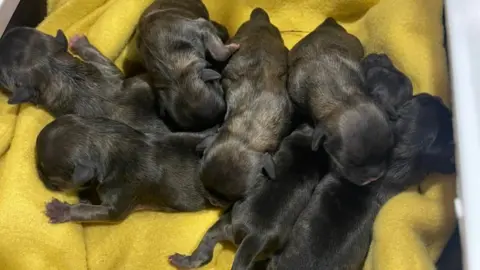 Animal Adoptions UK/Oxfordshire Animal Sanctuary
The Department of Agriculture, Environment, and Rural Affairs (Daera) have high hopes for it.
They said it will disrupt dealer chains which can conceal poor breeding practices, strengthen protections give owners clearer information about where an animal has come from.
Daera Minister Andrew Muir said: "The regulations will increase transparency and make it harder for irresponsible operators to conceal poor breeding practices."
But not everybody shares this optimism.
'Progress made but gaps left'
 Tara Cunningham
Tara Cunningham, from Causeway Coast Dog Rescue, said the legislation was "progress" but "left gaps" in Northern Ireland's animal welfare regulations.
"While Causeway Coast Dog Rescue thanks the minister for bringing this through... we are deeply disappointed the breeding register has been off the table within this mandate."
For years Cunningham has campaigned for an expanded and more robust version of Lucy's Law to be introduced in Northern Ireland, but said the one expected to go on statute books is much the same as the original.
Her main grievance is that the legislation will not create a breeding sale/supply register.
Such a system would keep a record of all dog breeders - including small breeders known as hobby breeders - in Northern Ireland, not just those who meet the criteria that requires them to have a licence.
Cunningham said putting all breeders on a register would have meant "premises could be checked at any time by the council".
But she said while it addressed third-party selling in Northern Ireland, "it does not address moving dogs to another country for sale and how the cross partnership of UK countries address this".
 Gary Jordan ADNI Dog Trainer/Canine intervention Facilitator
One of the largest animal charities in Northern Ireland, the Ulster Society for the Prevention of Cruely to Animals (USPCA), called Northern Ireland's own version of Lucy's Law "a welcome and important step forward".
Heather Weir said they "regularly see the consequences of an inadequately regulated puppy trade".
Weir made an important distinction between two sides of Northern Ireland's puppy trade problem.
"While thousands of puppies from large-scale commercial breeding establishments are transported to Great Britain for sale, we continue to see first-hand the welfare consequences associated with smaller-scale and backyard breeding here in Northern Ireland."
What do other front-line rescuers think?

Some front-line rescuers doubted whether Lucy's Law will make any real difference to Northern Ireland's puppy trade.
Kerry-Louise Lewis, who runs Just Like Home Rescues near Carrickfergus, said she had visited around 25 puppy farms to rescue abused dogs.
She said the only chance of tackling the puppy black market was regulation and enforcement.
She said, while Lucy's Law might result in more dogs getting to rescue centres, it would not stop them being bred in the first place.
"Breeders are already selling dogs across the country illegally," and "those same people will continue doing that", she said.

Kerry Louise's colleague, Kerry Graham, said they have rescued "thousands of abused cats and dogs, many abandoned kittens and puppies" over the last ten years.
Just last week they rescued four puppies that had been found abandoned in a cardboard box.
"Fleas were eating them alive" and one ultimately died.
Such incidents - extreme but quite common - have occasionally made Graham think about stepping away.
But she said she can't - "there is too much work left to do," she said.
'Massive step in right direction'
 Joanne Smith
Others, however, have seen promise in it.
Joanne Smith, who owns Kilworth Danes in Gilford, said Lucy's Law was "a massive step in the right direction" but agreed more could still be done.
Smith said Lucy's Law gave some legal underpinning to this method of breeding and selling.
"It stops people handing over dogs in cark parks and filling station forecourts."
However, she said it will not stop people getting dogs from large scale "puppy mills".
"Just because you have a licence doesn't make what you're doing ethical. There are some breeders who have 200 bitches and the animals are all machine fed.
"Lucy's Law can't stop that but we need one that will. But this is a good first step."
Eimear Tubman who runs Dogsni.love - "Northern Ireland's only ethical dog site, advertising dogs for sale, stud and related services" - said Lucy's Law will "make it harder for unscrupulous sellers to hide behind third-parties".
"That has to be a positive step," she said.
Most charities BBC News NI contacted said there are no dog breeders they would endorse.
Tubman was critical of this and said it is important to distinguish good breeders from bad ones.
"There are some wonderful breeders in Northern Ireland who devote enormous amounts of time, care and money to doing things properly.
"We should absolutely call out poor breeding practices, but we should also recognise and support the people who genuinely put their dogs first."
How do breeding licences work in Northern Ireland?
In Northern Ireland breeding licences are obtained from local councils.
You must get a licence from your local district council if your premises meet any of the following three conditions.
One - you keep three or more breeding bitches on the property.
Two - you breed, advertise or supply three or more litters of puppies in a 12-month period.
Or three - you run a business that advertises or sells breeding dogs.
Fees vary depending on the number of breeding bitches a breeder has, ranging from £150 for 10 or fewer and rising to £350 for over 200.
After that it is £50 for each additional 100 dogs.
Can you breed dogs without a licence?
Yes, you can breed dogs without a licence.
Exemptions are available for hobby breeders, hunt clubs and recognised animal charities.
Hobby breeders are people who keep only one or two breeding bitches and breed fewer than three litters in a year.
What happens to those who break breeding laws?
Licences come with strict rules.
Bitches must be over 12 months old before breeding.
A bitch can have a maximum of three litters every 3 years, and no more than 6 litters in her lifetime.
Puppies must stay with their mother until eight weeks old.
And all dogs and puppies must be microchipped - which is the case regardless of whether a dog is born in a licenced breeding premises or in a one-off domestic litter.
Operating a breeding establishment without a valid licence - or breaking licence conditions - can result in a fine of up to £5,000 and/or 6 months in prison.