MND patient in race to access life-extending drug

 BBC
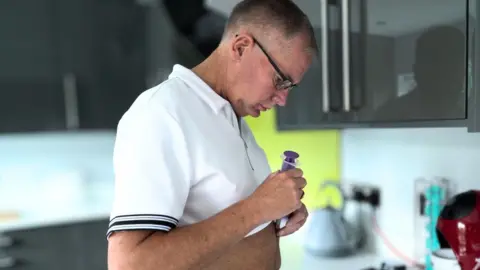
BBCA man with a rare form of Motor Neurone Disease (MND) says he could die within a year while waiting for access to a treatment that could significantly prolong his life.
Marc Powell, from Whaley Bridge, Derbyshire, has the SOD1 variant of the disease, which affects fewer than 100 people in the UK.
Drug manufacturer Biogen is supplying Tofersen free of charge to specialist centres, including Salford Royal, while the NHS decides whether to fund it.
However, hospitals must cover the costs of administering it, so numbers are limited. The Northern Care Alliance NHS Trust said Tofersen was not currently commissioned by NHS England and required specialist expertise and support to deliver safely.
Marc, who celebrated his 60th birthday this week, was diagnosed with MND in January after noticing problems with his speech.
"I got home and sobbed my heart out with my wife," he said.
"I thought 'That's it - life plan out of the window, not much time left.'
"Telling my three kids was the hardest part for me as we've always been so close as a family. So the time I have left is the most important thing to make more memories."
Marc's movement is still largely unaffected. But his mum died from the same disease so he knows what comes next.
 Getty
GettyWhat is MND and what does Toforsen do?
- MND is a life-shortening disease that damages the nerves which control movement
- Speech is one of the first things to be affected
- It causes progressive muscle weakness - and can affect walking, swallowing and breathing
- A third of patients die within a year of diagnosis.
So the priority for all patients is to slow down that progression.
Treatment options are limited, but for the small group of MND patients who have the SOD1 variant, a drug called Toforsen has shown significant benefits.
"What we're seeing for the first time in MND is it significantly slowing and in some cases halting the progression of the disease," said Stella McKernan, a senior policy advisor at MND Association.
"It's completely unprecedented and I think worth being excited about".

"It is getting hard and it's frustrating and upsetting for him and for us to see the decline" said Marc's wife Julie.
"So any drug that could stop that decline further would be amazing."
But there is a problem. Although Tofersen has been passed as safe to use in the UK, the health watchdog National Institute for Health and Care Excellence (NICE) is still deciding whether the NHS will pay for it.
That decision won't come until next March at the earliest - too late for many patients who want it now.
Thirteen of the specialist centres in the UK have taken up Biogen's offer and are now giving the drug out.
Salford Royal, which treats Marc, is one of them.
But the trust itself has to find the specialist staff and resources to give the monthly spinal injection without central NHS funding.
So all of the centres are strictly limiting the number of patients and Salford Royal says it is currently at capacity.
A race against time for a life-extending treatment
Marc is on a waiting list, but that could take months and in the meantime the disease is relentlessly progressing.
He has already lost the ability to speak and communicates by writing his answers into a machine, which then answers in his voice.
"If I don't get it quickly my eye muscles, neck muscles and ultimately breathing muscles will be affected" he said.
"The quicker I get the drug, the quicker it will slow down the killing of my facial nerves and allow my current condition to be put on hold, hopefully giving me a longer lifespan than the current expectation of death within the next 12 months."

The Northern Care Alliance NHS Trust, which runs Salford Royal, said:
"We understand how important access to potential treatment options is for people living with motor neurone disease, and we recognise how difficult it can be when patients are waiting for treatment.
"Tofersen is not currently commissioned by NHS England and there is no dedicated funding available to support its delivery. The treatment also requires highly specialised clinical expertise, facilities and multidisciplinary support to administer safely.
"We remain in contact with Mr Powell and have discussed the plan for his care. While he awaits treatment, we will continue to provide his routine clinical care and support."
Meanwhile Marc and Julie are hoping another centre may have a place where he can receive the treatment.
Marc said that he was still hoping to see his children grow up. "This is not about me but about all that follow - making sure they are seen to with compassion and dignity," he said.
Julie said they would continue fighting. "It's not fair that other people can have the treatment and Marc can't," she said. "It is a ground-breaking treatment and it will help - but not if you can't have it".