Former nuclear bunker now home to more than a million government files

 BBC
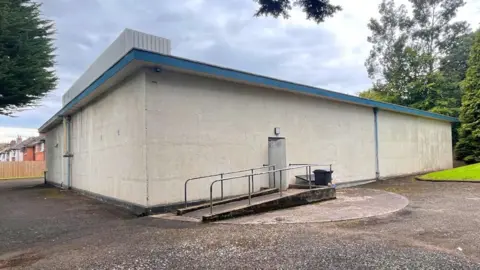
BBCAn old nuclear bunker in the suburbs of south Belfast is now protecting paperwork rather than people.
Built in 1953 at the start of the Cold War, its windowless rooms are now home to more than a million government pictures and files.
The historic environment records are being stored in what used to be an emergency hub in case of a nuclear bomb.
It had space for 45 people whose job it would have been to co-ordinate the post-attack response in a heavily-protected 'war room'.
Located just off the Malone Road in one of the wealthiest parts of Belfast, half of the flat-roofed building is below the ground.
It was one of 13 regional war rooms built around the UK at the time.
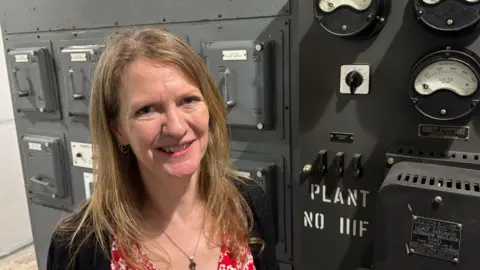
Rhonda Robinson, principal archaeologist at the Department for Communities, said the original purpose of the building was short-lived.
"It was used during the 1950s, but almost as soon as it was built it became obsolete," she said.
"Nuclear bombs got bigger, and this simply wasn't up to it, and new headquarters had to be built elsewhere down in Armagh."
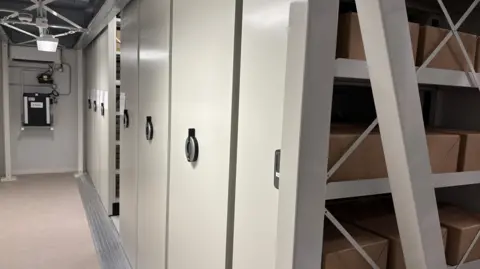
In more recent times, the Belfast building was repurposed as a storage facility for court service documents.
It has now had an overhaul and is home to the environment records.
The documents are well protected inside the building.
"It was obviously built to withstand a nuclear bomb, so it's got 1.5m thick concrete walls, an enormously thick ceiling and there's not a window in here," Robinson said.
"The temperature inside here and the humidity remains fairly stable, and that's exactly what you need for an archive.
"We have drawings, maps, plans. We have 1.1 million photographs."
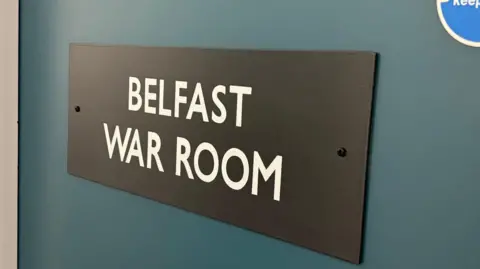
Historian Dr Jim O'Neill said the building is the Cold War "made flesh in concrete in the middle of Belfast".
Back in the early 1950s, the bunker was ready for a nuclear attack.
"There would have been civil servants, there would have been technical staff, scientific staff, representatives of the emergency services and the police and all backed up with support staff like typists and telephonists," O'Neill said.
"The interesting thing is there would be no politicians.
"A lot of people think this is where the politicians would come to hide while the rest of us die. It wasn't at all."
In the event of a nuclear bomb, their task would have been to try to restore vital services and bring back some order to society.
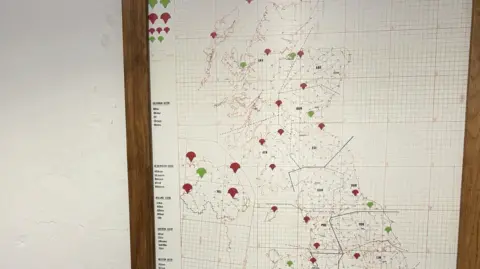
The modern redevelopment of the interior of the building was marked on Wednesday with a special ceremony and a ribbon-cutting by Communities Minister Gordon Lyons.
"We are taking a facility that would otherwise have laid abandoned," he said.
"We don't have much need for a nuclear bunker these days - I hope – and that's why it's important that we reuse it."
The Historic Environment Record of Northern Ireland (HERoNI) contains information on historic buildings, monuments, sites and artefacts which date from the Mesolithic period 9,000 years ago to the present day.
The Cold War (1947 to 1991) refers to the period after World War Two when growing tensions between the Soviet Union and the US led to an arms race and the threat of renewed conflict.