Councils turn to AI in attempt to fill £4bn black hole

 Getty Images
Councils across the UK are increasingly turning towards Artificial Intelligence (AI) as they try to fill a looming £4bn financial black hole.
But local government experts say it is not the "silver bullet" to save a system from "the brink of collapse".
There are also ethical concerns around the increasing use of AI in assessing the level of care vulnerable people need.
A government spokesman said it encouraged safe and responsible use of the technology where it could reduce workloads.
A study by the BBC Shared Data Unit found all but a small handful of the UK's local authorities will reduce the services they offer this financial year, despite recent reforms to the way they are funded.
The 218 upper-tier councils, which include borough, county, metropolitan and unitary authorities, will make a total of £3.2bn in cuts.
Planned measures include reducing the frequency of bin collections, closing heritage attractions, ending bus routes and - in the case of one council - completely removing sheltered housing support.
Fees and charges for parking permits and green waste bins will be hiked at dozens of councils, while almost every authority will raise council tax by the maximum 5%.
'Unrelenting pressure'
Jonathan Carr West, chief executive of the Local Government Information Unit (LGIU), which advises on policy across the world, said the BBC study showed the sector was "still struggling to keep up with astronomic rates of increase in demand and cost for those key statutory services like adult social care and children's services".
"The sector as a whole continues to become more and more on the brink of collapse," he added.
A spokesman for the Local Government Association, which represents councils across England and Wales, said the cost and demand pressures were "unrelenting".
"In just three years, councils will need around 25 per cent more money simply to stand still," he said. "Without action, the services people rely on every day, from social care to safe streets, will be eroded."
Though the government has increased the amount of grant funding councils receive from the Treasury since the pandemic, a study by independent thinktank the Institute for Government found it was still down on pre-2010 levels.
Even if this year's savings are achieved, councils predict they will need to find a further £3.8bn by the end of the 2027-28 financial year to balance their books. A record 37 councils will also receive forms of exceptional financial support this year.
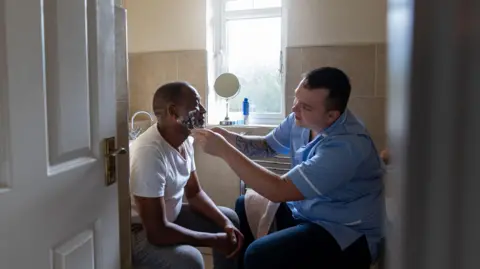
It means many are trying to lower the cost of providing care to the elderly and vulnerable, whether by re-tendering contracts with cheaper care companies, closing care homes or by re-assessing those already in care to see if their package of support can be reduced.
 Getty Images
This year, dozens of councils have pledged to use AI to drive savings.
Among them are Medway Council chiefs who say they will use AI to "draft care plans" and automate invoice processing.
Several councils will reduce staffing in their call centres - which enable people to query council tax bills, order new bins or arrange a care assessment among other things - and bring in chatbots to "triage" initial queries.
West Sussex County Council hopes its plans to replace nine call handlers with an AI contact centre could save £300,000 a year.
But campaigners for the elderly say older people are already struggling to interact with automated chatbots where they have been introduced.
Similar measures have proved controversial in other areas. Derby's AI chatbot Darcie received several complaints for struggling to understand the local accent.
'Clients need a human voice'
Dennis Reed, director of the Silver Voices campaign group for elderly people, said: "People seeking social care support are likely to be confused, perhaps in pain, and not used to negotiating the merry-go-round of contact centres using AI at first contact.
"What potential social care clients need at first contact is a sympathetic human voice, not a robotic answering machine."
Denise Rowley, 71, previously taught IT among other subjects to older people at a college in Leeds.
After suffering a stroke nearly a decade ago, she has relied on Wakefield Council's trips and falls service Carelink to help her if she gets into difficulty.
But with the Department for Work and Pensions expanding its AI-assisted call centre and local councils following suit, she says older people are increasingly feeling shut out by new technology when contacting services they need.
"Older people do struggle with technology," Rowley said. "It's bad enough having to use computers every time you need something, let alone having to talk to an AI.
"And the thing is, a lot of these AI call centres are based on a system that didn't work in the first place."
 LGIU
LGIUCouncils and care providers are already using AI to write case notes, predict falls and analyse care records.
But there are serious concerns around the use of such tools to draft care assessments, where social workers record a person's needs and decide what council-funded support they are entitled to.
"This is something our members are really worried about," said Andrew Reece, strategic lead for the British Association of Social Workers. "This is stepping into the area of making decisions and we don't think that's appropriate."
He said it was different to tools that assisted social workers - for example, recording a conversation to help them make good notes.
The use of AI to create assessments would be "stepping over the boundary between assisting a social worker and taking over from them", he said.
Derby City Council said its AI-drafted care assessments were always reviewed by a social worker.
But a report by the Ada Lovelace Institute found AI tools made frequent errors in care assessments, some of which found their way into finalised reports.
Reece was also concerned to see AI being trumpeted as a means to save money.
"The system is under a huge amount of pressure at the moment and most social workers are not able to complete their work within their normal hours," he added.
"The savings will come from shedding social work jobs, which will just put more pressure on the system."
'Marginal savings'
In some cases, the expected savings are relatively small.
Liverpool's use of AI tools to improve efficiency in children's social care will save about £150,000 by the end of the 2027-28 financial year.
In proportion, its total budget gap during the same time is more than £29m.
"There is no silver bullet," said Carr-West. "We have seen some savings being made from AI, but they are, to be frank, pretty marginal compared to the scale of the problem."
Councils across England said they were increasingly looking to technology and AI to help manage mounting financial pressures, as demand for social care, homelessness support and special educational needs services continues to rise.
Caerphilly Council said its transformation programme included the use of technology and AI to make services more efficient, while Essex County Council said it was exploring further savings through "technology and digitisation" and redesigning services.
A spokesman for the Ministry of Housing Communities and Local Government (MHCLG) said the government did not mandate how local authorities used AI, but encouraged its use where it could help "alleviate pressures and free up staff to help deliver better public services".
Many authorities said digital reform would help to balance future budgets, but warned technology alone would not solve wider funding pressures.
Across the UK, council chiefs said budgets were being severely stretched by the spiraling cost of providing care, homelessness services and supporting looked after children as well as providing home to school transport.
Barnet Council has one of the largest budget gaps in the UK for its size and will need close to £80m of government support this year.
Describing the council as a "tightly run ship", a spokesperson said it had faced "the perfect storm" of a decade of reduced government funding and year-on-year rises in service costs.
Six of the 10 councils set to make the most savings per head of population in 2026-27 are London boroughs, adding to fears town halls within the capital are being hit hardest by rising costs.
Carr-West said there had been hope Labour's recent local government reforms would begin to improve the situation.
It has introduced multi-year funding settlements, effectively telling councils how much they will get several years in advance rather than just the next year.
It also made drastic changes to the formula used to allocate funds, with more money directed towards areas assessed as having higher levels of need and less ability to raise income locally through council tax.
"If we're all marching towards a cliff edge, they've sort of slightly slowed down that progress, but they haven't fundamentally changed its direction," added Carr-West.
In July, Prime Minister Andy Burnham announced plans to give all mayors of city regions in England a share of income tax revenue for the first time, as part of his drive to transfer power from Westminster to local leaders.
The government is set to press ahead with plans to replace two-tier council areas with single councils responsible for all local services, in what ministers say will simplify local government.
The changes are also intended to save money by reducing duplication and cutting administrative costs.
The MHCLG spokesman said: "We're making £78bn available to local authorities across the country this year through our fair funding settlement – and thanks to our changes, nine in 10 councils in England will receive funding that matches their relative need by the end of 2028-29."
- The Shared Data Unit makes data journalism available to news organisations across the media industry, as part of a partnership between the BBC and the News Media Association. Read more about the Local News Partnerships here.
Additional reporting: Alex Homer, Joanna Morris, Catherine Heuston, Kris Bramwell