'Swimming was not in my community's vocabulary'

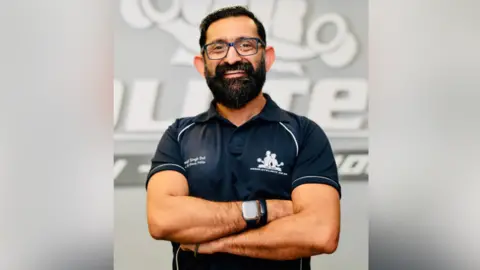 Manjit Singh Dol
A health scientist who cannot swim says the sport was not in his South Asian community vocabulary and was viewed as a luxury while growing up.
Manjit Singh Dol, 56, a personal trainer from Swindon, Wiltshire, said more needs to be done to teach parents how important swimming lessons are, adding: "It's a life-saving skill."
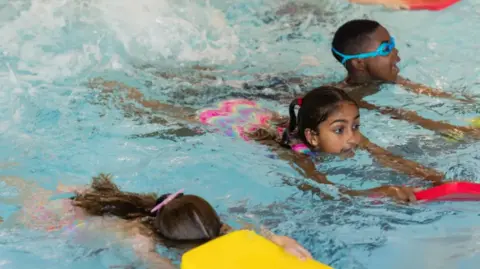
BBC research shows, on average, one third of children in Swindon and two thirds of children in Bristol cannot swim a 25m length when they leave primary school. Where there is a higher proportion of children of South Asian heritage at some Swindon schools that figure is as high as 80%.
The Department for Education (DfE) said it was aware of the gap and it "needs to change".
Singh Dol continued: "Parents didn't want to put their money into it - money was for food, clothes, education and savings."
The fitness coach said he in turn made sure his two children learnt to swim.
"If we want to increase the amount of Asians learning swimming, I think it starts with the parents to understand why it's important for their children," he said.
It comes after a BBC Freedom of Information request to the DfE revealed about a quarter of children cannot swim a 25m length by the time they leave primary school, with pupils on free school meals less likely.
It also follows the head of water safety and education at the Royal Life Saving Society (RLSS), Ashley Jones, telling the BBC there was an "inequality in drowning".
"If you're from a family of lower affluence you're twice as likely to drown...and black children are three times as likely to drown as white children," Jones said.
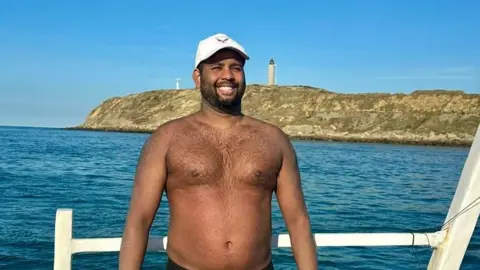 Prem's support crew
"It's pretty common among our community for swimming not to be the go-to exercise," said ultra-endurance swimmer Premal Pattani, who became the 35th Indian man to solo swim the Channel last year.
Pattani, formerly based in Swindon, said he hoped to "spread a message" and "reduce barriers" by "representing Asian minorities" in ultra sports.
Pattani, founder of The Stamina Club which helps international schools, universities and early-careers employers implement exercise, said: "Whenever I do ultra endurance challenges, we're talking about the South Asians representing a tiny, tiny slither."
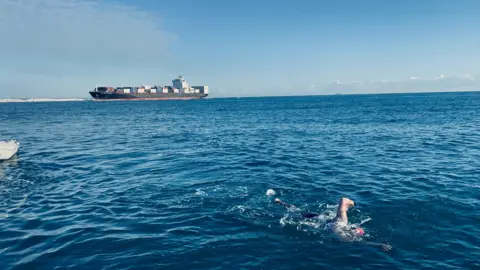 Prem's support crew
"In my father's generation from a working class background, swimming was definitely seen as a luxury. If your parents aren't doing an activity as part of their ritual, it's more unlikely you will," Pattani said.
He added his love of swimming was initially borne out of his father's fear.
"My father nearly drowned in a river in Nairobi when he was eight...so my parents made sure my sister and I were safe in the water," he added.
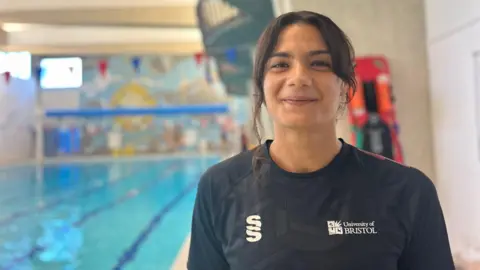
Bristol University and schools swimming teacher Amaya Scott said access to facilities is another barrier.
"A lot of kids don't have access to swimming lessons. It would help for it to be part of the school day and to stress the importance of it too, then you're learning about water safety as part of our school experience," Amaya said.
"You're definitely seeing more and more kids in the lower stage beginner groups that are that bit older...their confidence isn't there, it's harder to get them going in the water," she added.
 AFP via Getty Images
There's currently no minimum number of swimming lessons for pupils in English primary schools.
However, it is a statutory requirement of the national curriculum that all pupils should be able to swim over a distance of at least 25m when they leave Year 6.
The DfE said a new PE Partnership Network would help close the gap seen by disadvantaged children.
It will bring together schools, local clubs and national bodies like Swim England.
"This means targeted support for the areas and pupils who need it most, so every child, wherever they live, gets the same chance to learn to swim," it said.
Follow BBC Wiltshire on Facebook, X and Instagram. Send your story ideas to us on email or via WhatsApp on 0800 313 4630.