Mining landmark restoration costs more than double

 Ian Castledine
The cost of replacing a historic mining landmark in Nottinghamshire has doubled due to "unavoidable" pressures.
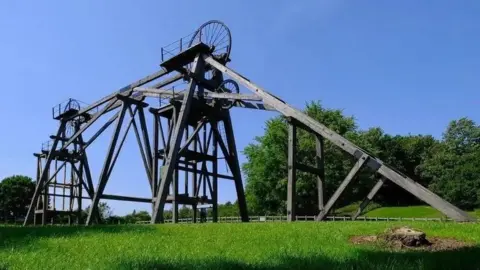
Browtowe Borough Council's plans to replace the Brinsley Headstocks - a wooden frame which formed part of a system to take miners into the pit - has been in the works for the last two years but the project has hit delays.
The authority approved £220,000 towards the replacement of the headstocks in January 2025 and it was projected the installation would be completed by April.
However, at a cabinet meeting on Tuesday, it was revealed the cost of the work had more than doubled to £453,000 and that progress had been impacted by "several unforeseen challenges".
The original wooden headstocks, parts of which date back to 1872, were dismantled and put into storage by the authority in December 2023 over safety concerns.
It was originally aimed that a wider site project, including a new wildflower meadow and remembrance orchard for miners who lost their lives at the pit, would be finished in October 2025, the Local Democracy Reporting Service (LDRS) said.
A 'significant' setback
The council said savings had been made in upcoming construction costs, "unavoidable" pressures from site conditions, programme delays and specialist construction requirements meant the original budget for the project would have to double.
An earlier delay was due to the discovery of two old mining shafts in October 2024 following a ground investigation partly using old maps.
One inaccessible tunnel was found to be underneath the remembrance orchard area.
However cabinet papers revealed another "significant" setback was the discovery of a third mine shaft – one that had not been capped and was unknown to the Coal Authority.
At the meeting Emma Georgiou, interim director of environment and leisure at the authority, said: "When [the mine shaft] was discovered we did approach the Coal Authority about trying to resolve it and undertake the work themselves.
"Despite a number of attempts to contact them, we haven't received a response."
Ms Georgiou said the authority would "continue to push" for the Coal Authority - now named the Mining Remediation Authority - to reimburse the council if the authority had to cap the mine itself.
The meeting heard that the uncovered mine shaft had been covered with boards.
The council said groundworks for the replacement headstocks had "proved substantially more complex" than initially thought due to the "extent of buried rubble and obstructions" underneath the site.
 LDRS
LDRSZoe Rose-Higgins, public safety and development director at the Mining Remediation Authority, said: "The mine shaft at the Brinsley Colliery site was uncovered in January 2025 during ground investigation works carried out by Broxtowe Borough Council under a Mining Remediation Authority permit.
"Our site inspection confirmed the shaft was securely fenced, with appropriate safety measures put in place by the council.
"As no immediate public safety concerns were identified, we were able to close the incident on that basis.
"Investigation and remedial works on former coal mining sites are managed through our permitting process, and we would welcome a further application from the council so we can support them in carrying out any safety works, including capping.
"We don't currently have a record of a request from Broxtowe Borough Council for funding to cap the shaft.
"While this wouldn't fall within our statutory responsibilities, we're very happy to talk this through with the council and continue working together on the right next steps for the site."
According to documents, the building of the new timber structure will take place off-site using specialist oak sourced from France.
The aim is for work to start on site by early next year, with completion anticipated by Easter 2027.
Listen to BBC Radio Nottingham on Sounds and follow BBC Nottingham on Facebook, on X, or on Instagram. Send your story ideas to eastmidsnews@bbc.co.uk or via WhatsApp on 0808 100 2210.