Plans for £20m hub to develop new medicines using AI

 Cambridge Stem Cell Institute
A new £20m research hub is being established in Cambridge to help develop new medicines using artificial intelligence (AI) and advanced laboratory models.
The site will be based at the Cambridge Stem Cell Institute on the Cambridge Biomedical Campus.
Funded by the Medical Research Council, the hub will work with Cambridge University Hospitals NHS Foundation Trust (CUH).
Researchers will use scientific models based on human tissues and diseases to improve the translation of lab-based research into new medicines. CUH said the hub would create "more accurate ways to study, predict and develop treatments for human diseases before they are trialled in patients".
It would also further "efforts to reduce dependence on research involving animals".
Professor Matthias Zilbauer, hub co-leader and honorary consultant at CUH, said: "By capturing important characteristics of individual patients, these human models allow us to study disease more accurately and test potential treatments before they reach the clinic."
 Cambridge Stem Cell Institute
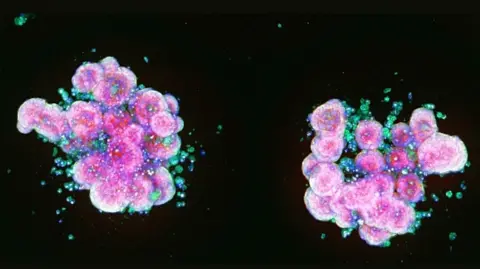
The hub is also expected to use lab-grown mini-organs called "organoids" and other stem cell-based systems and AI approaches, bioengineering and clinical research.
Zilbauer said the initiative could "ultimately lead to more effective, personalised therapies while reducing the time and cost of drug development".
The hub will be led by Zilbauer and Professor Bertie Göttgens, director of the Cambridge Stem Cell Institute and co-leader of the hub.
"By bringing together hospitals, research institutes and industry partners in Cambridge and across the UK, the Hub will accelerate the development and use of new, more accurate research tools that better reflect human biology to improve the development of new therapies," said Göttgens.
The Wellcome Sanger Institute, MRC-Laboratory of Molecular Biology (MRC-LMB) and Royal Papworth Hospital NHS Foundation Trust are also partners in the initiative.
Do you have a story suggestion for Cambridgeshire? Contact us below.
Follow Cambridgeshire news on BBC Sounds, Facebook, Instagram and X.