'I feel guilty': The farmer whose lamb had Scotland's first case of bluetongue

 BBC
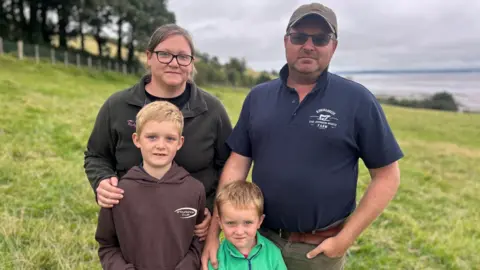
BBCEarlier this year, farmer Fiona Johnson moved her family 350 miles north from a small village in Bedfordshire to the coast of south west Scotland, hoping to start afresh. She had no livestock, just "dogs and children".
Four months later, having purchased a small number of animals locally to rear for meat, Fiona's fledgling farm in Creetown recorded the first ever case of bluetongue in Scotland.
It was an already-poorly lamb, which Fiona said had not shown typical symptoms - it had been drooling, dropping food from its mouth and its legs were stiff, but not lame.
Experts believe that midges infected with the potentially deadly disease were blown over the border from England, where there are currently 439 cases.
In Fiona's eyes it was "really bad luck".
The rest of her animals - 27 lambs and five calves - are testing negative, but the disease has since been detected in four animals on three neighbouring farms.
And farmers are acutely aware the disease could spread further - just when they are preparing to sell animals for breeding.
"For them, I feel guilty," she said. "Farmers local to us are on a much larger scale, they have thousands of sheep up on the hill.
"Although we'd done absolutely nothing wrong, I felt awful."
Bluetongue serotype 3 (BTV3) does not affect people or food safety but it causes a high rate of death in infected sheep and fertility problems in infected cattle.
Symptoms include nasal discharge, redness and swelling of the lips, nose and muzzle, lameness or reluctance to stand, a decrease in milk production and diarrhoea in cattle.
Fiona has lived on farms from a young age and has seen the pernicious impact of the virus before. Although her family never had any cases, they felt the financial toll of vaccinating an entire flock.
More recently, she knew that outbreaks were "rife" in England and had seen stories shared on social media and in the news.
But she said she had not thought to vaccinate her own animals this time, partly because they were not for breeding, but also because the closest case of bluetongue to Creetown was a significant distance away.
"We thought we were a bit safer," she said.
"It was in the back of our minds that it was a potential possibility, but because we were so far away from the cases closest to us, we sort of thought the chances are pretty slim."
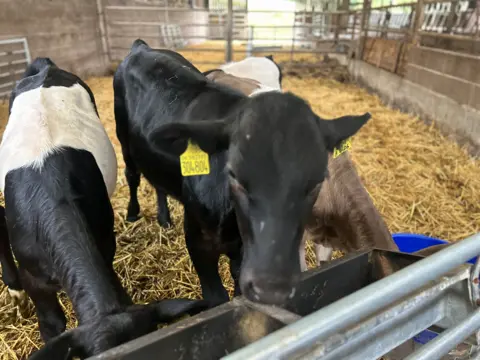
Nevertheless, Fiona had her lamb examined by a vet and said her "heart sank" when a test for bluetongue came back positive.
By that point the animal, which had gut problems, had already been euthanised on welfare grounds.
But Fiona was worried that the virus could spread to other farms and that the problem could snowball in scale.
So far, four farms have been affected in Creetown in just over a week - including the first cow to test positive.
Scotland's chief veterinary officer Sheila Voas has urged farmers to get their sheep and cattle vaccinated - but some vets are finding the treatment is in short supply.
John Hamilton, of Ark Vet Centre in Lockerbie, said they had 20,000 doses of the vaccine in stock at the start of the week but "that disappeared over 48 hours".
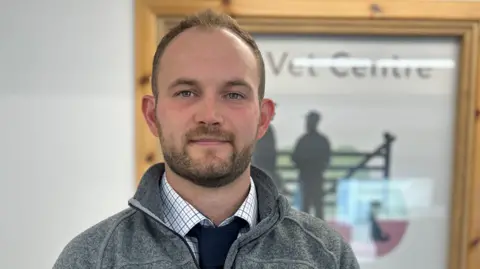
He said the first Scottish case had taken a lot of people by surprise - but he believed it was only "a matter of time" before the virus reached Scotland.
"I believe the working theory is that wind direction has taken midges across from England - I think that just shows how sporadic the disease can be and that everyone is on an even risk," he said.
"It's not just a case of monitoring south of the border, but trying to be vigilant and making early decisions to protect the flock and herd."
Hamilton said this was an important warning for the agricultural community in Scotland, but believes there is a good chance the virus can be contained if vaccinations come through.
Farmers could still face significant disruption to their business if restrictions on moving animals are put in place.
John Cowan, regional manager for the National Farmers Union (NFU) Scotland, said members were "by no means blasé" about the matter.
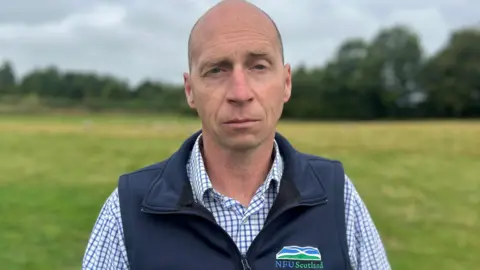
He said: "If there's any restrictions that stop them getting their lambs and breeding sheep to market, it's going to have a real big ongoing impact financially and on welfare."
Cowan added that although the situation was still developing, there was "every chance" the virus could spread.
All animals which have tested positive for the virus in Scotland have been euthanised.
Fiona hopes the measure is enough to keep cases contained, but she knows that farmers will be taking a hit.
"It's not nice for anybody," she said. "We know all our animals individually and it's not nice to think another five could have had it.
"Whether they're farmers that have got 2,000 sheep out on the hill, they're still counting their sheep every day and making sure they're OK. It's a massive hit on them financially and emotionally."