Some parents 'unaware' summer-born children can defer school

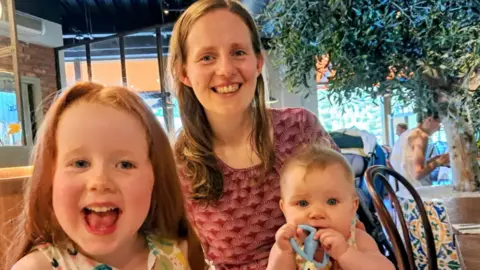 Maria
MariaSome parents are unaware they can delay their summer-born child's school start until age five, according to families who have been through the process.
Children born between April and August can legally defer starting school until the September after their fifth birthday.
However, several parents told the BBC they only discovered the option after researching it themselves, citing confusion about the rules and misconceptions about what happens if a child starts later.
The Department for Education (DfE) says parents can defer their child's start date and that requests for admission to reception outside the normal age group should be considered in the child's best interests.
'False information'
Victoria, from Swindon, delayed starting school for her son Jacob, now six.
"I found out it was an option for any child born between April and August, and it completely blew my mind," she said.
"The general consensus was that 'he'll be fine', but we felt the extra year would help him go on to thrive - and that's what's gone on to happen."
Maria, a reception teacher from Swindon, said there was "a lot of false information" about the process, including the myth that children who defer must start in Year 1.
Although she ultimately decided not to delay her daughter Emily's school start, she said misinformation made the decision harder.
"That's really unhelpful," she said. "You do need to be on top of it to know you've got the right to apply for a child to enter Reception.
"For parents to understand the system is quite tricky, and it's not fair that some parents might need more support with the process of applying than they're receiving."
Research behind the debate
The issue has attracted growing attention in recent years because research from the Institute for Fiscal Studies and others has "consistently" found children born later in the academic year perform "significantly worse", on average, than older classmates.
As a result, a tiny minority of parents choose to delay their child starting school until the September after they turn five, as allowed by current Department for Education guidelines (DfE).
However, there is less robust evidence on the effectiveness of delaying school entry and whether it eliminates the summer-born disadvantage, with policymakers still relying heavily on parental testimony.
 Getty Images
Louise, from Westbury-on-Trym in Bristol, said she had begun researching the issue about a year before her daughter Elise was due to start school.
"I looked at the research on outcomes for summer-born versus September or October-born babies and the data was pretty clear that children who were older in the year tended to do better overall," she said.
"There weren't many downsides to giving a summer-born youngster an extra year before going into primary school. For me, it was a no-brainer."
The DfE says parents who want their child to start in Reception need to request admission outside the normal age group from the school's admission authority. Otherwise, children who defer a year will automatically go straight into Year 1.
Louise said parents were not always aware that this was an option - and that since 2015 authorities had been expected to treat requests for admission out of the normal cohort "favourably".
Louise added: "If you're clear about what you're asking for within the framework as it exists, then you're asking not for permission to defer, but you're asking for permission, when you do defer, for the child to go into reception rather than Year 1."
Not the right choice for every child
Experts stress that delaying school is not necessarily the best option for every summer-born child.
Academics at the University of Bristol, who reviewed evidence from a number of studies, concluded that while some summer-born children may benefit from starting Reception at five, later entry is not necessarily the best option in every case.
Their review also found some younger children benefit from starting school at four and can progress more quickly in a formal learning environment than peers who remain in pre-school for an additional year.
Co-author Maxime Perrott, now a researcher at the Education Policy Unit, said more up-to-date research showed the application process for deferrals was made harder due to a "postcode lottery".
"It's often a bureaucratic process, and some local authorities will automatically grant flexible entry, but some will only do it if your child's got a SEN diagnosis.
"The whole system needs to be looked at and attention given to improving the school environment and making it more developmentally appropriate for all children," she said.
Ruth Richardson, development manager at the Early Years Alliance, said being born in the summer did not automatically mean a child was not ready for school.
"In Reception, everything is play-based," she said.
"If your child can write their own name, that's brilliant, but if they can't do it, then don't worry. That's why they're going to school, to learn how to do that."
 Ruth Richardson
Jessica Nicolaou, deputy manager and SEN lead at Little Smarties Nursery in Bishops Cleeve, Gloucestershire, said strong links between nurseries and schools could help children transition successfully into Reception.
"We feed into about five schools across Bishops Cleeve, who have been really proactive, and we've been able to build strong relationships with them over the years," she said.
"We've had a child with more physical needs this year, and that was a worry for the parents, but we were able to do extra tours around the school to make sure adjustments are made."
For some children with additional needs, delaying school can be beneficial, according to Bristol-based SEND specialist and children's psychotherapist Gee Eltringham.
"They are one third behind their age in executive function, so if they're not quite ready, giving them an extra year can give them that little bit of extra time to catch up," she said.
"Deferring can be a bold move, but a brave one and a good one."
 Handout
Several contributors felt parents were largely responsible for finding information themselves, with one DfE study showing requests to defer school entry were more common among families from more advantaged backgrounds.
Parents are advised to discuss concerns about school readiness with nurseries, early years settings and prospective schools before making a decision.
Follow BBC Somerset on Facebook and X. Send your story ideas to us on email or via WhatsApp on 0800 313 4630.