Why is Holme Fen wildfire lasting days?

 Cambridgeshire Fire and Rescue Service
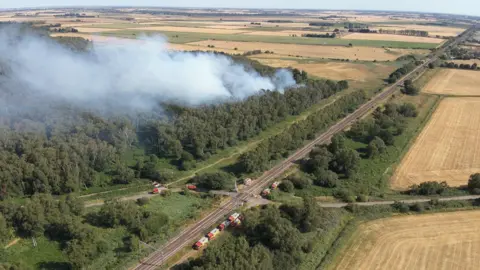
Firefighters continue to tackle a blaze at Holme Fen, near Peterborough, which has been described as one of the county's "most challenging incidents" in nearly 30 years.
As the blaze enters its sixth day, having burnt through half of the 660-acre (270-hectare) site, how long could the fire go on for and why is it so hard to tackle?
Why is Holme Fen so important?
Holme Fen is a peatland nature reserve between Peterborough and Ramsey in Cambridgeshire.
The sprawling Natural England-managed site is 2.75m (9ft) below sea level and the lowest land point in Great Britain.
It used to be the site of Whittlesey Mere, once the largest lake in southern England.
In the 1850s, it was drained to create farmland.
This became Holme Fen and survives as one of the only fragments of ancient wild fen, along with Wicken Fen on the other side of Cambridgeshire, run by the National Trust.
 John Devine/BBC
The site is a haven to such a variety of wildlife that it has been designated as a Site of Special Scientific Interest (SSSI), thanks to more than 500 types of fungi, a birch woodland, an ancient bog, heathland and beautiful birds, including the Eurasian siskin, nightingale and lesser redpoll.
According to the Woodland Trust, an SSSI gives sites more protection than other designations like Areas of Outstanding Natural Beauty.
The status means landowners must manage the site appropriately to conserve its special features.
Holme Fen National Nature Reserve is next to the main railway line between London and Edinburgh, with the nearest train station located at Peterborough.
The habitat spans about 660 acres (270 hectares) – roughly the equivalent of 375 Premier League football pitches.
More from Cambridgeshire:
How long have firefighters been there?
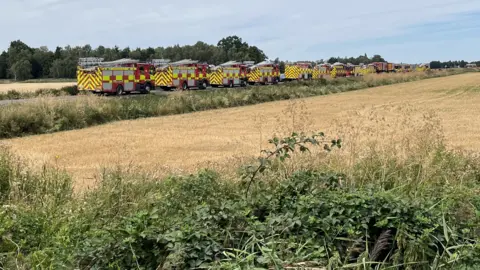
Firefighters have been tackling the blaze at Holme Fen since about 10:30 BST on Saturday, with at least 11 fire engines still remaining on scene.
At its peak, more than 80 firefighters and 14 fire engines were at the scene on Monday afternoon.
Crews from further afield – including Norfolk, Northamptonshire, Hertfordshire, and Bedfordshire - have been helping their Cambridgeshire colleagues.
Firefighters from the county had recently travelled themselves to help the effort to contain a major fire incident at Dunwich Heath in Suffolk.
Personnel from as far away as Merseyside are also due to help at Holme Fen in the coming days - with the site hit by two blazes in less than two weeks.
Cambridgeshire Fire and Rescue Service said it has the current fire surrounded and urged people to stay away from the area.
Incident commander Vicky Best said the service was planning to stay at Holme Fen until at least the end of this week.
The cause of the blaze has not yet been established.
Waterways around parts of Cambridgeshire have been closed to help efforts to put out this wildfire.
Firefighters are using supplies from waterways managed by two local drainage authorities, which have now closed locks around the Fens so boats do not end up grounded.
Paul Burrows, from the Middle Level Commissioners authority, said: "It's a decision we have taken due to the uncertainty of water levels in our system."
Several waterways have been closed until the "demand for water to fight the fire is over", the authority said.
These include Yaxley Lode, New Dyke, Monks Lode, Great Raveley Drain, Bevill's Leam, west of the pumping station, and Lodes End Lock, on the Old River Nene.
Why are peatland fires so hard to tackle?
 John Devine/BBC
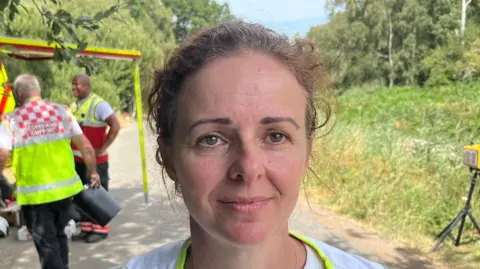
Best says crews are working in very hot conditions and that trees have been falling down around them.
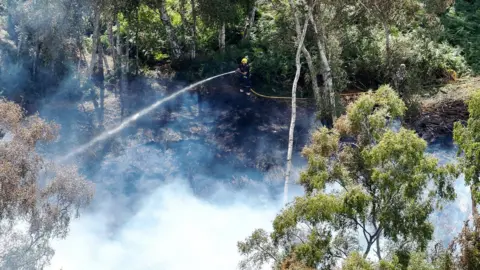
Peat fires can be a struggle to deal with as they can travel undetected several metres underground.
More than 40 firefighters first attended the site on 27 July to tackle the separate blaze, which the fire service said was "deep-seated in peat", making it likely to burn for longer.
Crews were stood down four days later on 31 July.
The fire is believed to have been started deliberately, with Cambridgeshire Police investigating how it started.
 Cambridgeshire Fire and Rescue Service
At the time, the fire service's incident commander Nev Burgess told the BBC: "My previous experience is that these do tend to last for days as opposed to hours because of the type of fire that they are and the access we need."
It was "incredibly difficult" to know the exact location of peat fires "because it burns under the surface and it burns quite fiercely", he added.
On Sunday, Suffolk Fire and Rescue Service said underground temperatures at parts of Dunwich Heath, which includes sections of peat, had reached 600C (1,112F).
The Suffolk wildfire broke out on 29 July and the major incident there was stood down on Monday, 12 days later.
What local impact is the fire having?
 John Devine/BBC
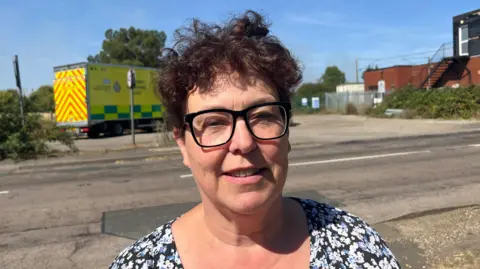
Julie Heap said she was no stranger to seeing fires at Holme Fen in Cambridgeshire, but the latest one has been different.
"You can see the smoke coming closer, the ambulances are right outside the house and the rapid response team are all there. It's quite scary," said Heap, who lives on Station Road in Holme.
"We've known the peat fires but it's always seemed to be more inside the fen, inside the woods, not as close to the houses as it seems to be this time," said Heap.
 Tom Jackson/BBC
Despite its proximity to the railway, a Network Rail spokesperson said on Monday the fire was having "no operation impact at present", adding it was monitoring the situation.
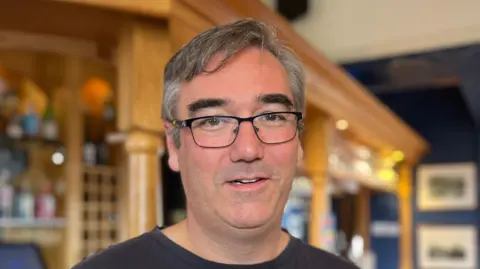
Mark Whittington, landlord of the nearby Admiral Wells pub, says the "commotion" in the area was unusual.
"It's such a sad sight, though, when you look over the railway track and see all the beautiful peat woodland there that's been there a long while," he says.
BBC journalist John Devine reported from the scene on Monday and told how he could see thick plumes of smoke billowing from about 10 miles (16km) away as he travelled there.
"When you approach the place, the smell really gets into your car. You can smell it from miles away," he says.
"It's a bit like driving through mist or fog."
Do you have a story suggestion for Cambridgeshire? Contact us below.
Follow Cambridgeshire news on BBC Sounds, Facebook, Instagram and X.