Trump wants to be friends with Kim - but South Korea could pay the price

 Reuters
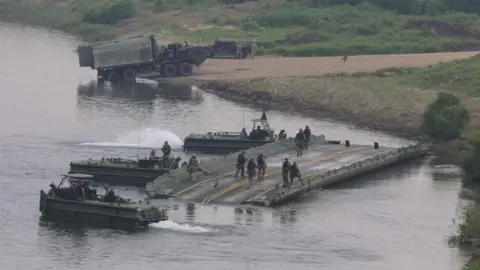
South Korea's annual military exercises with the US come to an abrupt end on Friday.
Ulchi Freedom Shield, which involves 18,000 South Korean troops and 11 other American ally nations, is being halted with only half of the scheduled programme complete - days after US President Donald Trump announced he had ordered the Pentagon to "substantially reduce" the drill.
This revelation by Trump, who called the exercise "inappropriate and hostile" towards North Korea and costly to the US, caught his allies by surprise.
Seoul's Foreign Minister Cho Hyun tried to paint the decision as one of mutual agreement, but admitted officials did not know of Trump's intent to scale down the exercise in advance.
The move will also have rattled the likes of Taiwan and Japan, which have long relied on US security guarantees in the region.
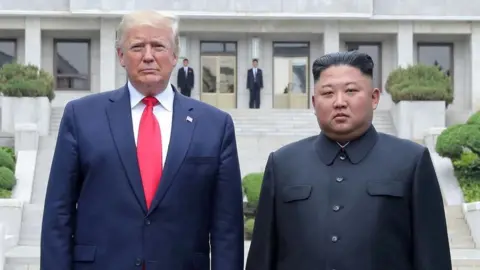
Trump, who has also criticised Seoul for refusing to take part in action against Iran, has said he expects to meet North Korean leader Kim Jong Un later this year.
And while South Korea has long been keen on Trump reaching out to Kim as a means of maintaining diplomacy, it would not have wanted it to come with demands for cash and military assistance in Iran.
The US-South Korea alliance
Seoul considers the annual exercises with the US core to the alliance and a demonstration of US commitment to defend it against Pyongyang.
Although it has traditionally been happy to scale down or suspend the exercises in order to lure North Korea to peace talks, Trump's unilateral and sudden decision to pull his troops early has shaken South Korean confidence in the US as an ally, according to Jo Bee-yun, a Senior Research Fellow at the Atlantic Council.
There is a fear that Trump may go further and draw down the 27,000 US troops stationed in South Korea or even abandon the longstanding policy of denuclearising the North - all without consulting its ally.
The two Koreas are technically still at war since they did not sign a peace treaty after the Korean War. Reuniting with the South had always been a key, if increasingly unrealistic, part of the North's ideology until Kim abandoned it in 2024.
Despite this, the threats against the South haven't stopped. Days before the military exercise, North Korea launched ballistic missiles towards Japan and repeated a warning that it had the right to exercise its nuclear weapons should the country be threatened. More missiles were launched on Thursday.
A larger concern for South Korea this time is that the Trump administration no longer separates security and trade issues. Trump said he was unhappy with South Korea's refusal to join him in his war in Iran but he also has been unhappy with it as a trading partner.
His administration has complained that the country's $1bn (£734m) annual spending to host the US troops is not enough, that it is dragging its feet in investing the $350bn it has pledged, and that it is discriminating against US companies operating in the country.
Now that trade disputes are evolving into national security concerns, some have called for South Korea to reduce its reliance on the US.
Cheong Seong-chang, vice-president at the Sejong Institute think-tank and a proponent of South Korea developing its own nuclear weapons, says Seoul must maintain its alliance with the US but also "take steps to acquire its own nuclear deterrence".
While the majority of its public supports a nuclear South Korea, the government has argued that acquiring the bomb is unnecessary and even harmful to the country's network of alliances. Such thinking could shift if the US withdraws further from Asia.
 EPA
EPAMeanwhile, South Korea has been trying to make the best of Trump's decision to end the drills early.
President Lee Jae Myung, who has sought to repair relations with the North, praised Trump in a post on X. "I believe [your social media post] was a bold decision that is the result of your deep consideration to achieve peace," he wrote.
Lee pledged to increase his country's defence spending and said he "fully agrees" with Trump's view the country should be responsible for its security.
Since Trump's first term, Seoul has seen his seemingly capricious approach to diplomacy as both a risk and an opportunity. With a mix of flattery and blind optimism, Seoul succeeded in setting up a first-ever meeting between a sitting US president and Kim Jong Un in 2018.
However, immediately after the meeting, Trump suddenly announced a suspension of joint military drills with South Korea.
He walked away from a second meeting in 2019 without an agreement when Kim refused to give up his entire nuclear facilities. Beyond the brief made-for-TV meeting at Panmunjom later the same year, the two leaders haven't engaged in any substantial negotiation.
Kim Jong Un in a strong position
It was Seoul that bore the brunt of Pyongyang's ire following these summits. North Korea demolished the South's liaison office in its territory and later swore off all communication with them. It introduced a new law making sharing of South Korean films and TV shows punishable by death, and codified the right to use nuclear weapons in its constitution.
Meanwhile Trump has maintained that he enjoys a "great relationship" with Kim, telling reporters on Wednesday: "He likes me".
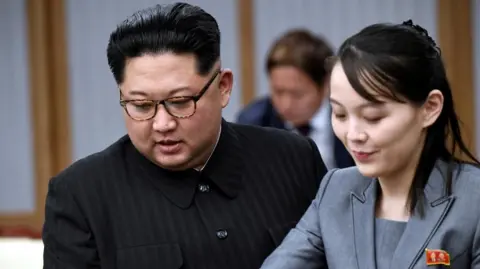
But Kim's powerful sister, Kim Yo Jong, said in a statement that she knew nothing about Trump's claim her brother had contacted him recently, adding it "must be the only thing I am unaware of in our foreign policy".
She also repeated the North's position that it would never give up its nuclear weapons as they enhance the balance and stability of the region.
Kim Yo Jong also said the scaling down of the drills with South Korea "doesn't merit (her country's) interest nor comment", nor change their "hostile and offensive nature," she was quoted as saying in state media.
 Reuters
Although Trump said he would meet Kim Jong Un later in the year, few experts believe there will be another summit, especially while Kim is profiting from an alliance with Moscow and strengthening his relationship with China. Unless Trump is ready to publicly accept North Korea as a nuclear state, its key demand, there is no incentive.
The scaling down of the drills is already a major concession, not only for Pyongyang but also for Beijing, which shares the view that the exercises are a threat to its security.
It potentially also leaves the door open to further demands by North Korea at a time when the country appears stronger militarily.
Despite Trump's repeated claim that it poses no threat, the country has never stopped sharpening its fighting capability. It has tested nuclear bombs six times and has the capability to deliver them via long range missiles that can reach continental US.
More recently, the country has joined Russia's war in Ukraine, where it has supplied what is believed to be billions of dollars' worth of artillery shells and missiles, as well as at least 13,000 troops. While it has suffered thousands of casualties, its troops are now drone-savvy, having absorbed the lessons of the Ukraine war.
As Jo Bee-yun sees it, there isn't much South Korea can do to defend itself against the North, making its US alliance "a matter of life-and-death".