Care review leaves questions unanswered, parents say
 BBC
BBCParents of children with complex disabilities say a review into a therapy service has failed to answer key questions about their children's care.
The report identified failings including staffing shortages and communication breakdowns within Sirona Care & Health's children's therapy service. But families say it does not fully address the issues that led them to speak out.
In a statement, Sirona chief executive Jo Beer said it was a "balanced assessment" and the organisation was focused on "learning and improving".
The BBC has also spoken to two Sirona employees, who asked not to be identified, who alleged that cost-cutting may have impacted on care and experienced staff had left due to stress.
In December, families of children with scoliosis - curvature of the spine - said Sirona was failing to supply experienced physiotherapists to Claremont School in Bristol.
This followed a decision from the healthcare provider to reduce the number of physiotherapists at the school and instead instruct unqualified teaching staff how to manage the condition.
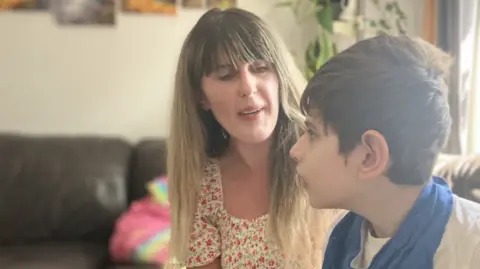
Among the parents is Claudia, whose son Matei attends Claremont School. She said she had faced a "huge battle" to make sure Matei's needs were fully met by his education, health and care plan (EHCP).
An EHCP is a legal document for children and young people aged up to 25 who need more support, and identifies educational, health and social needs. On this basis, it sets out the support a child or young person is entitled to.
With a number of complex physical disabilities including cerebral palsy, double scoliosis and a history of major hip surgery, Matei's family said they had to challenge the level of physiotherapy provision included in his EHCP.
'Huge battle'
"It was a huge battle," Claudia said, describing how she had been forced to challenge a recommendations made by Sirona in a draft EHCP for Matei.
"It was stressful - we got tired during this process because it's not just Matei, we have other children to take care of," she said.
An independent assessment warning that inadequate physiotherapy could worsen Matei's condition helped the family secure more detailed recommendations in his EHCP.
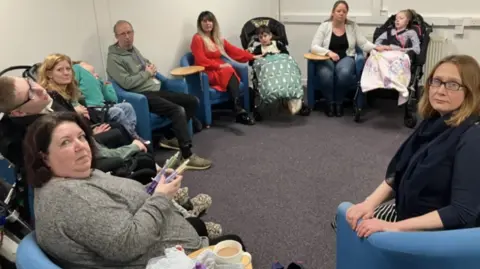
Another parent, Julian - whose daughter Gemma has a rare chromosome disorder and cerebral palsy - said important concerns remained unresolved.
"There is some acknowledgement of the issues, but also a lot of talk that frames the clinical issues as a 'difference of opinion' between NHS therapists and external private therapists," he said.
One of the review's recommendations is to establish clearer processes for resolving professional disagreements.
But Julian said there remained "a lot of ambiguity" about how the arrangements would operate in practice.
Sirona said it would not be appropriate to comment publicly on the circumstances of individual children or families.
Warnings from Sirona insiders
The BBC has spoken to two members of Sirona staff who asked to remain anonymous because they feared repercussions from speaking publicly.
One staff member said the leadership team brought into the children's therapy team in 2024 had focused on reducing costs, despite warnings from clinicians about the impact on children with complex needs.
This led to experienced staff leaving the service and others taking long-term sick leave because of stress and anxiety, they said.
A second staff member alleged reports to support EHCPs were sometimes produced in as little as 15 to 30 minutes, and claimed some recommendations were reduced by non-clinical managers before being sent to local authorities.
Both members of staff said the findings of the inquiry reflected concerns that frontline teams had been raising internally for a prolonged period.
Sirona did not comment on the allegations made by the two members of staff.
Failings identified
The review was commissioned after concerns were revealed by the BBC. It draws together findings from internal reviews and an independent inquiry involving therapists, families, school staff and commissioners.
It was not intended to investigate individual cases, but instead identify wider themes and opportunities for improvement.
While a number of positives - including commitment to children's care and the ability of therapy staff to adapt under pressure - were found, the following weaknesses were also identified:
- Therapists were not always supported by consistent training, supervision and senior clinical expertise
- Workforce losses had created risks around continuity of care and specialist knowledge
- Repeated concerns about specialist equipment, postural management and servicing arrangements
- Communication breakdowns had become "one of the deepest sources of mistrust", and trust between Claremont School, families and therapists had been damaged and required "structured repair"
- Concerns about demand exceeding capacity
- Confusion around EHCPs
- Tensions between NHS and private therapists, with families, therapists and school staff carrying a significant "emotional burden" as a result of the difficulties
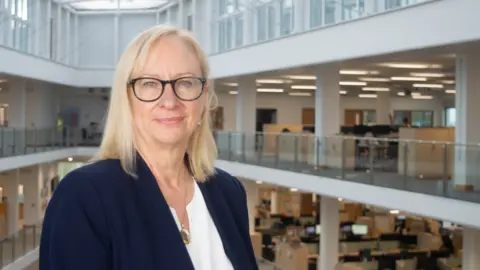
Beer said the report recognised the professionalism of staff while identifying areas where improvement was needed.
"It sets out a comprehensive programme of actions, many of which have already been started or are well under way," she said in a statement.
"These include strengthening clinical leadership, increasing specialist support, improving governance and oversight, investing in staff development, and working closely with families, schools, commissioners and partner organisations to strengthen the service."
She added: "Our focus throughout has been on listening, learning and improving. We remain committed to being open about where we need to do better while recognising the dedication of colleagues who continue to provide care for children with complex needs every day."
The BBC has approached Claremont School for comment.
Bristol City Council said the contractual responsibility for delivering children's therapy sat with the Integrated Care Board (ICB) but it remained committed to helping the ICB and Sirona "improve outcomes".
A spokesperson said: "To achieve this, we are working closely with Bristol Parent Carer Forum, Sirona and the ICB on practical solutions, including enabling private therapists to work in schools where appropriate and funding provision commissioned by parents where specified in Section F of a child or young person's EHCP.
"We are also supporting a regional review of school therapy services to help inform future improvements."
"Looking ahead, we will closely work with the ICB throughout the recommissioning process to ensure future contracts include clear performance measures, stronger reporting arrangements and greater accountability."
The ICB added that it is working with Sirona to consider the report and actions identified and "is monitoring this through contract and quality assurance arrangements.
"The ICB remains committed to ensuring children and families receive safe, appropriate and high-quality support."
Follow BBC Bristol on Facebook, X and Instagram. Send your story ideas to us on email or via WhatsApp on 0800 313 4630.