'Supported housing saved me - now I'm going to university'

 MICK LUNNEY/BBC
Rose* was just 19 when she entered supported accommodation after an abusive home life left her feeling "desperate".
The effect on her mental wellbeing was "crippling" and she reached out to the college she attended for help in finding a housing placement.
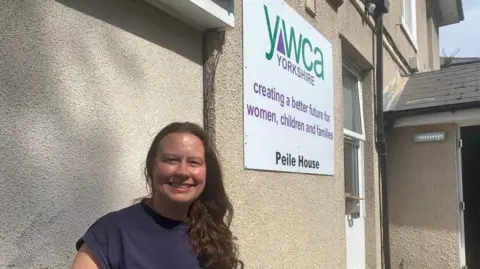
She was referred to the Young Women's Christian Association (YWCA) centre in Sheffield, Peile House.
As well as providing her with accommodation and support, she was given help with her living costs under a scheme called Future Forward.
Rose is now preparing to go to university to study law, thanks to the stability she found at Peile House.
 MICK LUNNEY/BBC
"I just want to have a better life, make a better life for my kids if I end up having any," said Rose, who does not use her real name.
The Future Forward scheme was a nine-month project that directly supported 24 people aged 16-25 out of financial hardship and into the workplace or study. It granted them money to reduce their rent costs.
Rose said: "When I was at home it was very chaotic, it was very loud, it was scary, it was abusive and unsafe. I knew I couldn't do it anymore."
Her referral led her to Peile House, a large complex in Pitsmoor where she found sanctuary while studying for her A-Levels.
"I was in year 12 when I moved out, and I was able to actually revise and have staff here to talk to about everything, to process what I was going through."
The YWCA's project manager, Claire Harding, explained that supported housing placements were vital for young people from disadvantaged and abusive backgrounds, but costs for a room ranged from £200-500 per week.
Housing benefit rules could create "unintended disincentives' for people living in supported settings to work, as they could be left worse off if earning a wage.
She said: "The help given through the scheme has shown the young people and others that they could afford the rent, get used to paying rent, shown that they could budget, know how much things cost, without having the disadvantage of 'extortionate' service charges."
For Rose, the effects of such financial and practical help have been significant. She has a part-time job and felt she was not "punished" by having to work more hours to pay more rent because of her participation in the scheme.
In September she takes up her university place.
"I want to be a solicitor one day. I want to be a judge eventually. I want to help people.
"I think I've experienced a very positive transition in supported accommodation. I came from being someone who thought I had no chances anymore to going to study law, and I'm really proud of myself for making that change and for giving myself a chance."
Listen to highlights from South Yorkshire on BBC Sounds, catch up with the latest episode of Look North