Summary

Media caption,
Watch: Canada will negotiate if US has the "right attitude", says Mark Carney speaking on Monday
  1. Analysis

    Trump has sharpened his rhetoric, but political fallout could be damagingpublished at 16:04 BST 25 August

    Anthony Zurcher
    North America correspondent

    While we wait for Canadian ministers to provide an update, we can bring you analysis from our North America correspondent:

    US officials were reportedly surprised that Canada walked away from trade negotiations over the weekend.

    The next step for America’s northern neighbour, to announce a series of targeted retaliatory tariffs, has been telegraphed for days, however.

    It represents the latest ratcheting up of a growing dispute between two nations that, combined, account for more $872bn in bilateral trade in goods and services.

    Donald Trump has sharpened his rhetoric, repeatedly accusing Canada of "ripping off" the US. But the political fallout here in America is likely to be damaging to his Republican Party.

    While there are certain segments of the US economy that will ultimately benefit from the administration’s confrontational approach to trade negotiations, the pain will be more widely shared - particularly in states like Michigan and Ohio, which depend heavily on trade with Canada.

    Midwest states in particular have been a key part of Trump’s political coalition - and will be prominent battlegrounds in November’s midterm congressional elections - raising the stakes for the administration as it seeks to prevail in what is becoming an increasingly contentious economic confrontation.

  2. Canadian officials about to respond to Trump tariffs - watch and follow livepublished at 16:00 BST 25 August
    Breaking

    In the next few minutes, several Canadian officials will announce the country's response to Trump's tariffs.

    Finance Minister François-Philippe Champagne will be joined by other ministers to outline measures that will be taken to "protect and support Canadian workers and businesses".

    We're expecting the news conference to get under way at 11:00 ET (16:00 BST) - part of the update will be in French.

    You can watch live at the top of this page, and we'll bring you the latest updates. Stay with us.

  3. Three ways Canada could have leverage in trade disputepublished at 15:55 BST 25 August

    Jessica Murphy
    BBC News, Toronto

    Canada’s Prime Minister Mark CarneyImage source, Reuters

    Canada sells around 70% its goods to the US, so what leverage does it have in this trade dispute?

    Energy and critical minerals

    Carney said Canada supplies the vast majority of US natural gas and electricity imports and about 60% of crude oil imports. Squeezing the US on energy is not a current countermeasure, but it hasn't been ruled out.

    Canada also has significant reserves of critical minerals like lithium, nickel and graphite - another area where Ottawa could apply pressure.

    Purchasing power

    Even before trade talks broke down, a decision by most provinces to ban US alcohol from liquor store shelves - in response to the first wave of US tariffs early last year - dealt a devastating blow to that industry in the US.

    The boycott remains in place in 11 out of the 13 provinces and territories, with US wine exports to Canada falling by 78% year over year, a $357m (C$494m; £261m) loss in export value, according to government data.

    Political pressure

    The US midterm elections are fast approaching, with the economy front and centre for voters and the Republican hold on Congress looking tenuous.

    Two of the biggest Senate races are in Michigan and Maine, which both border Canada and send most of their exports there.

    The Yale Budget Lab calculates that under current law, Trump's global tariffs will cost American households about $1,100 annually.

  4. Analysis

    This is a gamble for Carneypublished at 15:50 BST 25 August

    Michael Race
    Business and economics reporter, in New York

    Mark Carney, an older white man with short hair wearing a blue suit talking into a microphone.Image source, Getty Images
    Image caption,

    Canadian Prime Minister Mark Carney speaking about the trade dispute at the Davie Shipyard, in Quebec, on August 24

    With Donald Trump it could be argued that it is right to expect the unexpected.

    But the US president did not end these trade negotiations, his Canadian counterpart Prime Minster Mark Carney decided to walk away first.

    This now places the neighbouring nations, who have been long-term allies and enjoyed decades of free trade, in uncharted waters, and it's a gamble from Carney.

    He has the backing of the majority of Canadians, but is up against the might of the world's largest economy.

    While the rhetoric between the two sides has stepped up a notch, it could be argued that this is all part of a negotiation plan to eventually return to the table and strike a deal.

    As we've seen before, deadlines can be extended and compromises made.

    Trump's latest threat to impose US tariffs on cars being built and imported from Canada has a deadline of 1 January, which provides a long time for things to change.

  5. US 'seriously considering' renaming Lake Ontario to 'Lake America' - Trumppublished at 15:44 BST 25 August

    US President Donald Trump says the US is giving "serious consideration" to changing the name of Canada's Lake Ontario to "Lake America".

    It comes as a war of words between the US and Canada has ramped up in recent days following failed trade negotiations.

    In a post on Truth Social, the US president adds "we don't expect to [be] doing much business with Ontario any longer".

    Lake Ontario straddles the US-Canada border. To the north is Ontario, Canada, and to the south is New York, US.

    Ontario Premier Doug Ford had accused Trump of behaving "like a bully at school" in the trade war.

    Map of eastern Canada and the northeastern United States showing the location of Lake Ontario. A black box highlights the Lake Ontario region along the Canada-US border. Labels identify Canada, Ontario, the United States, New York, and Lake Ontario. The Great Lakes are visible, and a scale bar indicates distances of 500 km and 200 miles. BBC logo appears in the lower-right corner.
  6. What does this trade war mean for consumers?published at 15:38 BST 25 August

    Michael Race
    Business and economics reporter, in New York

    Shipping containers in a yard in Detroit, Michigan, USA, 25 August 2026Image source, EPA/Shutterstock

    Tariffs, in short, can lead to higher prices for consumers over time.

    That's because the tariff - which is an import tax - is paid for by the business, or person, bringing in the product to a country and businesses might decide to pass on higher costs to customers via higher prices in the shops.

    But while prices may rise in the short term, businesses over time may end up switching from importing goods from other countries to buying supplies domestically, which could boost that country's jobs market and wider economy.

    Therein lies President Donald Trump's vision of tariffs. He believes tariffs will boost American manufacturing and jobs - parts of the US were hollowed out economically when free trade deals resulted in industrial jobs heading overseas.

    He also uses them as a bargaining chip in negotiations with other countries. Given the US's position as the world's largest economy, there are many countries - and businesses within them - that want access to the American market.

    Trump has seen some results since introducing tariffs so far, with household names such as Apple announcing big US investment plans.

  7. How did we get here?published at 15:24 BST 25 August

    Jacob Phillips
    Live reporter

    U.S. President Donald Trump speaks with Canadian Prime Minister Mark Carney.Image source, Reuters

    1 February 2025: Shortly after returning to the White House, US President Donald Trump introduces sweeping tariffs against Canada, Mexico and China. Under the leadership of Prime Minister Justin Trudeau - who had resigned a month earlier - Canada places counter tariffs on billions of dollars of US goods.

    March 14 2025: Former Bank of England governor Mark Carney is sworn in as Canadian prime minister after winning the leadership election days earlier.

    August 2025: Carney announces Canada will drop some of its retaliatory tariffs, but will keep levies on cars, steel and aluminium.

    July 2026: Trump ramps up tariffs against Canada in retaliation to what he called the "unequal treatment" of US cars, dairy and alcohol.

    19 August 2026: Trump says he will delay imposing fresh tariffs as the US and Canada close in on a trade deal. Carney asks Canadians to put US alcohol back on store shelves.

    22 August 2026: Talks break down. Carney blames "unfair, uneconomic" last-minute changes from the US. The US says its offer would see Canada "receive the best treatment of any major exporter". New US tariffs come into effect and the Canadian PM promises to respond "dollar for dollar".

    24 August 2026: Trump says he will be increasing tariffs on Canadian cars, trucks and automotive parts starting in January and accuses Canada of "ripping off" the US for years.

    25 August 2026: Canadian officials will announce their response to Trump's tariff threats - we'll be bringing you the latest updates when the news conference gets under way shortly.

    Return to the latest post
  8. Analysis

    Trump and Carney's relationship was bound to unravelpublished at 15:15 BST 25 August

    Nadine Yousif
    Senior Canada reporter

    Prime Minister Mark Carney and President Donald Trump had initially got off on the right foot.

    But with Trump’s unpopularity in Canada, and Canadians’ anger over Trump’s tariffs and threats to make their country the "51st state", that relationship was bound to unravel.

    Even with both sides claiming last week that they were close to a trade deal, Canada ultimately walked away because, it says, the US had presented terms that it cannot accept and that interfered with its sovereignty.

    US-Canada relations are now arguably at their lowest point yet.

    The US has tariffed a number of key Canadian sectors and businesses and is threatening to hike those levies even more. Canada is threatening to hit back by matching these tariffs "dollar-for-dollar".

    The economic escalation was matched with a war of words that reached a fever pitch on Monday.

    Heated rhetoric aside, this trade war threatens billions of dollars in trade between Canada and the US.

    It risks job losses and lost revenue for businesses on both sides of the border, while pushing up prices for everyday consumers.

    It also puts the entire future of North American free trade - valued at $1.6tn - into question.

  9. Canadians say trade dispute is 'distressing' and 'ridiculous'published at 15:07 BST 25 August

    We've been hearing from Canadians in the aftermath of the failed trade agreement.

    When asked by the BBC to describe the trade dispute, the responses include "distressing", "absolutely ridiculous" and "unnecessary".

    "Canada and the US have been friends, partners, neighbours, for decades," says Ontario resident Moses. "This should not be happening."

    "The bulk of our economy is currently angled towards America," adds fellow resident Marc. "It's something that is very concerning but I have not been losing sleep yet."

    You can hear the reaction from more Canadians in the video below:

  10. Trump says Canada is the most 'difficult and unreasonable' country to deal withpublished at 15:00 BST 25 August

    In a post on Truth Social a few minutes ago, Donald Trump reiterated his claim that Canada has been "ripping off" the US for decades.

    Here is the full post:

    "Canada has been “Ripping Off” the U.S.A. for decades. They have been charging our Farmers 400% Tariffs, and more.

    "They have driven many wonderful U.S. companies out of business. For 10 years they wouldn’t certify Gulfstream Jets, until I got involved.

    "They wanted 100% of the market for Gulfstream’s Canadian competitor. I deal with many countries, and Canada is easily the most difficult and unreasonable.

    "They feel entitled, but they are not a State, and will be entitled no longer!"

  11. Trump and Carney's back and forth - what we've heardpublished at 14:58 BST 25 August

    US President Donald Trump and Canadian Prime Minister Mark Carney both in suits sat next to each other.Image source, Reuters

    Trade negotiations between the US and Canada fell apart on Friday and new US tariff hikes have escalated tensions between the two countries.

    Here's what we've heard:

    Mark Carney ended trade negotiations on Friday, saying the US's proposed terms "were unfair, uneconomic, and called into question the reliability of any deal".

    Trump then imposed a 50% tariff on some Canadian exports. He accused Canada of "ripping off" the US for years and being one of the "worst nations in the world to deal with".

    In response, Carney said he would match Trump's tariffs "dollar for dollar" on US exports from 8 September.

    On Monday, Trump announced he would increase tariffs on Canadian cars, trucks and automotive parts to 50% starting in January, up from their current 25%.

    In a news conference shortly after, Carney said Canada had been "pragmatic, patient and persevering" in trade negotiations.

    "We could not accept what the US has offered, nor could we give what they asked," he said.

    He added that Trump wants to "destroy" Canada's large industries, including its automobile industry.

    We're expecting to hear more from Canadian officials shortly, and we'll bring you Trump's latest comments on Truth Social in our next post.

  12. Canadian officials to announce response to Trump tariff threatspublished at 14:55 BST 25 August

    Manish Pandey
    Live reporter

    Canada’s Prime Minister Mark Carney speaking into a black microphone, with two of the red and white Canadian flags behind him. His hands are raised and he is wearing a blue suit and tie.Image source, Reuters
    Image caption,

    Canada's Prime Minister Mark Carney said he will negotiate if the US have the "right attitude"

    Canada is expected to announce its response to new US tariff threats after trade talks collapsed late on Friday.

    The breakdown of negotiations triggered new 50% US tariffs on a range of Canadian goods, effective immediately, and Canada’s Prime Minister Mark Carney said he would match US President Donald Trump's tariffs "dollar for dollar" starting 8 September.

    On Monday, the US president threatened to increase tariffs on Canadian cars and trucks, as well as auto parts, from 25% to 50% as of 1 January.

    In response, Carney accused Trump of wanting to "destroy" Canada's auto industry and that he would not return to the negotiating table until the US returned with the "right attitude".

    Canadian officials, including business and finance leaders, will outline how the country will respond to the trade war in a news conference at 11:00 ET (16:00 BST).

    You'll be able to follow that news conference as it happens and we'll bring you the latest updates and analysis on this page.

  13. US-Canada trade war ramps up as Trump threatens auto tariffspublished at 22:19 BST 24 August

    Sakshi Venkatraman
    US reporter

    A trade war between US and Canada has escalated today as leaders on both sides of the border exchange threats.

    It kicked off after talks to reach a trade deal fell apart late on Friday, and then on Monday US President Donald Trump fired a major economic shot at Canada in announcing he would place a new 50% tariff on vehicles imported from the country.

    Here's what's happened since then:

    • Trump accused Canada of "ripping off" the US for years and being one of the "worst Nations in the World to deal with"
    • Reviving his depictions of the country to the north as a 51st state, he added that "Canada will be treated like a State no longer!"
    • Canadian Prime Minister Mark Carney said the new levies were unsurprising, but confirmed he would match Trump's tariffs "dollar-for-dollar" from 8 September
    • Carney also said he would not return to the negotiating table until the US returned first with the "right attitude"
    • US Vice-President JD Vance said Canada needed to stop "taking advantage of the US"
    • Ontario Premier Doug Ford, leader of Canada's biggest province by population, had some choice words for Trump, saying he could "kiss my ass" and Canada should put pressure on Republican-majority US states

    Meanwhile, small business owners in both the US and Canada say they are already feeling the impacts. In the US, that's through increased prices on Canadian goods, and in Canada, it means fewer orders from a major market.

    We're ending this live coverage, but you can read more about the tariffs here.

  14. Portland small business is 'literally stuck' after new tariffs imposedpublished at 21:28 BST 24 August

    Ana Faguy
    US reporter

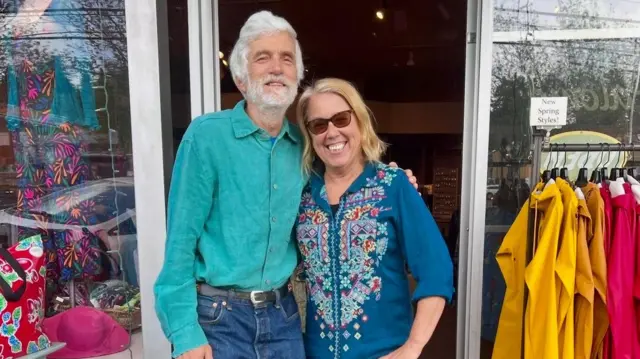
    Mike Roach and Kim Osgood outside their shopImage source, Carley King
    Image caption,

    Mike Roach and Kim Osgood

    Mike Roach and Kim Osgood, owners of Paloma Clothing in Portland, Oregon, are preparing for one of their best-selling items to potentially increase sizeably in price.

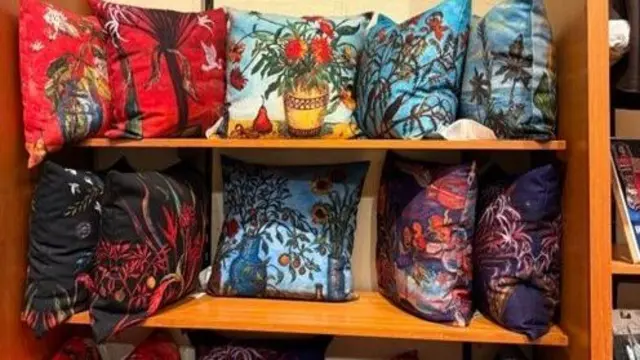
    Osgood creates designs that she has a Montreal-based company transfer onto pillows the couple sells in their store.

    Those pillows are their best-selling gift item, retailing at $59. With the newly imposed tariffs, a normal markup would bring the price of that pillow to somewhere between $86 and $90, Osgood told the BBC.

    "Gift items are really price-point sensitive; people have in their mind what they're going to pay for a gift, and they're not going to pay more than that," Roach said.

    The couple, whose shop has been operating for 51 years, say they will likely hold the original price and hope the "tariff problem," as Roach calls it, gets worked out.

    "It would be one thing if we had three months' notice; that would be something you could plan around, do some work with the vendors, but when it happens literally overnight you're really stuck," he said.

    Pillows on a shelfImage source, Carley King
    Image caption,

    Pillows for sale at Paloma Clothing

  15. Fake beards, bookbinding machines and other unexpected imports to be taxedpublished at 21:02 BST 24 August

    The range of products from Canada that will be subject to the 50% US tariff is wide and, at points, odd. While common goods like certain types of dairy, alcohol, plants and plywood will be taxed, a list published in the Federal Register also included some unexpected items, such as:

    • Ossein and bones treated with acid
    • Horsehair and horsehair waste
    • Wigs (partial), false beards, eyebrows and the like, of synthetic textile materials
    • Brewery and bookbinding machinery
    • Antiques aged between 100 and 250 years
    • Men's, women's, boys' and girls' track suits, not knitted or crocheted of man-made fibers
    • Articles of wood other than bamboo, including pencil slats and gates for confining children or pets
  16. Canada's opposition leader demands Parliament reconvenepublished at 20:52 BST 24 August

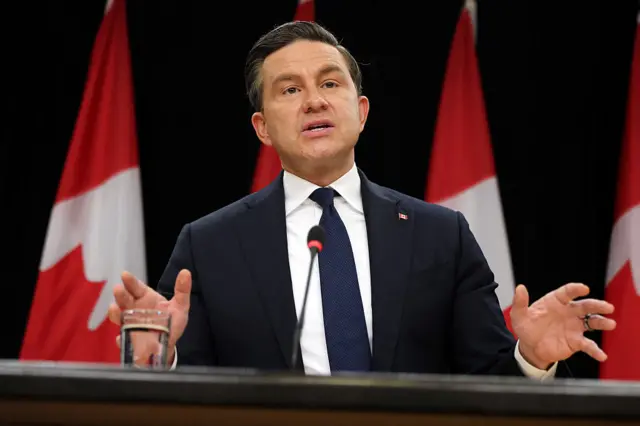
    Pierre Poilievre, opposition leader of Canada's Conservative Party, is urging Prime Minister Mark Carney to immediately reconvene Parliament to discuss the fresh trade war with the US.

    Parliament must convene, he says, to confront three urgent matters:

    1. He wants to know what specifically was in the deal that both sides abandoned when trade talks fell apart, and calls for the deal's text to be released
    2. He asks how much Canada's reciprocal tariffs on US exports will affect Canadian taxpayers, worsen inflation, and increase prices of groceries and gas
    3. He also asks to know how Canadian jobs and industry - specifically in the steel, lumber and auto sectors - will be protected from the tariffs

    "Canadians deserve answers on how trade talks collapsed, what tariffs will cost their families, and how their jobs will be protected," Poilievre says.

    A man in a suit gestures from behind a lectern against a backdrop of Canadian flagsImage source, Getty Images
  17. Most Canadians back Carneypublished at 20:30 BST 24 August

    Nadine Yousif
    Senior Canada reporter

    One thing that sets Prime Minister Mark Carney apart from President Donald Trump is his popularity among his electorate.

    Carney’s approval rating more than a year and a half into his mandate is a healthy 60%, according to an August national poll by Liaison Strategies. A recent Angus Reid poll suggests that 76% of Canadians feel their prime minister was right to ditch trade talks with the US.

    President Trump’s approval rate in the US, on the other hand, has fallen to 33% in recent weeks — the lowest of his presidency and a vulnerability ahead of November’s US midterm elections.

    Carney’s popularity gives him political leeway to respond defiantly to the US, with Canada’s provincial leaders and businesses backing him even if the escalation of the trade war brings pain to Canadians.

    But that doesn’t mean Canadians are not concerned about what comes next. Two in five surveyed by Angus Reid said they feared for their jobs.

  18. Canada has financial capacity to face US threats, minister sayspublished at 20:21 BST 24 August

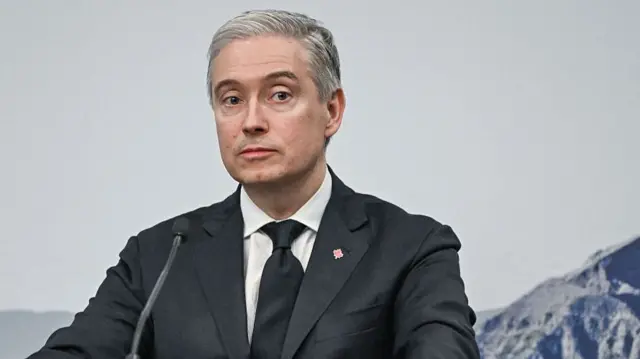
    Francois-Philippe ChampagneImage source, Getty Images

    Speaking to reporters earlier today, Canada's Finance Minister François-Philippe Champagne says his country is focused on supporting businesses through the latest round of US tariffs.

    He argues that Canada is operating from a position of strength, with the "fiscal capacity" and a very good credit rating that will help it to keep impacted businesses afloat and minimise job losses.

    Champagne adds that Canadians are realising "America has changed" and that "enough is enough".

    “When you have a close economic partner wanting to use integration as leverage in negotiations, as opposed to a basis for a win-win situation, I think it sends a message and it makes people reflect," he says.

    Champagne says that the rest of the world is taking note, and eyeing Canada as a reliable trade partner.

  19. 'Small businesses are going to get smashed by this'published at 20:14 BST 24 August

    Ana Faguy
    US reporter

    Matteo Sgaramella sits on a concrete slab with the skyline of Toronto in the backgroundImage source, Matteo Sgaramella

    Like many retailers, Toronto-based menswear brand Outclass collects orders from clothing designers months before they are due to arrive in stores.

    Products that US stores ordered in January will arrive in September but now with a new tariff.

    "If I contact them now and tell them, hey, you know, you may get an extra 50% bill from UPS on top of what you need to pay me for this shipment, they're all going to say, 'no way, don't ship it,'" Matteo Sgaramella, the company's founder, tells the BBC.

    He still has to figure out where that additional cost will go.

    "There's going to be a lot of people that go out of business because of this," Sgaramella says, but notes that only 20% of his wholesale sales and 20% of his e-commerce come from the US.

    "Big business can, you know, always find a way... but small businesses are going to get smashed by this."

  20. Trade dispute 'insane', says US couple in Canadapublished at 19:57 BST 24 August

    Eloise Alanna
    BBC News

    Taking shelter from the rain beneath the entrance to Montreal's Bonsecours Market, Kim and Harry Murphy - a married couple visiting from Delaware - say they were dismayed by the tariff tensions between Canada and the US.

    "We hate what's happening in our country," says Kim, who described the dispute as "insane". Harry adds that the couple had found themselves apologising to Canadians during their trip.

    Despite the political tensions, both say they had been met with warmth and kindness throughout their visit.

    While hopeful that relations between the two countries can eventually recover, Kim says rebuilding trust, particularly in Canada, could take time.

    Harry says he believed ties would return to normal in the future, adding that he remained optimistic about the long-standing friendship between the neighbouring nations.

    A man and a woman wearing rain gear smile at the camera, he has his arm around her