Summary

Media caption,
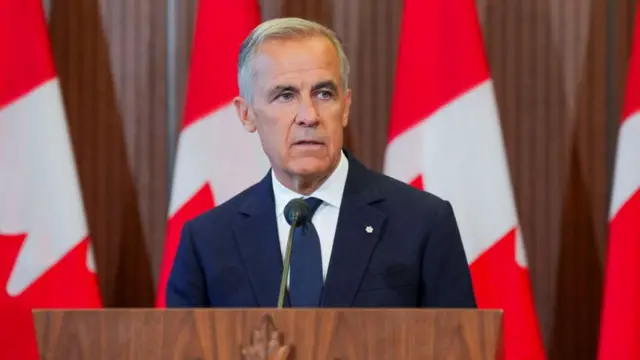
Watch: Canada will negotiate if US has the "right attitude", says Mark Carney speaking on Monday
  1. Electricity and critical minerals could be key in trade war, says Fordpublished at 19:45 BST 24 August

    Two potential battlegrounds in Canada's fight against US tariffs are critical minerals and electricity, Ford continues.

    "We could put massive, massive pain on the US," he says. "President Trump underestimates us."

    Ford points out that Canada has rich reserves of certain critical minerals that can be used as leverage in trade dispute with its southern neighbour.

    He says he and Canadian Prime Minister Carney also spoke about a 25% surtax on electricity from Ontario, and Carney agreed it is on the table.
  2. Ford stands by his choice words for Trumppublished at 19:38 BST 24 August

    Speaking on a radio programme earlier today, Ford said US President Donald Trump could "kiss my ass".

    He was just asked by a reporter if Prime Minister Mark Carney told him to tone down his language. "No," the premier says, doubling down on his earlier comments.

    "I have a lot of real estate on my ass, so he has a lot of room to kiss my ass. I'm a big dude."

    Media caption,

    Watch: Doug Ford's blunt warning to Trump over Canada tariffs

  3. Ford comments are bluster, Trump writes on Truth Socialpublished at 19:34 BST 24 August

    US President Donald Trump has responded to comments made by Canadian premier Doug Ford, who is currently speaking and who said Trump was "like a bully at school" as trade talks collapsed over the weekend.

    Writing on his Truth Social platform, Trump characterises Ford's scathing remarks as "lots of 'bluster'" and calls Ontario's premier as "the less charismatic, intelligent, and overall unimpressive brother" of former Toronto mayor Rob Ford, who died in 2016.

    "Trump America has been carrying Canada for decades, but no longer! The USA. will always be far bigger, richer, and stronger than Canada," Trump says, adding that, without the US, Canada "couldn’t survive".

    "It’s where they get all of their money and, because of their current bad leadership, primarily Governor Carney, and his Flunky, Ford, they will not be allowed to keep taking advantage of the United States — Their key to survival," he says.

    "Someone should get these clowns to 'fall in line' or, the consequences for Canada will be far WORSE!"

  4. Canada needs to target Republican US states in fight against tariffs, Ontario premier sayspublished at 19:15 BST 24 August

    "Everything needs to be on the table" in Canada's fight against US tariffs, Ontario premier Doug Ford says, including specifically targeting Republican US states and "making sure America's economy feels the pain".

    "We need to use Canada's many points of leverage to create maximum impact," he says, adding: "Americans are already feeling the pain."

  5. Ontario premier says Canada will not 'roll over' for US dealpublished at 19:03 BST 24 August

    Doug Ford, premier of the Canadian province Ontario, is now speaking to the public.

    Ford says Prime Minister Mark Carney has his "full support" in walking away from a "bad deal".

    He says the US proposal would have "hurt Canadian workers and undermined Canadian sovereignty".

    Canadian leaders need to "make clear to President Trump that Canada is not for sale", he adds.

    "We're not going to roll over," he says. "We're going to stand up for our country."

  6. Canada chose to reject 'good deal', says Bessentpublished at 18:49 BST 24 August

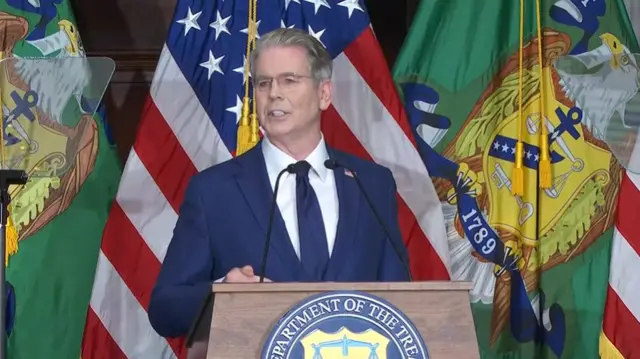
    Scott Bessent standing at a podium in front of American and other colorful flagsImage source, Reuters

    Like Canadian PM Carney, US Treasury Secretary Scott Bessent has also been speaking at a press conference, where he is asked if President Trump is still interested in making Canada the 51st US state.

    "I think he would like Canada to come to the table and negotiate in good faith. They were offered quite a good deal last week. They chose to reject it," Bessent answers, echoing recent comments from Trump administration officials blaming Canada for the failed trade talks.

    Bessent says Carney rose to power on an "anti-American, anti-Trump platform", and questions why he would reject the deal if he truly has the Canadian people's interests at heart.

  7. US felt French language laws were 'irritants' in talks, says Carneypublished at 18:41 BST 24 August

    The Canadian PM is also asked to respond to comments made earlier today by US trade representative Jamieson Greer on the role Quebec's language laws have played into the collapse of negotiations.

    The prime minister says the US made requests that he deemed "non-negotiable" about the requirement on US businesses to label their products in both English and French.

    Greer has dismissed this, telling CNBC on Monday morning that it is a "funny, fake story".

    Speaking to reporters just now, Carney says Quebec language laws have been raised as "irritants" by the US. But, he adds, to Canadians they are "fundamental rights".

    "This is not a funny fact for Canadians," Carney says to applause.

    He adds that in the last hour of negotiations, conversations around the French language, including its use by streaming companies like Netflix, were also brought up.

    The press conference at which he was speaking in Quebec has now ended.

  8. Carney says he'll return to the negotiating table - but only if the US does firstpublished at 18:36 BST 24 August

    Carney says Canada will return to the negotiating table with the US, but only under the right conditions.

    "When the Americans return to the negotiating table first with the right attitude toward our industries and a true partnership, of course we'll come to the negotiating table," he said.

    The US can't act like "Canada is a subsidiary of the United States", or that Canadian industry is going to be disadvantaged.

    "That's not something we're going to accept," Carney added.

  9. Trump's latest tariff threat is not surprising, says Carneypublished at 18:19 BST 24 August

    Prime Minister Mark Carney is now taking questions from reporters in Quebec.

    He is asked about Donald Trump's latest escalation of the trade war by threatening to increase US tariffs on cars and trucks originating from Canada to 50%.

    Carney says the threat is not a surprise, adding that it is revelatory of what he says are US intentions to destroy Canada's large industries, including its automobile industry.

    He also says that US workers will be hurt by Trump's threat to increase tariff on autos.

    "What is the message sent out to the workers in Michigan, Ohio, Kentucky, Alabama? These workers depend absolutely on Canada, their largest consumer," he says, adding that Canada buys more American cars than the EU and other countries.

    Carney says policy makers around the world should take note of Canada's actions and response to the US.

    He adds that there is a "mutually beneficial deal" that Canada and the US can come to, but it has to be one that respects Canada's sovereignty.

  10. Canada has one of the 'worst trade policies' in the world, says Vancepublished at 18:05 BST 24 August

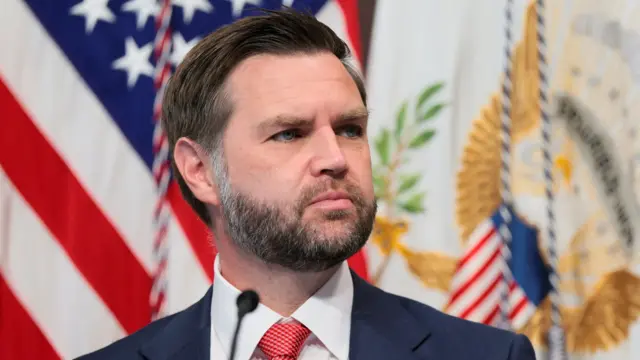
    US Vice-President JD Vance says the Trump administration's objective is to get a "fair deal" for states that do business with Canada.

    Speaking a short time ago in the US state of Maine, he also accuses Canada of having one of the "worst trade policies", along with China.

    "China, you of course expect. They are our biggest economic competitor," Vance says. "I would not expect that from Canada."

    Vance adds that Canada has underinvested in its military and would be invaded by a foreign country if it were not for "the umbrella of protection provided by the US".

    On the collapse of trade talks, he says: "What happened at the very end is [Canada] came in with a bunch of unreasonable last-minute demands. I frankly thought that we had a deal."

    He adds: "We need to send a message loud and clear to the prime minister to stop taking advantage of the US."

    A close-up shot of JD Vance, who looks to the rightImage source, Reuters
  11. Canadian premier says country must push back against Trumppublished at 17:59 BST 24 August

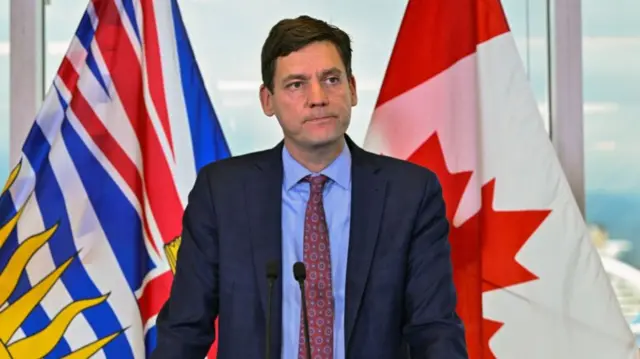
    David Eby, who leads Canada's third most populous province, British Columbia, tells CNN's Sara Sidner that Canada has to retaliate against US tariffs, even though it will hurt Americans.

    "I feel sorry for Americans right now that they have a president that is so disinterested in their cost of living concerns and is making them a global pariah. But we have to hit back," he says.

    Eby adds that he hopes other countries follow Canada's example and push back on Trump's trade policies.

    "At some point the rest of the world will say enough."

    David Eby stands behind a lecturn in a suitImage source, Reuters
  12. Carney's speech has endedpublished at 17:55 BST 24 August

    Mark Carney has finished speaking and we have since been hearing from other officials.

    We will bring you any important lines from their remarks, as well as answers to questions that the PM may be asked.

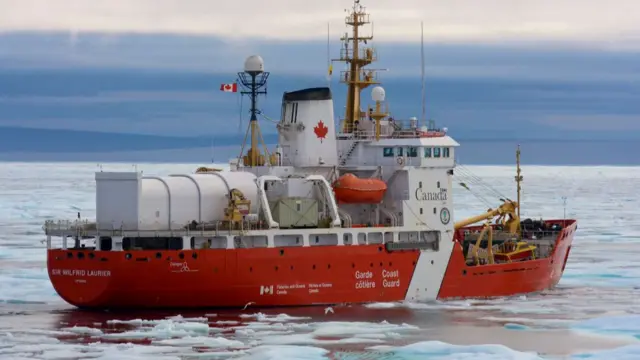
  13. Canada to spend C$11bn on new icebreaker fleetpublished at 17:32 BST 24 August

    an ice-breaking ship in icy watersImage source, Universal Images Group via Getty Images
    Image caption,

    A Canadian Coast Guard icebreaker ship

    Carney announces that his government will spend C$11bn ($7.95bn) to build a new fleet of icebreakers for the Canadian Coast Guard.

    Six ice breakers will be built in total by Quebec shipbuilder Chantier Davie using Canadian steel, he says.

    They will replace the Coast Guard's ageing heavy and medium icebreakers. The first ship will be delivered in five years, and the entire fleet will be ready in 10 years.

    Carney calls it "the largest ship building initiative in Quebec's history".

    These icebreakers will be used to open shipping passageways through Canada's northern and Atlantic icy waters in the winter, he says, ensuring trade is viable year-round.

  14. Carney celebrates Canada's successful trade agreementspublished at 17:23 BST 24 August

    Carney next touts Canada's recent successful trade agreements with countries across five continents, saying Canadian businesses now have free trade access to 1.5 billion people.

    Canada will double that number through deals with the Association of South East Asian Nations (Asean) and India, he adds.

    Carney turns to speaking about the importance of Canada's sea routes to trade and to the economy - the central theme of his comments today.

  15. Canada 'pragmatic' and 'patient' before talks collapsed, Carney sayspublished at 17:20 BST 24 August

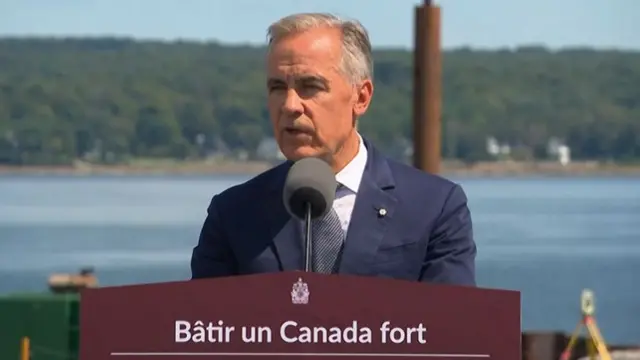
    Mark Carney speaks at podium in front of waterImage source, Reuters

    Prime Minister Mark Carney begins his remarks in Quebec by addressing the collapse of trade negotiations with the US.

    He says Canada has been "pragmatic, patient and persevering" in an effort to reach an agreement that protects Canadian workers, families, and which respects the country's sovereignty, French language and culture.

    The priority for Canada, he says, was to get the best deal, and "never a deal at any price or any time frame."

    He adds that progress was made in talks but that momentum was reversed in recent days.

    "We could not accept what the US has offered, nor could we give what they asked."

  16. Canada and the US are big trading partnerspublished at 17:15 BST 24 August

    Michael Race
    Business and economics reporter

    Canada and the US are usually strong trading partners, with hundreds of billions of dollars-worth of goods and services crossing the borders of the North American neighbours.

    To give a sense of how intertwined the economies of the two nations are, Canada exported more than three quarters of its goods to the US and imported almost half of its goods from the US, according to US government statistics.

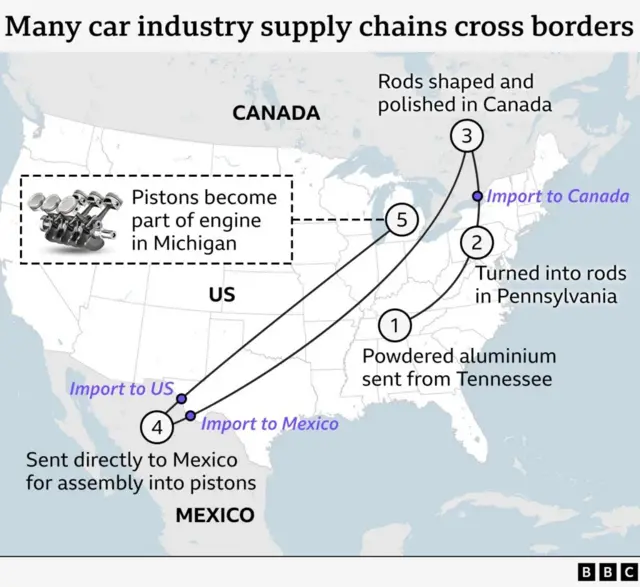
    Vehicles, energy and food are the primary goods the countries trade. When it comes to cars and trucks, North America's car manufacturing sector is highly integrated, with a vehicle crossing the US-Canada-Mexico borders multiple times before it is assembled and ready to be sold.

    If companies have to pay a tariff, also known as an import tax, every time a vehicle or part crosses a border, then the cost of producing a car or truck will go up and risk higher prices for customers.

    Disagreements over tariff talks for light-duty and larger trucks were a reason for trade talks failing last week.

    A chart showing how the car manufacturing supply chain crosses US, Canadian and Mexican borders
  17. Carney to speak soonpublished at 17:00 BST 24 August

    Canadian Prime Minister Mark Carney is expected to speak soon from Lévis, Quebec, where he will announce new investments to defend Canada's waters and waters and strengthen its trade routes.

    Quebec Premier Christine Fréchette and federal procurement minister Joël Lightbound will join him.

    You can watch live above, and follow along here for the latest updates.

  18. A lot can happen in four months...published at 16:56 BST 24 August

    Anthony Zurcher
    North America correspondent

    Donald Trump has set a start date - January 2027 - for his new tariffs on key Canadian industries.

    The 50% duties to be imposed on steel and automotive exports would be devastating to Canadian industries. But the fact that they don’t kick in until next year leaves plenty of runway for further negotiations.

    The president's announcement was cloaked in bellicose rhetoric – “ripping America off” and “we don’t need Canada, they need us” – but the bottom line is he’s buying more time before this dispute with America’s second-largest trading partner expands into a full-on trade war.

    A lot can happen in four months. The US has midterm congressional elections that could bolster Trump’s position or change the political dynamic in Congress, adding new restraints on his political power.

    Cooler heads could prevail, if Canadian and US negotiators return to the table to hammer out details outside of a harsh international spotlight.

    Or this could just be a delay in a showdown that could further redefine relations between America and one of its closest allies.

  19. Carney to speak from Quebec - a politically crucial provincepublished at 16:42 BST 24 August

    Nadine Yousif
    Reporting from Toronto

    Mark Carney stands at a lecturn in a blue suit and tie with a white shirtImage source, Reuters

    The location of Prime Minister Mark Carney’s latest press conference, which is due to take place shortly, is no accident.

    His second public remarks since trade talks with the US collapsed are set against the backdrop of a Quebec shipyard, where he will be speaking alongside Quebec premier Christine Fréchette about funding for trade and defence.

    This is meant to convey a message of unity and defiance in the face of US tariffs, while also reminding Canadians and others watching that the country is open for business and is looking for trade partners elsewhere.

    Carney is also speaking directly to Quebecers, a crucial, French-speaking voting bloc whose support can often sway Canadian elections.

    Quebec's unique language laws were caught in the crosshairs of the recent trade talks, with the prime minister saying that one of the sticking points was a US request for Canada to drop its requirement of American businesses to write manuals and labels in French for Quebec consumers - something US negotiators have denied.

    Carney and Premier Fréchette have characterised that alleged request as a nonstarter that infringes on Canada’s culture and, as the prime minister put it on Saturday, “our sovereignty”.

    “It is a non-negotiable issue. It is simply off the table,” Carney said.

  20. Business owner doubtful Canada can win trade war with USpublished at 16:29 BST 24 August

    Ana Faguy
    US reporter

    Lind Furniture has been in business for almost 60 years in the Canadian province of Ontario - selling leather furniture to big store clients like Sears and Costco.

    Sales dropped when Trump took office in 2025. "As soon as there were tariffs in the air, people put purchases on hold," Michael Saifer, general manager of Lind Furniture, tells the BBC.

    Now, his concern centres around Canadians' chances for victory.

    "Everyone wants to sell to the Americans - they can buy from whoever they want," he says. "I don't know that we're going to win a war with them; we may get killed."