Summary

  1. Venezuelan government deploys the army and heavy machinery to worst-hit areapublished at 22:48 BST 25 June

    Venezuelan Acting President Delcy Rodríguez has met with the army's general staff to coordinate urgent relief measures for La Guaira state, the area worst hit by the earthquakes.

    They will mobilise state security forces as well as heavy machinery to remove large amount of debris.

    They also agreed to open priority routes for rescue efforts, and organise support logistics for water, food, blankets, and mattresses for people who lost their homes.
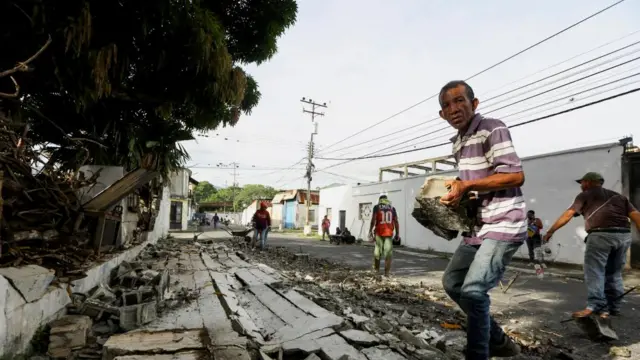
  2. In pictures: Cracked buildings and destroyed homes seen across Venezuelapublished at 22:30 BST 25 June

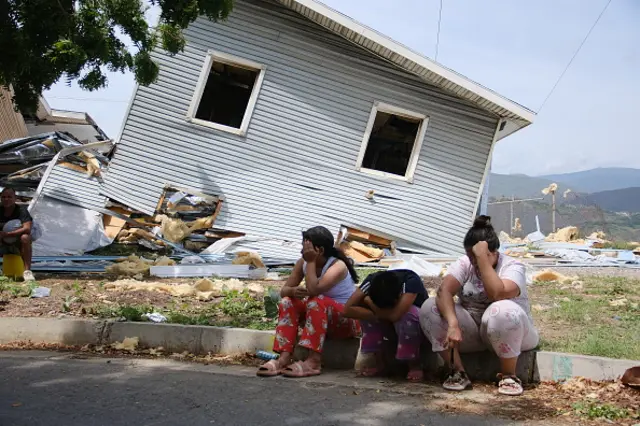
    Three people put their heads in their hands as they sit outside a damaged home in CaracasImage source, Getty Images
    Image caption,

    A group of residents sit outside a destroyed home in Caracas

    A man carries a large bit of rubble away from a damaged houseImage source, Reuters
    Image caption,

    People remove rubble from a damaged house in Moron, Venezuela

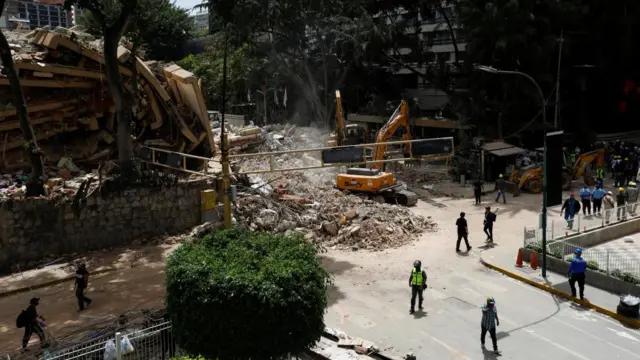
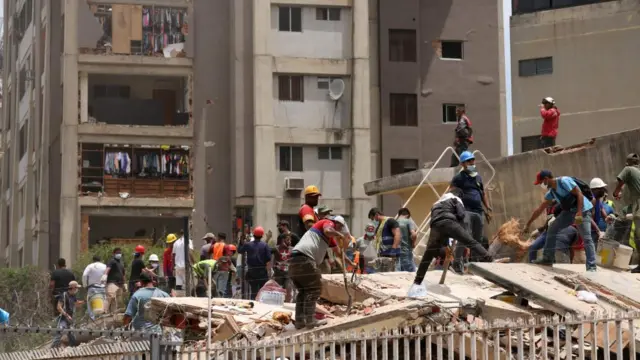
    Two diggers work in a pile of rubble next to a collapsed building. Several workers are walking past the sceneImage source, Reuters
    Image caption,

    Emergency services work at the site of a collapsed building in Caracas, Venezuela

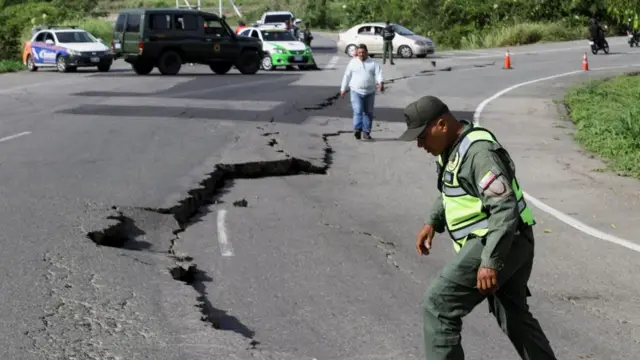
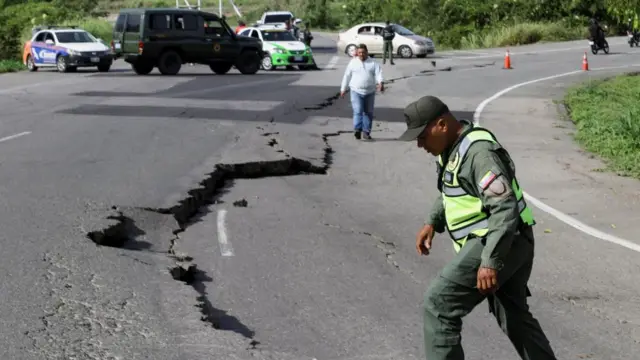
    A member of the national guard wearing a green florescent vest and uniform steps over a large crack in the roadImage source, Reuters
    Image caption,

    A member of the Bolivarian National Guard of Venezuela walks on a road cracked road in Moron, Venezuela

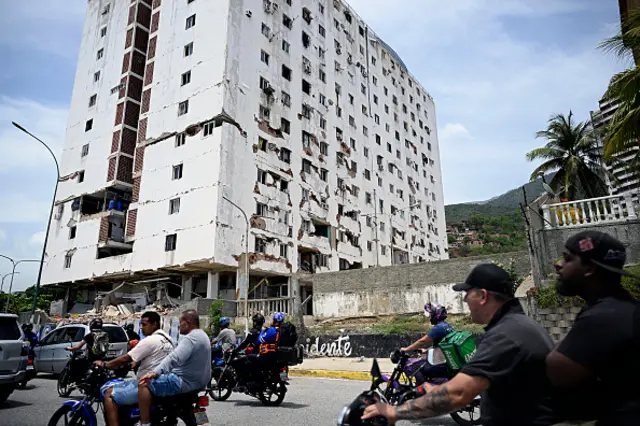
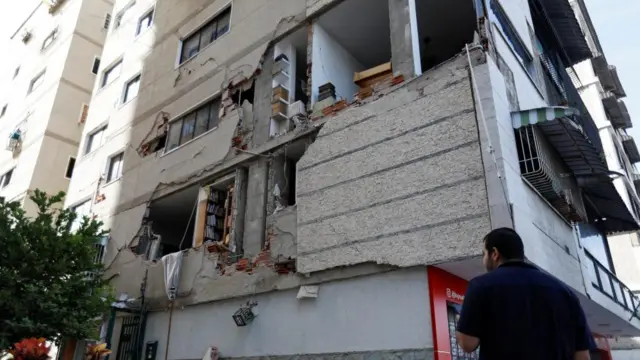
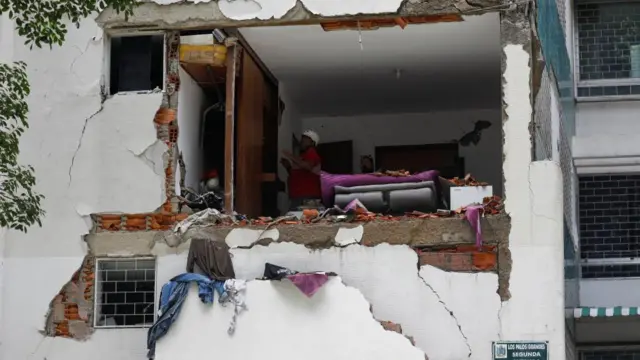
    A large crack appears across a white tower block. The walls of one side of the building have crumbled and the paint has pealed awayImage source, Getty Images
    Image caption,

    Locals ride past a damaged building in Los Corales in La Guaira state

  3. More countries pledge rescue workers and fundspublished at 22:25 BST 25 June

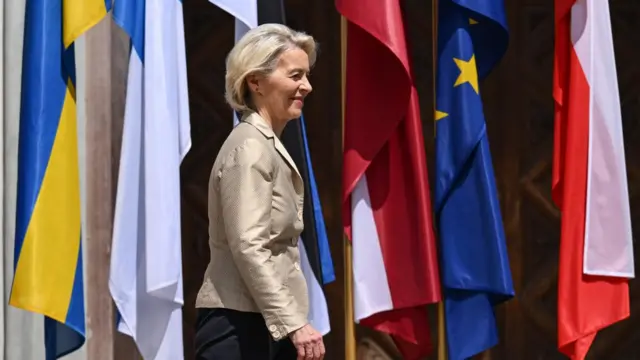
    European Commission President Ursula von der Leyen pictured earlier this monthImage source, EPA

    Earlier, we reported some of the nations around the world pledging help - including the US which has promised a "big and fast" response.

    We can now bring you some more.

    Spain, Italy, Czechia, France, Germany, Luxembourg, the Netherlands and Portugal are all sending search and rescue teams, according to President of the European Commission Ursula von der Leyen.

    She says the commission is "coordinating the European response".

    Mexican President Claudia Sheinbaum has also announced the assistance of rescuers and health workers.

    Meanwhile, the Vatican says that Pope Leo has sent an initial €100,000 (£86,200) emergency donation, calling it a "first step" with further help to follow.

    The mayor of Bogotá, Colombia Carlos Galán says he is sending a specialised search and rescue team from his city's fire department, along with Dastan, a dog trained in locating trapped people. They are part of a Colombian delegation of 64 people headed to Venezuela to offer aid.

    Some organisations have also weighed in. The chief of the World Health Organization (WHO), Tedros Adhanom Ghebreyesus, says WHO teams are in "close touch" with responders and "on standby to deploy additional staff" and medical supplies.

  4. How is earthquake magnitude measured and how important is it?published at 22:18 BST 25 June

    Mark Poynting
    Climate and science reporter

    The two major earthquakes to hit Venezuela yesterday have been measured as 7.2 and 7.5 in magnitude, according to the US Geological Survey.

    These are based on something called the Moment Magnitude scale, which is often used by geologists to measure the strength or size of earthquakes.

    The scale is not linear, so each whole number increase in magnitude is equivalent to a very large increase in earthquake strength.

    For example, a 7.0-magnitude earthquake is 10 times bigger than a 6.0-magnitude quake in terms of the amplitude of the quake’s vibrations – and releases about 32 times as much energy.

    But the magnitude is only one factor in shaping the damage.

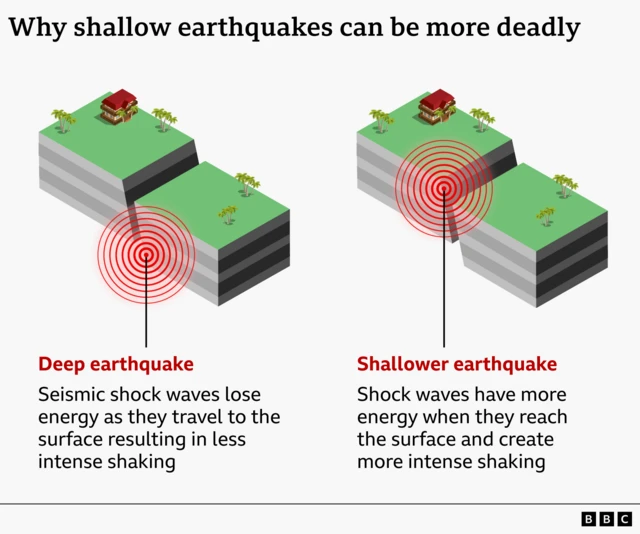
    As we explained earlier, the depth is also important – shallower earthquakes can cause more shaking.

    And one of the most important factors of all is the extent to which homes and properties are built to withstand earthquakes.

    Why shallow earthquakes can be more deadly
  5. What are aftershocks and how long do they go on for?published at 22:14 BST 25 June

    Mark Poynting
    Climate and science reporter

    As we’ve been reporting, Venezuela has been shaken by dozens of “aftershocks” throughout the day.

    Aftershocks are pretty much as the name suggests – smaller earthquakes that follow the main earthquake, or in this case the main two earthquakes.

    They’re typically caused by parts of tectonic plates adjusting to changes in stress after the main quake.

    Shallower earthquakes – as we’ve had in Venezuela – are more likely to be followed by aftershocks, according to the US Geological Survey.

    Aftershocks can be dangerous, particularly if buildings have been partly damaged or weakened by the initial earthquake.

    They can go on for weeks, months or even years, but bigger aftershocks become less likely over time.

  6. Twin earthquakes were 'extraordinarily powerful' and dangerous, geophysicist tells BBCpublished at 22:08 BST 25 June

    The side of a building has been reduced to rubble revealing the insides of four room. A pile of rubble can be seen at the edge of the buildingImage source, Reuters

    A geophysicist with the US Geological Survey describes how the twin earthquakes were "extraordinarily powerful" and says they were particularly dangerous because they hit areas with large populations.

    "A 7.2 earthquake alone would be a catastrophic earthquake in this region," William Barnhart tells the BBC's Newshour programme. "But to immediately follow it only 39 seconds later by a 7.5, - that's about three times more powerful than that 7.2 earthquake - leads to a really dire situation."

    Barnhart says the closer the earthquake is, both in depth and distance from people, the more damaging it can be.

    Aftershocks following the earthquakes could "continue for months or beyond a year" and could be "quite large and damaging" themselves, he adds. And, there is always a small possibility that another large earthquake strikes.

    Barnhart adds that people should listen to local officials for advice about when to stay away from structures.

  7. 'Food is one of the most important things we are collecting'published at 21:58 BST 25 June

    Vanessa Silva
    Reporting from Caracas, Venezuela

    Oriana

    At a makeshift distribution site in Caracas I met Oriana,a volunteer helping people who lost their homes in the earthquakes.

    "We are collecting clothes, medical devices and food - all types of things to help people whose houses have been damaged and people who suffered from the earthquake," she says.

    "Food is one of the most important things we are collecting."

  8. Before and after photos show buildings turned to rubblepublished at 21:51 BST 25 June

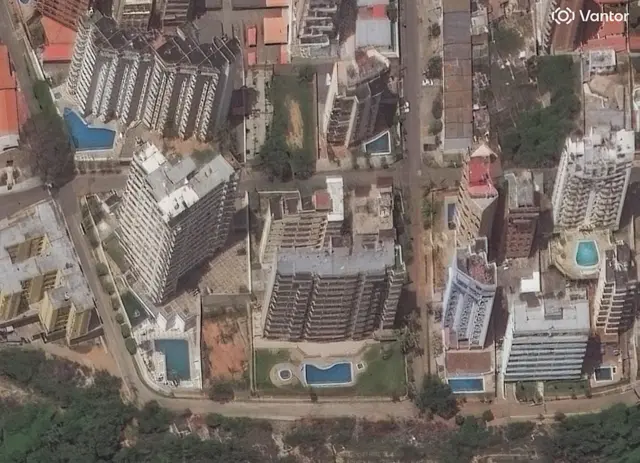
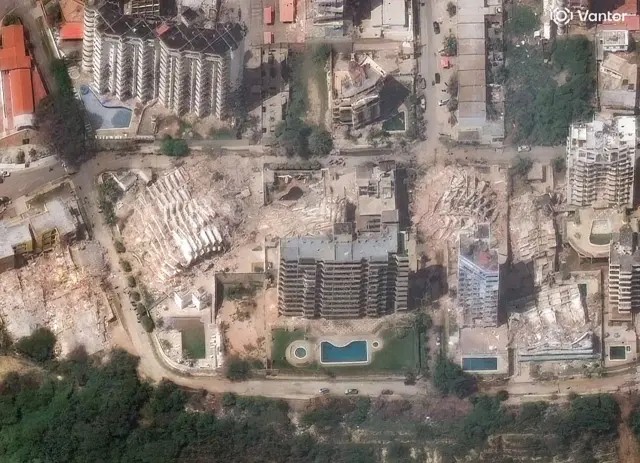
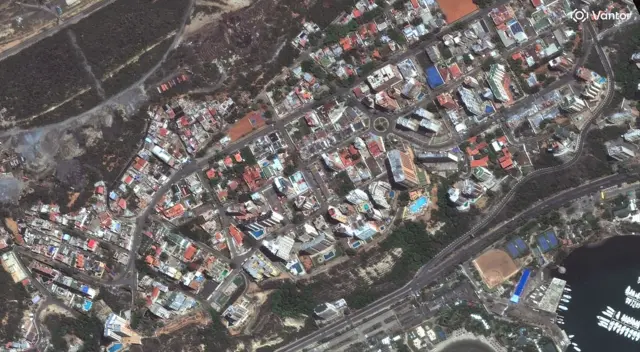
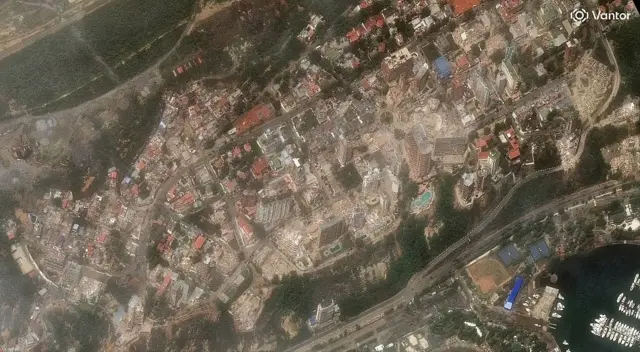
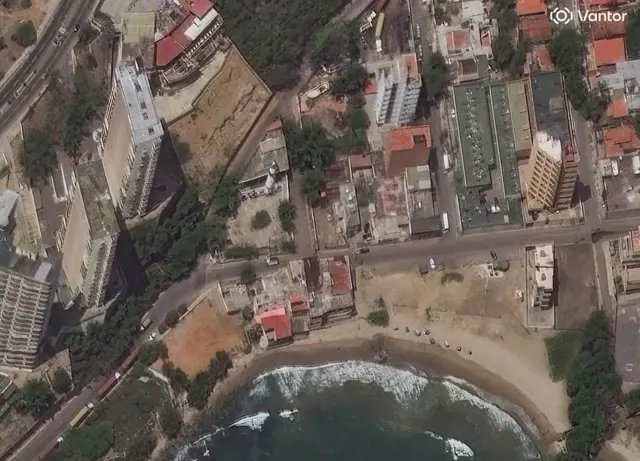
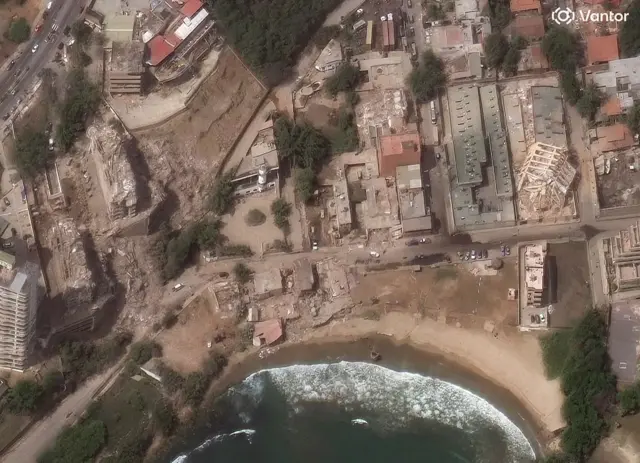
    Satellite images taken before and after twin earthquakes shook Venezuela show the severity of the damage to the country.

    High-rise apartment complexes, businesses and people's homes were reduced to rubble by the 24 June tremors.

    Vantor satellite image shows apartment buildings in Playa Grande, La Guaira, before earthquake damage.Image source, Vantor via Getty Images
    Image caption,

    Apartment complexes on 24 June, hours before the twin earthquakes

    Vantor satellite image shows collapsed apartment buildings and widespread earthquake damage in the Playa Grande neighborhood of La GuairaImage source, Vantor via Getty Images
    Image caption,

    Apartment complexes flattened after earthquakes

    Vantor satellite image shows Playa Grande neighborhood with undamaged high-rise apartments and infrastructure before the 2026 earthquakeImage source, Vantor via Getty Images
    Image caption,

    Playa Grande neighborhood with undamaged high-rise apartments on 15 June

    Vantor satellite image shows extensive earthquake damage including collapsed high-rise apartment buildings and heavily damaged structures in the Playa Grande neighborhood of La Guaira.Image source, Vantor via Getty Images
    Image caption,

    Extensive earthquake damage including collapsed high-rise apartment buildings in Playa Grande

    Vantor satellite image shows before view of earthquake damage to buildings in the Playa Grande neighborhood of La GuairaImage source, Vantor via Getty Images
    Image caption,

    Ocean front apartments on 22 June, two days before quakes

    Vantor satellite image shows collapsed apartment buildings and damaged structures in Playa Puerto Viejo neighborhood of La Guaira following a devastating earthquake.Image source, Vantor via Getty Images
    Image caption,

    Ocean front apartments sustain damage

  9. Earthquakes devastate Venezuelan health centrespublished at 21:41 BST 25 June

    Bernd Debusmann Jr
    White House reporter

    Just a few moments ago, I spoke to César Jiménez, an aid worker for Project Hope. The US-headquartered global health and humanitarian NGO operates 55 health centres in eight Venezuelan states, including in the earthquake-stricken areas of Caracas, Miranda and La Guaira.

    I asked him whether Venezuela and the various organisations that work in the country were prepared for a disaster of this magnitude, which comes after years of economic woes and political strife.

    “No country could have been prepared, but we were trying,” he responded. “But this type of disaster took us by surprise. There was no planning for this. You can’t even count the number of people that are looking for help. All of their buildings have been wrecked, entirely.”

    Jiménez was at home with his family when the earthquakes struck.

    “It started quite softly,” he tells me. “But it got more intense very quickly. It surprised us that it lasted so long, over a minute.”

    As it became stronger, Jiménez tried to shelter near a column inside his house, alongside his family.

    “It was so strong we couldn’t stay on our feet,” he recalls. “The electricity went out. The cabinets and the TV broke. We left immediately out onto the street, and all our neighbours were there. That’s when the aftershocks happened.”

    Soon after the earthquakes, Project Hope staff across the country began inspecting the various health centres.

    Some of them, particularly in La Guaira, had severe structure damage. Some are no longer stable.

    “They are collapsing under the weight of people who are coming in looking for help,” he says.

    The challenge now, Jiménez explains, is meeting the urgent need for medical supplies including bandages, sutures and medicines.

    Donations and volunteers are already coming into the organisation, but he says more help is needed.

  10. UN working closely with Venezuelan government, says chiefpublished at 21:33 BST 25 June

    A man stands outside a damaged building, the inside is exposed by a hole in its side.Image source, Reuters

    UN Secretary-General António Guterres says on X that the UN is "mobilizing assistance" and "working closely" with the Venezuelan government and partners to support the country.

    He says he is "deeply saddened" by the loss of life following two major earthquakes last night.

    Earlier, Tom Fletcher, the UN's under-secretary-general for humanitarian affairs, said principals from the humanitarian community would meet in Geneva to work out how to scale up relief response.

    In a video update, he also his department was deploying teams to the affected region today and that the UN's humanitarian coordinator in Caracas spoke with acting President Delcy Rodríguez this morning about what should be the top priorities in the response.

    Fletcher also listed several countries which have offered their support to the emergency response including the US, Dominican Republic, El Salvador, Switzerland, Qatar, Mexico, China, Brazil, Caribbean nations, Syria, the UK, Russia and Spain.

  11. 'Shock and confusion' over many missing friendspublished at 21:20 BST 25 June

    Gabriela Pomeroy
    Live reporter

    Juan OrtizImage source, Juan Ortiz

    I've been speaking to Juan, a medical student in Caracas.

    "I have multiple friends from my university who are missing," he says. "Around 20 people as far as I know, from the university medical school."

    One close friend has been confirmed dead. One is believed to be under the debris. Many from his class are missing.

    They all live in the coastal area worst hit by the earthquake while attending classes in Caracas.

    "I'm in shock and confusion, and frustrated that I can't help," he says.

    He hopes it's just that they are out of contact due to the communication networks being down, "but it's rough out there".

    He and his friends are saying prayers that their friends will be found. He is going with a group of medical students to volunteer tomorrow in the hospital in Vargas.

  12. Earthquakes could worsen 'already severe' humanitarian crisis, says Oxfampublished at 21:10 BST 25 June

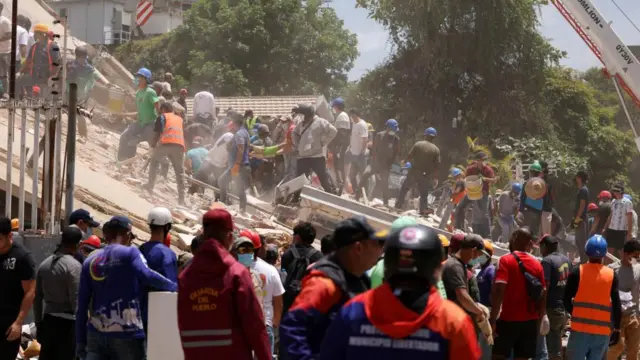
    People search for casualties amid the rubble of a collapsed building in CaracasImage source, Reuters

    Charity Oxfam has warned the destruction caused by twin earthquakes in Venezuela could worsen living conditions for "thousands of people" and contribute to a humanitarian crisis that is "already severe".

    An estimated 7.9 million people were already in need of aid in the country as of early 2026, Oxfam says.

    Partner organisations working locally are carrying out "initial assessments" of the damage and determining the "most urgent needs", the charity says.

  13. Recap: Search for survivors continues as next few hours prove crucialpublished at 21:00 BST 25 June

    A member of the Bolivarian National Guard of Venezuela walks on a road cracked after two strong earthquakesImage source, Reuters
    Image caption,

    Venezuela experienced its strongest earthquake since 1900 last night

    Emergency workers are racing to reach people trapped beneath the rubble in Venezuela, as the next few hours prove crucial following yesterday's earthquakes.

    At least 188 people have been killed and more than 1,500 are injured, according to the latest reports.

    State media channel Venezolana de Televisión says 157 are reported missing - although the exact figure is unclear with a separate missing people website pointing to a figure in the tens of thousands.

    Twin earthquakes of magnitudes 7.2 and 7.5 hit less than a minute apart last night, and the second was the strongest in the country since 1900.

    President of the National Assembly Jorge Rodríguez says 250 buildings have been damaged or lost, primarily in La Guaira.

    Pictures show the searches in action in different parts of the country - but 20-year-old Antoan Marín from Caracas fears efforts are "insufficient" given the scale of the destruction.

    He thought his own house would "split in two" last night, and says a professor from his university is trapped in a building that has "completely collapsed".

    Meanwhile, a woman in La Guaira says: "I just want to know where my son is."

  14. People wait in the streets of Caracas as aftershocks continuepublished at 20:43 BST 25 June

    Vanessa Silva
    Reporting from Caracas, Venezuela

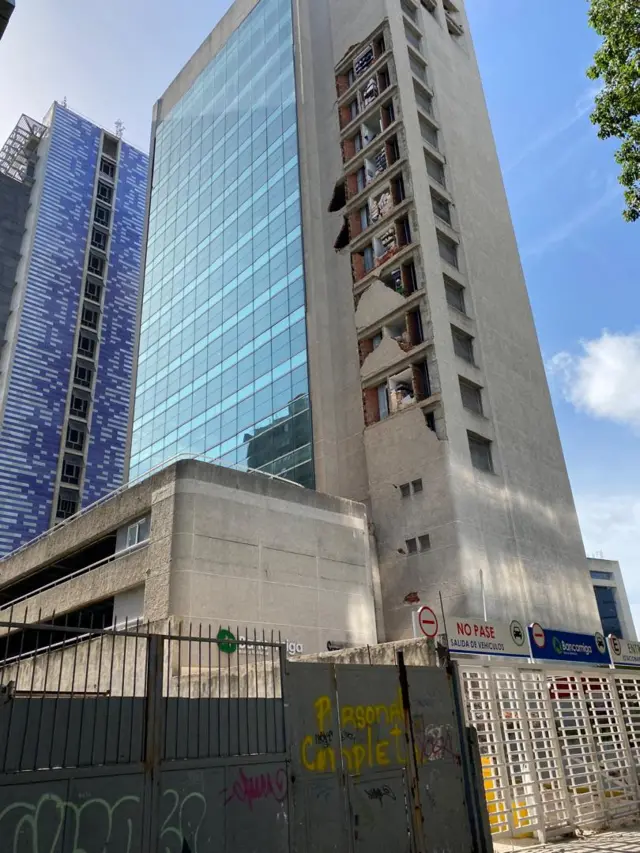
    A tall damaged apartment building with walls crumblingImage source, BBC/Vanessa Silva

    Some people are staying with relatives, in public spaces, while others remain outside their buildings, at least in the Chacao municipality, where two buildings collapsed and many others suffered structural damage.

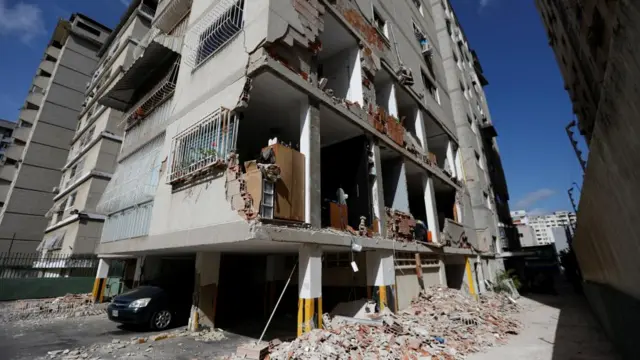
    I saw people in their apartments, now without walls, perhaps searching for anything they could salvage in case they couldn't return home. Some say that, according to the firefighters, the main columns are solid, but the walls are not and are at risk of falling.

    Here in the Palos Grandes area of ​​the Chacao municipality, we've felt aftershocks, like a kind of gentle wave passing by. People get scared and hurry, taking their belongings or moving to the middle of the streets away from walls and windows.

    People from other municipalities have come to this area with water and food for those who can't return to their homes, as well as those assisting in the rescue efforts by removing debris.

    There's a lot of traffic, and the surrounding plazas are serving as collection points. Many residents remember the 1967 earthquake.

    Despite the risk in this area due to the seismic fault that runs through it, it is a favourite spot in Caracas for expatriates. It is an area full of bars and restaurants that was coming back to life.

    A gentleman was about to open his business in a few days and commented that now it was damaged.

  15. British search and rescue team stands ready for deploymentpublished at 20:25 BST 25 June

    The UK's International Search and Rescue team "stands ready for deployment" to Venezuela, the Foreign Office says.

    A Foreign Office spokesperson says: "Following the devastating earthquakes in Venezuela the UK government is working to support a rapid humanitarian response, helping to address urgent needs on the ground.

    "We are working closely with international partners to ensure a coordinated response, and our UK International Search and Rescue team stands ready for deployment."

    All UK staff are safe and accounted for in Venezuela, it adds.

    No British nationals are understood to have been involved in the earthquakes and the number of Brits who are in Venezuela is thought to be in the low hundreds.

  16. Next few hours will be absolutely crucial to get to the voices under the rubblepublished at 20:08 BST 25 June

    Will Grant
    Central America correspondent

    Dozens of emergency workers, some wearing hard hats and masks, search through the rubble of a collapsed buildingImage source, Reuters
    Image caption,

    People search for casualties in the aftermath of earthquakes in the Venezuelan capital Caracas

    These first few hours are absolutely crucial for emergency workers to get to the voices they can hear under the rubble.

    The Venezuelan emergency services are experienced with dealing with this kind of disaster, however the brain drain of the last few years and a mass exodus of young people have impacted the ability of firefighters and ambulance crews to operate.

    Nonetheless, they are working around the clock attempting to reach those most affected in the state of La Guaira.

    Desperate family members are sitting and waiting for news.

    In January, the Venezuelan capital Caracas came under fire from air strikes from the US.

    The then-president Nicolas Maduro was removed from power at gunpoint by US Delta Force troops.

    But now things look very different.

    The subsequent administration under acting President Delcy Rodriguez has been working with Washington despite decades of opposition.

    This is a big test of that new relationship and it was interesting to see US President Donald Trump immediately offer support to Rodriguez.

    In La Guaira 100 buildings have collapsed and the picture is very bleak.

    There is the potential for casualties to be in the thousands.

    Medical teams, possibly provided from the US, will be essential in the coming hours.

  17. The search for loved ones in coastal area devastated by quakepublished at 19:48 BST 25 June

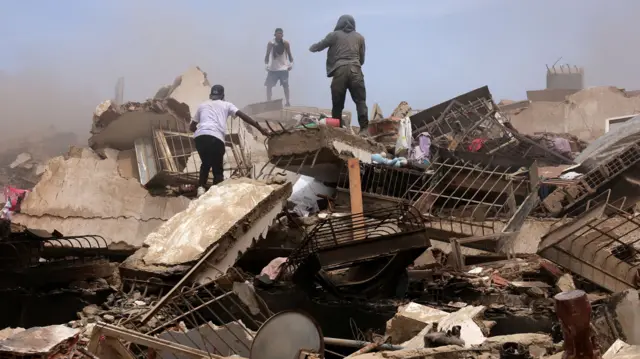
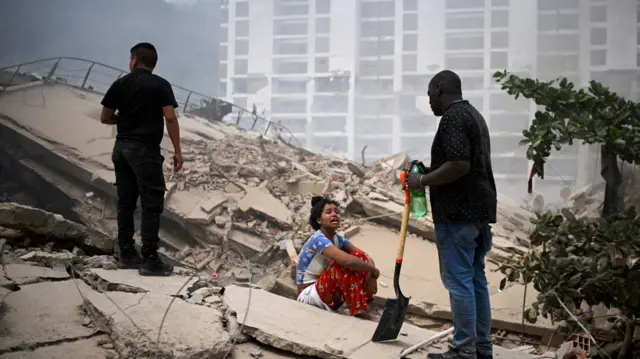
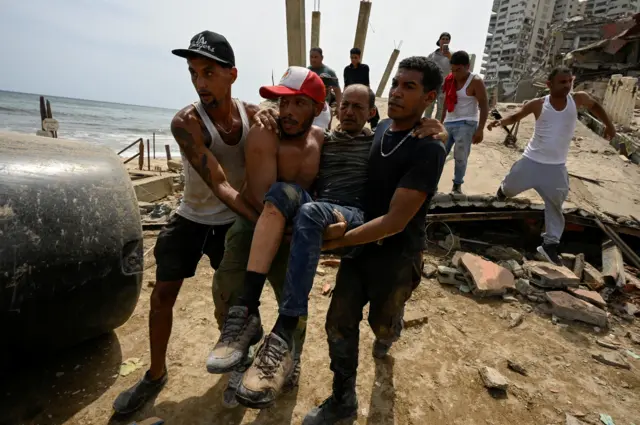
    We can bring you these latest pictures of the aftermath of the earthquake in La Guaira, a coastal area where more than 100 buildings have collapsed. Local residents and rescue workers have been searching for people who could still be under the rubble.

    amid the rubble of collapsed buildings, in the aftermath of earthquakes in La GuairImage source, Reuters
    Image caption,

    People searching for casualties in the rubble of a building in La Guaira

    aftermath of earthquakes in La Guaira,Image source, Reuters
    Image caption,

    A woman sits in the rubble of a building reduced to rubble by the earthquake

    People carry an injured man, in the aftermath of earthquakes in La Guaira, Venezuela, June 25, 2026Image source, Reuters
    Image caption,

    An injured man is carried to safety

  18. How resilient are buildings in Venezuela to earthquakes?published at 19:29 BST 25 June

    Katie Williams
    Live reporter

    People check the damage at an apartment in CaracasImage source, Reuters

    That's a question I asked two experts today.

    Ilan Kelman, professor of disasters and health at University College London, says Caracas "does have a building code" with "modern seismic provisions in it". But enforcement is a "roll of the dice", in his view.

    He says some of the collapses we are seeing suggest provisions were not always taken.

    He references social and political challenges in Venezuela, saying these can make it "difficult" for laws to be monitored and enforced.

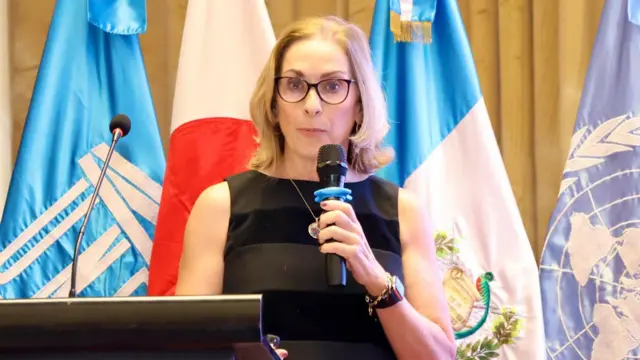
    Seismic design expert América Bendito, who is Venezuelan and has previously advised organisations including Unesco, says building codes are "only one part of the safety system". They also need to be "consistently implemented".

    "Whether that happened in this case is something that post-earthquake investigations will determine," she says.

    But she adds that important lessons were learned after the 1967 Caracas earthquake, calling it a "watershed moment".

    For example, she says engineers working on modern buildings today "use much more rigorous detailing of reinforced concrete so that beams and columns can deform without failing suddenly".

    América Bendito speaking into microphone wearing black dress with flags behind herImage source, América Bendito
    Image caption,

    Seismic design expert América Bendito says some lessons were learned from 1967

  19. 250 buildings damaged or lost, says president of National Assemblypublished at 19:08 BST 25 June
    Breaking

    We can bring you more information from remarks by President of the National Assembly Jorge Rodríguez.

    He says two hundred and fifty buildings have been damaged or lost, primarily in La Guaira.

    Speaking on national television, he says Venezuela faces "severe disruption" after two earthquakes struck last night.

    The twin earthquakes of 7.2 and 7.5 magnitude have been followed by 138 aftershocks, he adds.

    He says national unity is a priority as the rescue effort continues, and confirms the arrival of specialist rescue teams from the US, Mexico, Spain, Qatar, and the UN.

    He also says measures from acting President Delcy Rodríguez include a request for private companies to provide machinery to remove debris, the creation of a $200m fund for assistance, and special credit lines for affected businesses.

  20. US military preparing earthquake responsepublished at 18:59 BST 25 June

    Bernd Debusmann Jr
    White House reporter

    We still don't have firm details on what US assistance to Venezuela will look like, but the US military's Southern Command - which has responsibility for Latin America - has said that its forces are "moving quickly" to support the Venezuelan government.

    In a post on X, the command said it established an operational planning team which includes specialists in disaster relief, and is working with regional partners who have also pledged to join the international assistance mission underway in the country.

    "Our forces are prepared to move quickly, bringing the unmatched airlift, logistics, and operational capabilities of the US military to help save lives and support the Government of Venezuela during this crisis," Pentagon spokesman Sean Parnell said in a separate post.

    Earlier, Secretary of State Marco Rubio said that the US military would be handling American aid flights to Venezuela due to damage sustained by Caracas' airport.

    We have yet to hear directly from President Trump so far today.