Eclipse comes further into view in Bermondsey, south Londonpublished at 18:37 BST 12 August
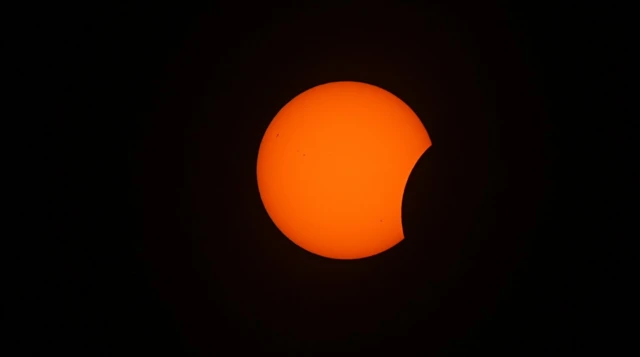 Image source, PA Media
We've ended our live coverage - read our story here
Millions of people across the UK and Europe have witnessed the most significant solar eclipse since 1999
For most of the UK, more than 90% of the Sun was covered by the Moon
It was also visible across large parts of Europe - a rare total eclipse could be seen in Iceland and Spain
Science correspondent Pallab Ghosh is in Burgos, Spain, and says he got goosebumps from the spectacle - I've seen it a few times but it never gets old
In Benavente, Spain, there was silence for the 84 seconds of totality, a woman on a south Wales beach described the spectacle as "phenomenal" and a large cheer went up when the cloud cleared in Edinburgh
Image source, PA MediaClaire Quinn
Reporting from Armagh Observatory
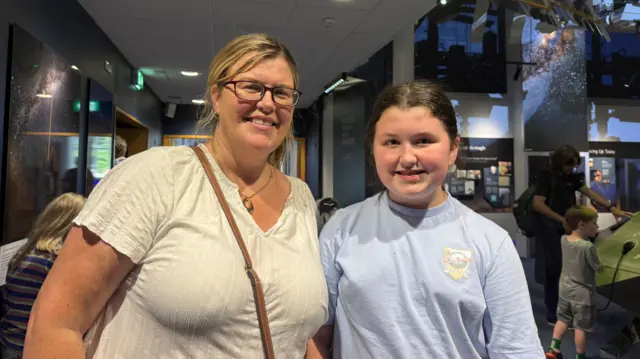
Sharon says this is a "once-in-a-lifetime" event
Dozens of people both young and old have gathered at Armagh Observatory, Northern Ireland’s only planetarium.
Sharon Walsh and her daughter Mia have travelled up from Dublin to the observatory, with Sharon saying she wanted to mark the event.
“There won’t be another one until 2090 and I’ll probably be dead by then,” she jokes.
"So it’s a once-in-a-lifetime thing."
 Rachel Flynn
Live reporter
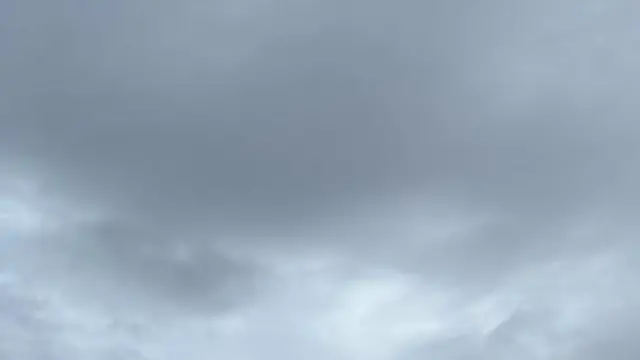 Image source, Una Eggertsdóttir
Una's view from her mum's garden in Hafnarfjörður, near Reykjavik
Una Eggertsdóttir is in Hafnarfjörður, 15 minutes outside of Iceland's capital Reykjavik, where she's gathered with her family to watch the eclipse.
So far, it's not looking good. "It is extremely grey, cloudy and rainy so we’re not seeing much yet," she tells me, "and it's supposed to just get worse".
Una says just two days ago, it was perfect sunny conditions for the eclipse. "But our expectations were realistic," she adds. "No one was expecting clear skies, but people are still excited for what happens later."
Iceland lies in the path of totality, so there's still hope for some drama, Una explains. "People are still excited for what happens later," she says.
The eclipse is visible in parts of Iceland - and it's near totality too - here's the view further north in Látrabjarg.
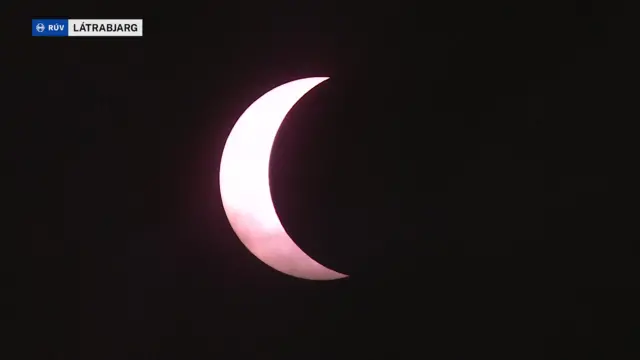 Image source, EBU
Lorna Gordon
BBC Scotland correspondent
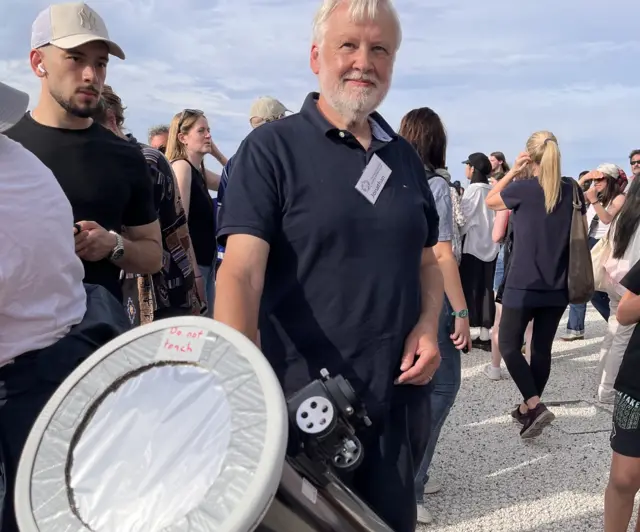
Jonathan Smith from the Astronomical Society of Edinburgh has been letting people view the eclipse through his Dobsonian telescope
The eclipse is now underway here in Edinburgh. It will peak at 19:06 BST.
Jonathan Smith from the Astronomical Society of Edinburgh is explaining to a large crowd the Dobsonian telescope he has set up here on Calton Hill.
The telescope is basically a large steel tube with a custom made filter at one end and a very good mirror at the other, giving 48 times magnification.
He gave me and others a look through the eye piece. He tells me the view is slightly hazy because of the clouds, but you see considerably more detail than you get through the eclipse glasses.
You can see the moon starting to take a bite out of the sun and a couple of sunspots. It is extraordinary.
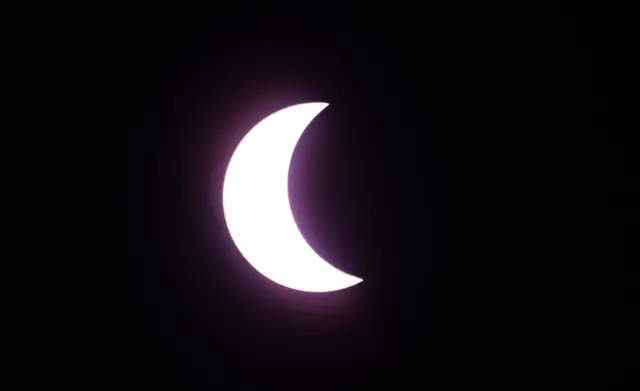 Image source, PA Media
While the eclipse is only just starting to become visible here in the UK, it is well under way in elsewhere.
Here's the sight aboard the Ambassador cruise ship Ambition, which is currently off the coast of Greenland.
As a reminder, you can watch follow the eclipse as it happens by pressing watch live at the top of the page.
The solar eclipse is now visible from Newquay in Cornwall, with a portion of the Sun being covered by the Moon.
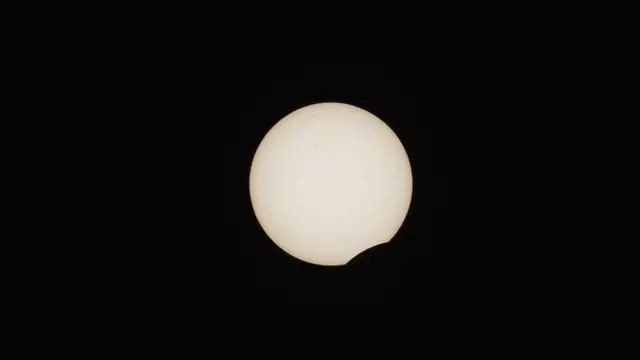
As we get the first pictures of the solar eclipse in the UK, millions in other northern hemisphere countries are also gazing at the sky in fascination.
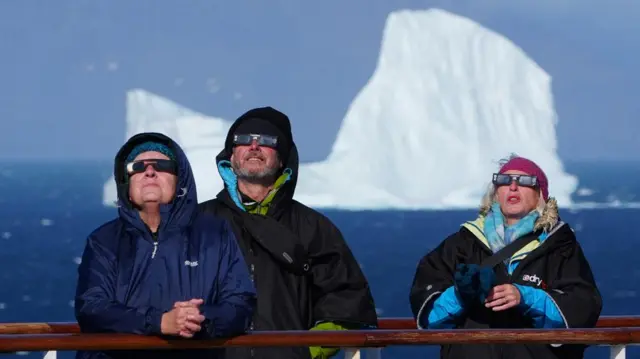 Image source, PA Media
Passengers on a cruise ship watching the eclipse off the coast of Greenland
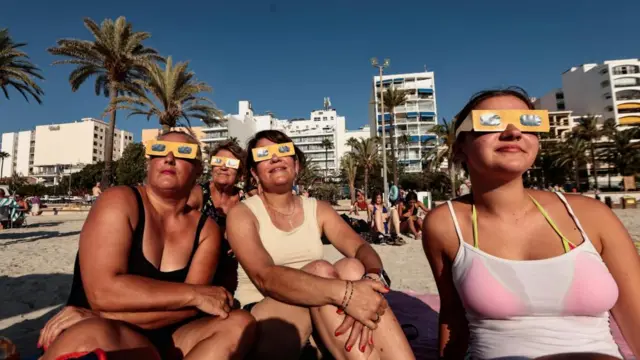 Image source, Reuters
Women from Cologne in Germany test their protective glasses at El Arenal beach in Mallorca
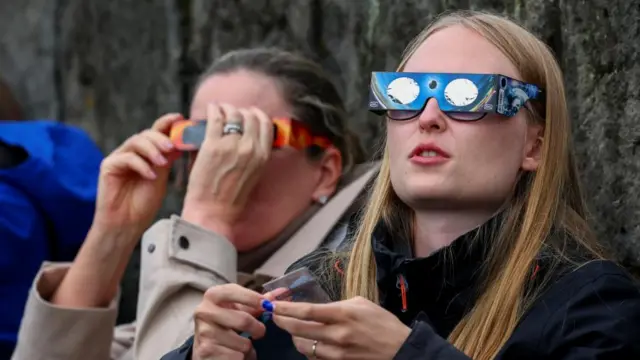 Image source, Reuters
Two women watch the eclipse in Reykjavik, Iceland, before it reaches totality
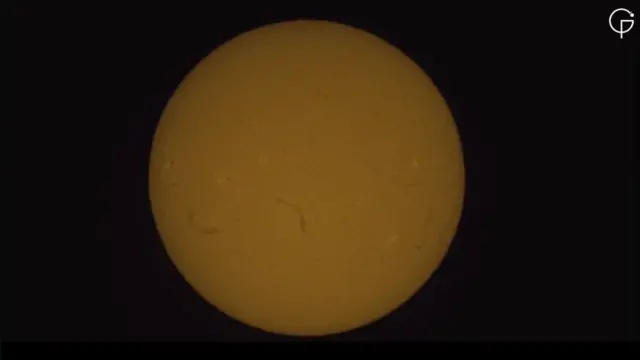 Image source, Royal Observatory Greenwich
It may not look like it - but the eclipse is now under way here in London.
The solar event is set to peak in the capital in just under an hour.
You can share your comments, pictures and videos of the event by clicking here - and you can follow the eclipse itself through the stream at the top of this page.
 Alison Freeman
Reporting from Stockton
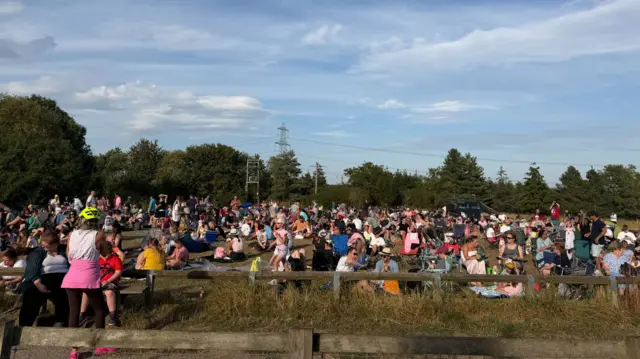
It's now a mere minutes until the eclipse will come into view here.
At Wynyard Planetarium, near Stockton, the field is packed with hundreds of people looking west.
The volunteers who run it say they have been overwhelmed by enquiries for the past few days.
The 300 pairs of special glasses the organisation purchased were given out in minutes. Visitors are now being asked to share.
The eclipse is now creeping its way towards the UK.
Here's the view moments ago in Stavanger, Norway.
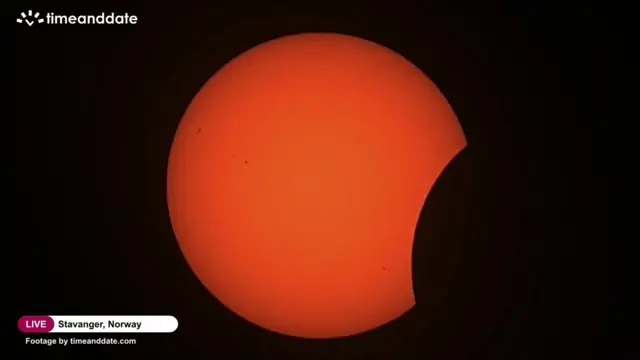 Image source, Reuters
 Pallab Ghosh
Science correspondent, reporting from Burgos, northern Spain
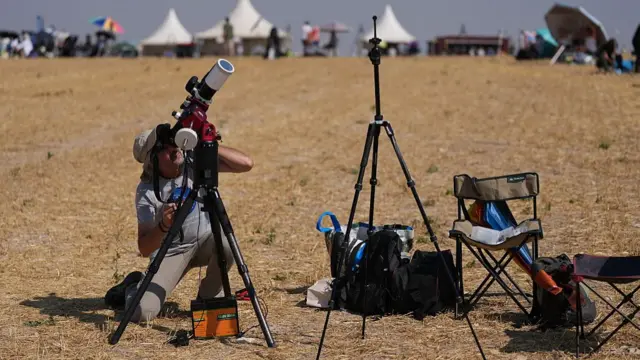 Image source, Getty Images
Scientists and enthusiasts alike have gathered in Burgos to watch the solar eclipse
I’m in the delightful countryside of Burgos in Northern Spain, in the path of the total eclipse.
It’s a perfect location. When the eclipse happens, it will happen low in the horizon, so I am up high with no trees nor buildings in the way.
And there are no clouds so far.
In front of me there are also around 200 excited eclipse chasers who have gathered to take pictures and witness this experience for themselves.
Wedaeli Chibelushi
Live reporter
Katie Hallett is deep in preparations for a viewing party this evening, and she's particulary excited as she wasn't born when the UK experienced its last eclipse.
Around 90 people are expected at the event at Hallet's workplace, Crooklets Beach Cafe in Bude, Cornwall.
"I'm not really sure what to expect," the 23-year-old tells me, but adds that the staff are putting on a huge spread, which will include lots of snacks and cocktails.
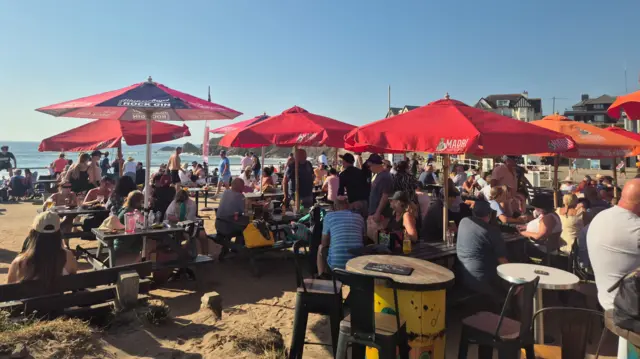 Image source, Katie Hallett
It's a high turnout already for Crooklets Beach cafe in Cornwall
Lorna Gordon
BBC Scotland correspondent
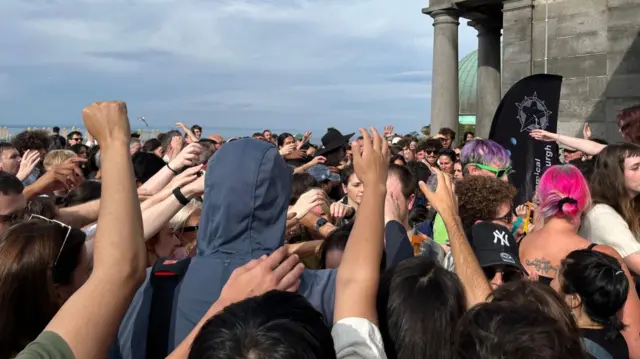
Hundreds of people are gathering on Calton Hill in Edinburgh to watch the eclipse.
It’s around a hundred metres above sea level and has a clear view across the city to the west. The view of the eclipse from here - if the clouds stay away - should be good.
There was a rush of people as staff from the Astronomical Society of Edinburgh handed out five hundred pairs of eclipse glasses.
A considerable number missed out but they are still here, still asking if any more eclipse glasses are available, and hoping that some of those who did get lucky will share them out for a few minutes.
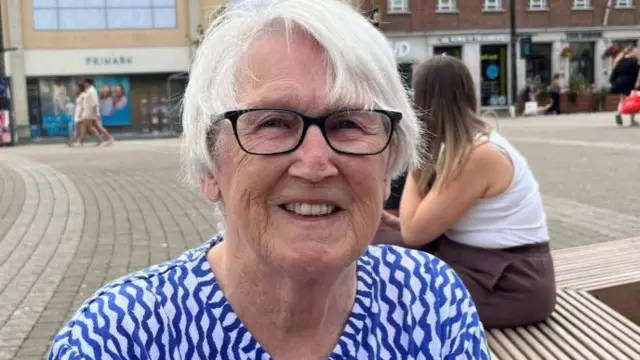
Barbara Logan said it was strange not to know if it was day or night during the 1999 eclipse
As the most dramatic solar eclipse in almost 30 years gets under way in the UK, one woman has shared her experience of the total eclipse in 1999.
On 11 August 1999 a few minutes of the day turned to night as the Moon blocked out the sun's light.
It was the last total solar eclipse of the 20th Century, with Cornwall and the Channel Islands the only parts of the British Isles to witness totality, the full blacking out of the sun by the Moon.
Barbara Logan, who watched the eclipse in Shortlanesend, near Truro, said the experience was a "weird sensation".
"One minute it was light then it began to get dark and I could hear all the birds singing and getting ready to go to roost,” she continued.
"We were all gathered down in the square with our glasses ready.
"It was a weird feeling, you didn't know if it was night-time or daytime."
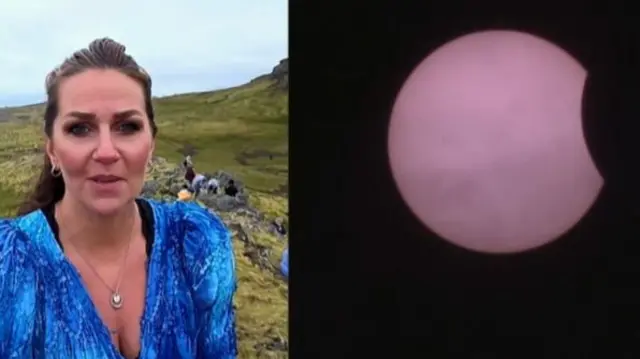
The eclipse is well under way in Iceland.
Icelandic musician Guðrún Árný is watching from Snæfellsnes in the west of the country. She tells the BBC News channel that she's been playing music for all the people gathered to watch it passing over.
"We will get two minutes of darkness, so we are very excited," she says.
"I think it will be the longest two minutes that we have experienced... it's going to be pitch black in the middle of the day."
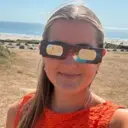 Eleri Griffiths
Reporting from Porthcawl
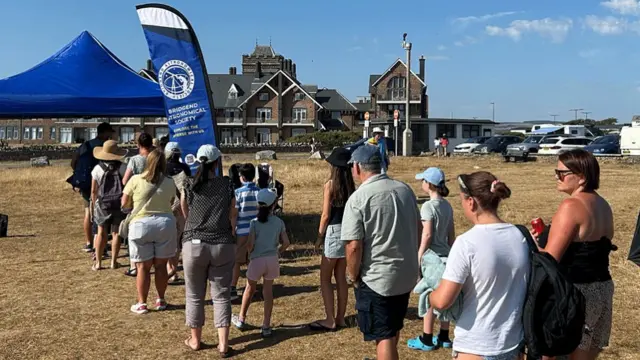
Members of Bridgend Astronomical Society have just arrived at Rest Bay in Porthcawl and started giving away special glasses ahead of tonight’s spectacle.
There are dozens queuing for their last-minute glasses.
Hundreds more are sunbathing and enjoying the conditions while others continue to arrive and find their spot on the beach for the evening.
There’s a real buzz here. From small children to grandparents, this really has a special family feel about it.
 Matt Graveling
Reporting from Primrose Hill
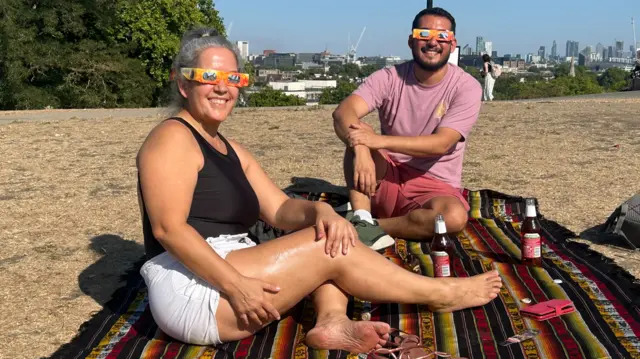
I'm currently on Primrose Hill, which is going to be one of the choice spots in London to see this eclipse.
There are hundreds of people here, most sheltering under trees - but not Alfredo Piter.
He’s visiting his Aunt Nancy, and gets to watch with her after his flight home to Mexico was cancelled.
He tells me he wanted to get here early to make sure he got a spot!
"I feel super lucky to be doing this with my aunt," he says.
"I’ve come out early with glasses I managed to buy at two this morning for ten pounds each.
"It’s a lot but this is a once in a lifetime opportunity."
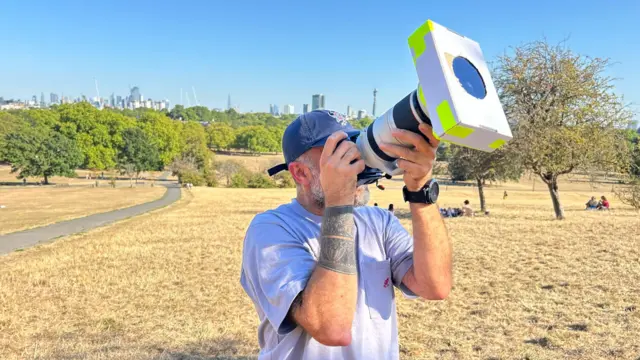
Elsewhere on Primrose Hill, professional photographer Nergal Youkhana has made a protective cover out of "rubbish" to snap the eclipse
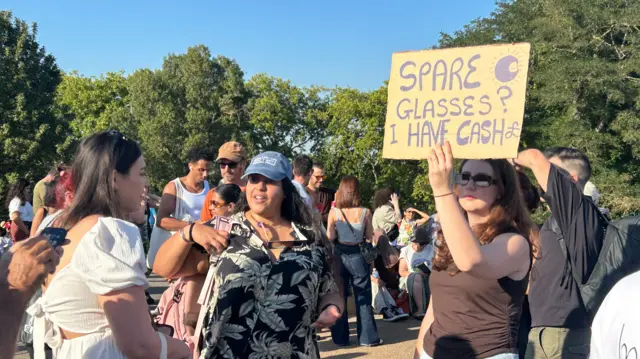
While others have turned to extreme measures to secure some solar specs
 Esme Stallard
Senior climate and science reporter
It's not long now until the the solar eclipse event will begin here in the UK - just around 18:00 BST - as the Moon begins to take small bites out of the Sun.
The time of maximum coverage will vary across the country with Scotland seeing the first signs of this astronomical spectacle.
The peak times are as follows:
19:06 - Edinburgh
19:07 - Newcastle-upon-Tyne
19:08 - Belfast
19:09 - Hull
19:10 - Manchester and Glasgow
19:11 - Norwich and Birmingham
19:13 - London
19:14 - Southampton, Bristol and Cardiff
19:15 - Cornwall
In Iceland, we're starting to see the Sun start to be obscured by the Moon as the solar eclipse starts.
We can see a tiny little bite that's already been taken out of it.
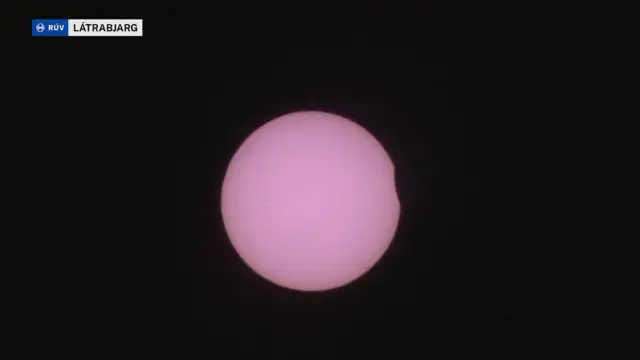 Image source, ISRUV - Rikisutvarpid (Icelandic National Broadcasting Service)
The eclipse is passing over Alaska, Canada and Greenland right now - but these places are only seeing partial coverage.
This is in contrast to Spain, which will have some of the biggest coverage during the solar eclipse - as much as 99%.
It will begin at 18:36 BST in Madrid, hitting the maximum coverage at 19:32 (20:32 local time). Let's take a look at how people are getting ready:
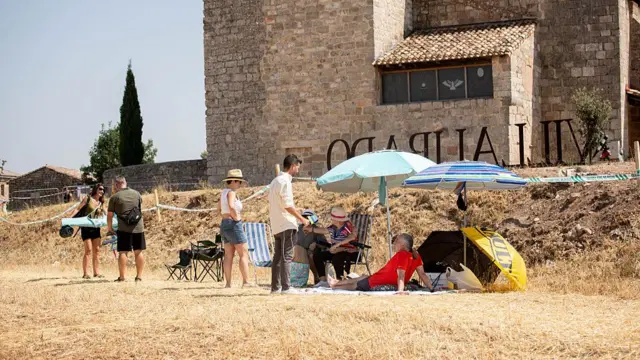 Image source, Getty Images
Nasa has chosen Villalibado, a village in Burgos (Spain), as its main base to broadcast the live feed
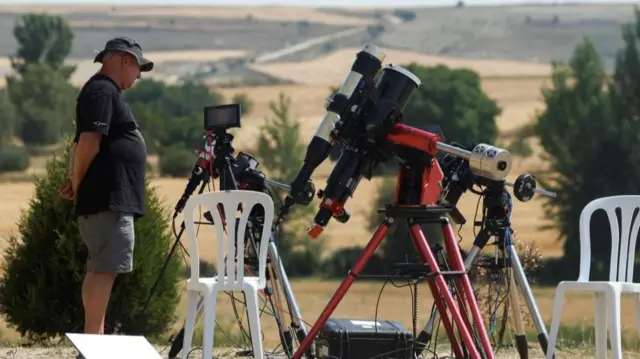 Image source, Reuters
Experts from San Francisco's Exploratorium, a science museum, are setting up their telescopes to catch tonight's historic solar eclipse
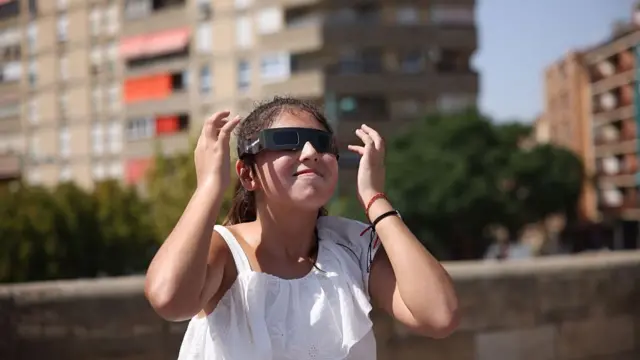 Image source, Getty Images
In Zaragoza, in northern Spain, a young girl tests out her new pairs of eclipse shades